Back
Production, process & quality
Pharma & chemical industry

Temperature monitoring with smart technology

Complete thermographic solutions for safety and process control

Thermographic methods, whose typical false colour images visualise temperatures, are suitable for many areas. Their possible uses in industry are particularly varied during the monitoring of temperature-dependent processes. In this context, not only are hot rolling, plastic welding or glass hardening typical examples, applications also exist in chemicals, petrochemicals, the energy sector and the automotive industry. Safety concepts can also be easier to implement when it is necessary to detect pockets of embers or other heat spots which could lead to explosions in critical environments, for example. Complete thermographic systems, consisting of smart, ATEX-approved thermal imaging cameras and the matching modular image processing software are now opening up interesting possibilities, as they can be adapted to completely different scenarios.

In the short-wave infra-red range (SWIR), many things can be seen that are not visible to the human eye. The examples range from the detection of pressure marks on fruit, to the inspection of grain, through to manufacturing defects on silicon wafers or solar cells. Polytec (see company info box) has been an experienced distributor of area and line scan cameras, line arrays, smart cams, video cameras and display devices for the short to long wavelength in infra-red for some time, including state-of-the-art InGaAs and micro-bolometer cameras. A practically-oriented thermography application needs much more than just a camera, however. The company, which is based in Waldbronn, Germany, therefore offers intelligent camera systems as a complete solution, including software and engineering, and supports the user with its know-how during the commissioning on site.

Intelligent camera plus adaptive software

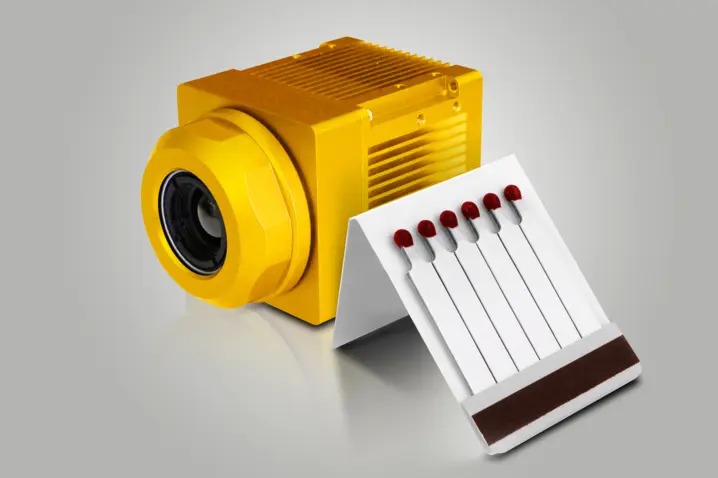
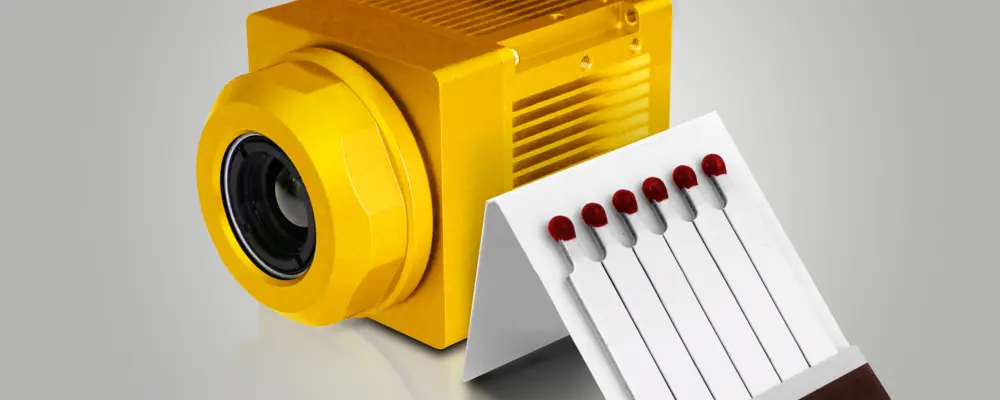
As the “heart” of its complete thermographic solution, the Waldbronn company has chosen a thermographic camera from the German manufacturer AT - Automation Technology GmbH which was developed as an intelligent system especially for industrial use (image 1). It combines a radiometric calibrated thermal image sensor, a powerful processor, as well as several industrial interfaces in a compact, rugged IP67 enclosure. In cooperation with Polytec, a system solution has been developed that complies with the ATEX guidelines and is able to communicate directly with the process control system. It is configured to issue alarms at certain thresholds, for example, or to automatically switch between multiple inspection tasks as required.

image 1: Intelligent thermal imaging camera for industrial use. Thanks to its compact dimensions, it can also be easily accommodated in confined spaces

For more extensive analyses of the camera signals, complex image processing options and a clear, detailed display, Polytec has also developed a powerful form of software in cooperation with the software experts at kernel concepts GmbH, which also impresses due to its modular structure. This means that the user only “sees” what they need for their application. This means simpler tasks can be realised as well as high-performance thermographic solutions for process monitoring and quality assurance through to Industry 4.0, as well as Deep Learning in temperature measurement technology. An example from the area of paper production shows how effectively the thermographic complete package can be integrated, including into existing systems structures.

Temperature monitoring to detect pockets of embers

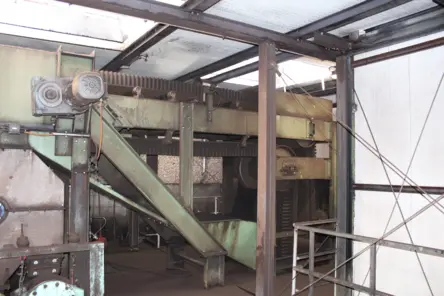
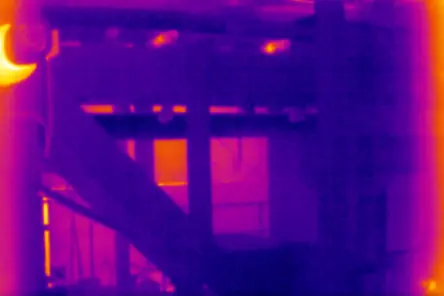
An international company from the paper and forestry industry, makes toilet paper, household towels and industrial rolls at a manufacturing plant in Germany. The energy supply is provided by the company’s own coal-fired power plant. When transporting the coal to the power plant, the requirements of ex-zone 22 apply, as the dust present in the air could explode as a result of possible pockets of embers in the coal. Today, such embers can be detected reliably around the clock using intelligent thermal imaging cameras (image 2a and b).

image 2a: Monitoring of conveyor belts
image 2b: The areas of heat are clearly visible on the camera image

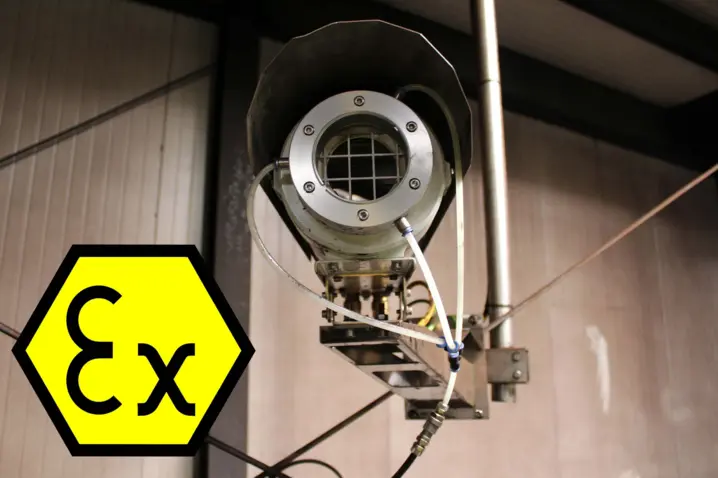
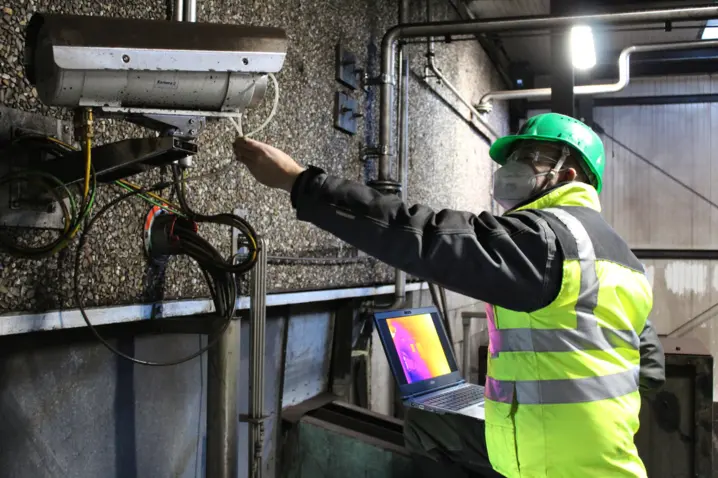
For this purpose, a total of four cameras are installed on the conveyor lines (image 3). These are housed in an explosion-proof enclosure due to the harsh environmental conditions and potentially explosive atmosphere; an integrated air purge also keeps the optics dust-free under adverse conditions. If the temperature in the flow increases, the cameras issue a warning message. Threshold values for the initial alarm and main alarm are stored in the systems and the cameras are connected to an embedded PC via a network, which makes the data available to the control room via MODBUS.

image 3: The cameras are housed in an explosion-proof enclosure due to the harsh environmental conditions and potentially explosive atmosphere; an integrated air purge also keeps the optics dust-free

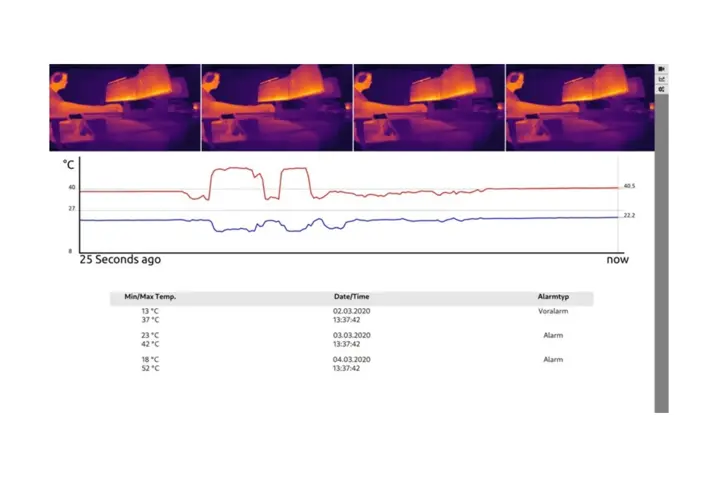
All live images from the cameras, including trend displays, can be viewed on a monitor (Figure 4). Pre-alarms, alarms, and operating data temporarily stored in the cameras' ring buffer are archived in a data manager. If necessary, this data can be retrieved and displayed together with the images. The cameras also provide the corresponding signals and evaluations for fail-safe operation in the safety-relevant monitoring system: an alternating signal as a heartbeat, operating status, and humidity and temperature monitoring of the housing.

image 4: Clear display of temperature curves and alarms

Technical support for the smooth commissioning

The commissioning of the system proceeded smoothly thanks to the good preparation (image 5). The mechanical installation and wiring to the control room were carried out by the plant operator together with a subcontractor. During this task and in the final set-up, the installation team were able to rely on the support of Polytec. In addition, the Waldbronn company took responsibility for all the adjustments during the start-up of the system, such as the definition of the monitoring range, the temperature thresholds and during the testing and simulation of the alarm management. The employees at the coal-fired power plant have been trained accordingly so that they can resolve any difficulties which can arise during the operations. However, Polytec is still available if required. Remote maintenance via remote software has also been planned in consultation with the user’s IT department.

image 5: Technical support for the smooth commissioning. Polytec took responsibility for all the adjustments during the start-up of the system, such as the definition of the monitoring range, the temperature thresholds and during the testing and simulation of the alarm management

There are many similar applications for the thermographic monitoring process with the intelligent thermal imaging cameras. All generally-flammable substances that are not stored inertly can form pockets of embers similar to coal, for instance. A typical example here is wood pellets or wood chips. However, the temperature of reactors in the process industry or other temperature-relevant processes can be monitored just as efficiently, in plastics processing, the steel industry or the automotive sector, for example. Monitoring temperatures using smart ATEX-approved complete solutions also makes sense in temperature-critical processes in battery production or the oil, gas and petrochemical industries.

Images courtesy: Images courtesy of Polytec GmbH unless otherwise specified.

Our Authors

M.A. Ellen-Christine Reiff
Redaktionsbüro Stutensee, Germany
Carsten Schermer
Sales Photonics Business Unit Photonics, Polytec GmbH, Germany
info@polytec.com

Related Articles

Pulsed UV light against germs

Hygiene is essential in all areas of the food industry. This is especially true for dairy products like yogurt, which are highly susceptible to contamination by microorganisms and mold spores. These can or…

4 min

A modern approach to germ-free food packaging

Since the 1960s, sterile packaging has played an important role in food safety. However, there has been little innovation since then. Chemicals and heat remain the most common methods for sterilizing food …

4 min

How fiber-optic temperature measurement helps develop Power-to-X technologies for the energy transition

Fiber-optic systems measure temperatures across fields, excelling where many sensors, compact size, and low thermal mass are needed—one 150 µm fiber can replace hundreds of sensors.

5 min

Inline measurement system for powder coatings

Powder coating quality depends on thickness and uniformity, especially at critical points. Photothermal measurement systems offer practical solutions for quality control.

4 min

Precise layer thickness measurement without referencing

For many products, coating quality is crucial—such as material thickness, color, gloss, or adhesion of one or more layers to a substrate. Regardless of their purpose, measuring the thickness or uniformity …

5 min

Distributed fiber-optic temperature and strain measurement with extremely high spatial resolution

Sampling of the Rayleigh scattering along a length of optical fiber allows the realization of a distributed sensor system where every point along the fiber acts as a sensor. This novel method allows ...

10 min

Fiber Bragg Grating Sensors in Practice

Fiber-optic sensors are used in wind turbines not only for monitoring but also for control, for example, to adjust the rotor blades based on load measurements of the blades.

4 min

Fiber-optic sensing in basic research

Friction clutches are used in millions of automobiles to transfer the engine’s torque to the drivetrain. However, the physical processes involved in frictional power transmission are still not completely u…

4 min

Fiber-Optic Temperature Measurement in Chemical Process Engineering

Conventional measurement methods quickly reach their limits when electromagnetic immunity, high measurement density, or chemically aggressive environments are required

10 min

Sterilization by Light Flash

The success of sterile environments in the pharmaceutical, medical, and food industries depends on transferring materials in and out without causing microbial contamination

3 min

Photothermal measurement method for opaque coatings and all common substrates

For many industrial products, the quality of coatings plays an important role. For example, the material thickness, color, gloss, or adhesion of one or more layers on a substrate

5 min

UV Technology for a Wide Range of Applications

Bei Portfolioerweiterungen setzt Polytec auf ausgereifte, qualitativ hochwertige und technologisch zukunftssichere Produktlinien.

5 min
Load More