Back
Production, process & quality

Modern UV curing

UV technology for a wide range of applications

When Polytec expands its portfolio, the new product line must not only be of high quality, mature, and state-of-the-art, but also convincing in terms of the future viability of the technology used.

A good example of this is the OmniCure® product line from Excelitas Technologies, which includes a wide range of light sources for industrial UV curing. The systems are designed for UV curing in point, line, and area applications – featuring both intelligent UV medium-pressure lamps and cutting-edge LED technology.

UV curing of a wide variety of materials has been established for decades. OmniCure® intelligent UV medium-pressure lamps deliver highly precise and repeatable light output. Modern LED light sources, on the other hand, offer longer lifetimes, lower maintenance requirements, and significant environmental benefits. These advantages stem from considerably lower energy consumption and the fact that the lamps contain no mercury and produce no ozone during operation. As a result, operating costs are also reduced. The applications vary widely due to the broad range of available products.

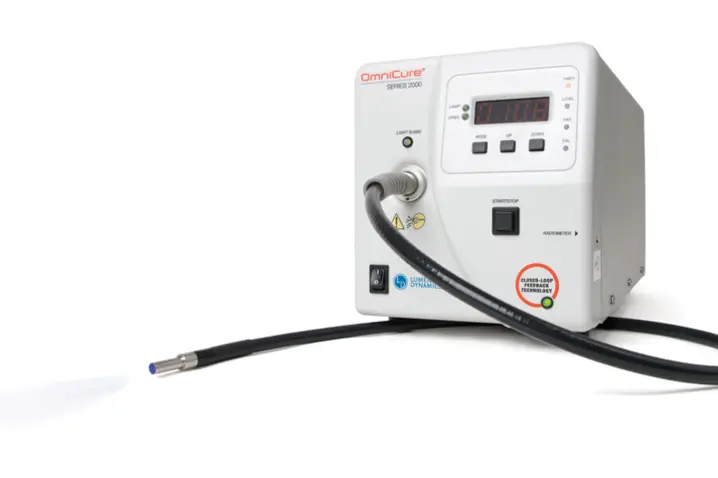
A classic system based on a UV medium-pressure lamp for spot curing of adhesives

Medical devices

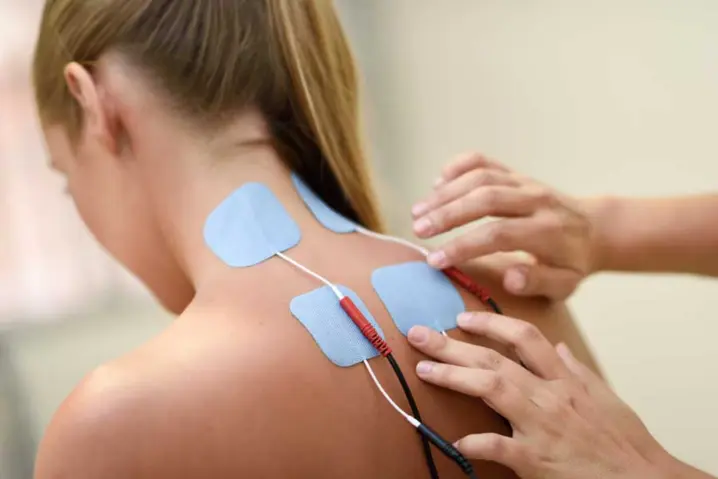
In the production and use of medical devices, features such as closed-loop feedback, precise irradiation control, and wavelength selection of the UV source play a crucial role. They enable manufacturers to achieve a controlled and highly repeatable production process, as well as strict process control of critical parameters such as delivered optical energy, product temperature, and spectral content. UV curing systems are used, for example, in the production of catheters, cannulas, and endoscopes, as well as hearing aids and anesthesia masks. LED solutions are becoming increasingly important in the manufacture of hydrogels for medical electrodes, such as those used in ECG examinations.

UV-cured hydrogels form the adhesive layer on medical electrodes, such as those used in ECG examinations

Fiber coatings

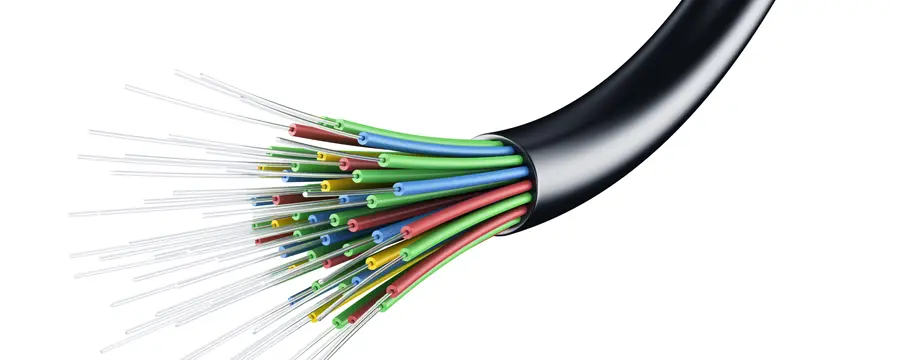
Fiber-based telecommunications is a rapidly growing market. Corresponding fibers are produced in so-called draw towers, which can reach heights of several stories and production speeds of 2,000 meters per minute. During manufacturing, the fibers are coated with multiple polymer layers, which are cured using UV light. The production speed gives an idea of how powerful and precise the irradiation must be to ensure uniformly coated fibers. It is no wonder that a dedicated OmniCure® system was developed for this application.

Electronics & optoelectronics

The production of electronic and optoelectronic components benefits from UV curing systems that ensure the highest precision and repeatability – a prerequisite for achieving the throughput and yields required for high-volume automated processes. The range of applications is very broad and extends far beyond examples such as coatings and adhesives in chip, display, and component production or fiber-optic component

Assembly, placement, and coating

The use of UV-curable adhesives is becoming an increasingly important assembly technique due to their fast processing, easy automation, low energy requirements, and solvent-free bonding. UV curing can be used to bond stainless steel, glass, ceramics, rubber, a wide variety of plastics, and other materials, or for diamond mounting. Spot curing systems are primarily used for these applications.

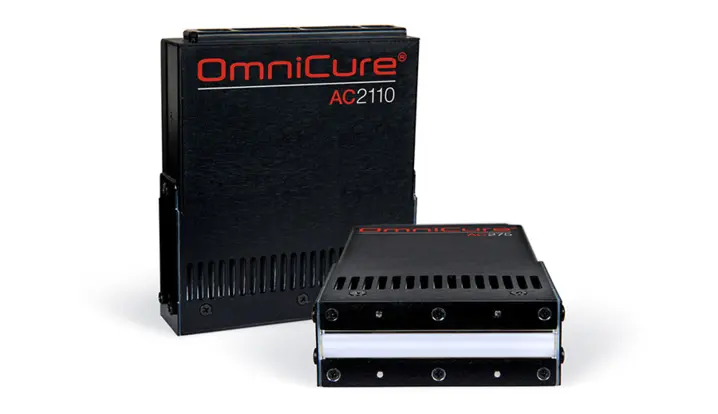
Compact, air-cooled LED curing systems for inks, coatings, and adhesives

Digital printing

UV curing or drying of digitally printed codes, labels, product markings, or serial numbers is an established practice. Modern LED curing systems improve print quality by reducing heat exposure to the substrate, as LED light is concentrated within a narrower spectral range than conventional light sources. This also enables printing on heat-sensitive substrates. Operating costs are reduced thanks to a tenfold longer service life and lower maintenance requirements compared to arc lamps.

Image Credits: Unless otherwise noted below, all images © Excelitas Technologies Corp. Cover image: © shutterstock.com/zentilia; Image 2: © fotolia.com/javiindy.

Our Authors

Dipl.-Ing. (FH) Jochen Grimm
Strategic Product Marketing Photonics Division
info@polytec.com

Related Articles

Pulsed UV light against germs

Hygiene is essential in all areas of the food industry. This is especially true for dairy products like yogurt, which are highly susceptible to contamination by microorganisms and mold spores. These can or…

4 min

A modern approach to germ-free food packaging

Since the 1960s, sterile packaging has played an important role in food safety. However, there has been little innovation since then. Chemicals and heat remain the most common methods for sterilizing food …

4 min

How fiber-optic temperature measurement helps develop Power-to-X technologies for the energy transition

Fiber-optic systems measure temperatures across fields, excelling where many sensors, compact size, and low thermal mass are needed—one 150 µm fiber can replace hundreds of sensors.

5 min

Inline measurement system for powder coatings

Powder coating quality depends on thickness and uniformity, especially at critical points. Photothermal measurement systems offer practical solutions for quality control.

4 min

Complete thermographic solutions for safety and process control

Thermographic methods, whose typical false colour images visualise temperatures, are suitable for many areas. Their possible uses in industry are particularly varied during the monitoring of temperature-de…

5 min

Precise layer thickness measurement without referencing

For many products, coating quality is crucial—such as material thickness, color, gloss, or adhesion of one or more layers to a substrate. Regardless of their purpose, measuring the thickness or uniformity …

5 min

Fiber-Optic Temperature Measurement in Chemical Process Engineering

Conventional measurement methods quickly reach their limits when electromagnetic immunity, high measurement density, or chemically aggressive environments are required

10 min

Photothermal measurement method for opaque coatings and all common substrates

For many industrial products, the quality of coatings plays an important role. For example, the material thickness, color, gloss, or adhesion of one or more layers on a substrate

5 min
Load More