Back
Acoustics & ultrasonics
Automotive & aerospace
Electronics, semicon, solar

Feeling the invisible

Laser vibrometry visualizing haptic feedback

Visualizing haptics by non-contact vibration analysis

The smartphone has shown that buttons can be replaced without sacrificing comfort. The freely configurable display with gesture control has made it even easier to switch between applications. Hap2U drives this revolution in human machine interfacing forward. Its novel technology adds high fidelity haptic feedback to touch interfaces that overcome current limitations enhancing the user experience in consumer electronics. Haptic feedback touchscreens improve in vehicle safety by providing touch controls keeping the driver’s eyes on the road. Polytec laser vibrometers are the key technology for developing high-end haptic technologies.


In the following interview, Matthieu Rupin, Acoustics Director at the French innovation driver for haptic feedback Hap2U, presents his view of the future of driver and vehicle interaction. He makes it clear that, with the right technology, vibrations can be used to create virtual textures that even adapt to the speed of a finger that glides over them. And that works completely silently and not only on displays.

The core of this technology are ultrasonic wave fields that specifically and locally influence the coefficient of friction between the finger and the surface. People feel familiar surfaces and find their way around immediately. The mapping of the propagation parameters in the ma­terial is indispensable for dimensioning the ultrasonic transducers and calibrating the models.

For this purpose, Hap2U successfully uses the 3D scanning vibrometer from Polytec. Applications range from basic development, industrialization of the product to fatigue and service life tests.

In what areas can your haptic technology be used?

Haptic feedback means creating a mechanical stimulus under the user’s fingertip when interacting with a touch-sensitive interface, which is useful anywhere there is an interaction with a machine. Since the arrival of smartphones, screens have gradually replaced most interfaces that used mechanical buttons. This phenomenon can be explained by various factors ranging from the simplified differentiation of interfaces through basic programming, to the development of more robust designs by eliminating mechanical and mobile parts like knobs, sliding buttons, etc.

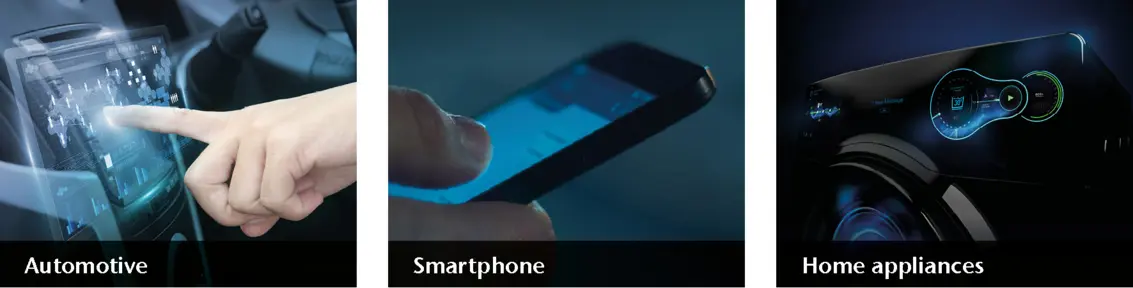
However, this widespread trend resulted in the disappearance of tactile feedback from all these interfaces where previously mechanical buttons usually provided sensory feedback due to their tangible nature. The creation of programmable tactile feedback is therefore very practical for different uses. In the automotive industry, driver screen interfaces are becoming increasingly bigger both for design and innovation purposes. This trend however, raises the issue of safety; drivers must remain fully concentrated on the road without being distracted by a visual interface. Haptic screens solve this problem by creating tactile communication between the vehicle and the user.

Thus, interaction means drivers do not have to take their eyes off the road. For home products, such as home appliances, haptic feedback technology offers ergonomics on a par with mechanical buttons. Concerning smartphones, this implies a new level of immersion in terms of all the functions that will emerge. Imagine being able to add textures to our different interactions on a website, in a game, on social media. It will even be possible to set up button controls with the screen off.

How is this different from existing technologies or from your competitors?

Hap2U technology represents the future of haptic feedback. We are all very familiar with the vibrations of a cell phone. This type of tactile feedback, which sends the user information without them having to interact with the interface, called passive touch, has two fundamental limitations; it comes with a noise and is a comprehensive event, in the sense that the whole interface vibrates.

Hap2U technology allows this proposition to go further so that it is placed directly under the user’s fingertips, thereby producing a greater degree of sophistication in the haptic feedback. In particular, it is also possible to create artificial textures which will depend on the position and speed of a finger.

All types of buttons or sliders can thus become touch sensitive again in a completely digital environment. This technology allows us to combine the flexibility of digital interfaces with a new level of tactile sensitivity, making the man machine interaction both more intuitive and more accurate.

The silent nature of the technology is also a major advantage, because as well as focusing on the tactile perception, it greatly enriches the user experience; ensuring the confidentiality of information transmitted in touch form.

Finally, this is about much more than screens. Hap2U technology also works on tactile surfaces made from plastic, wood, glass and even metal. And we have recently developed three-dimensional objects that you can locate and hold in your hand with a programmable haptic feedback feature.

These are intended to replace the moving mechanical parts of tangible buttons exposed to premature wear and tear.

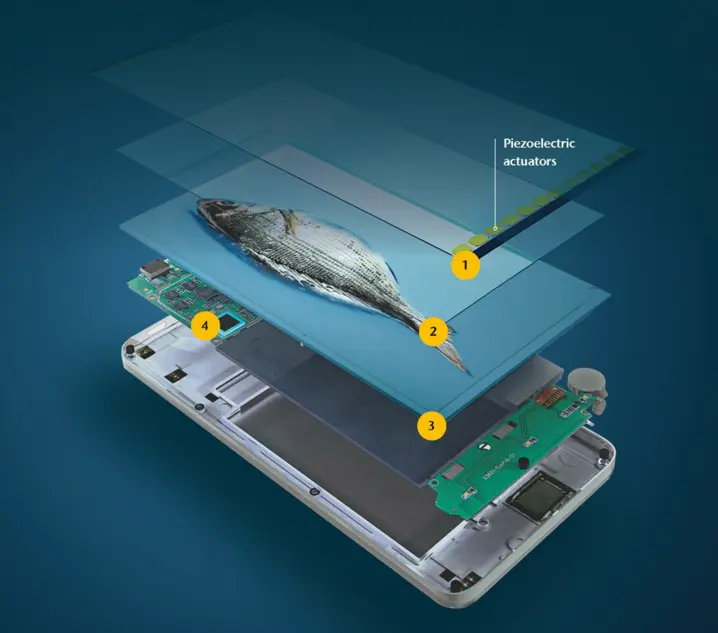
1: Cover glass with piezoelectric actuators. This 1 mm thick slab begins to vibrate under excitation of piezoelectric transducers. The amplitude of these vibrations does not exceed 2 μm.
 

2: Touch glass. It locates the position of the finger on the screen. Speed and direction of the finger are calculated from the measurement of its successive positions.
 

3: Display (LCD or OLED). As on a traditional phone or tablet, the display of the screen is modified in real-time according to the behavior of the finger on the touch interface.
 

4: hDriverTM. This electronic board controls piezoelectric actuators and therefore the vibrations they generate as a function of the movement of the finger on the glass slab.

What is the general working principle of your haptic displays? How is the sensation of touch actually generated?

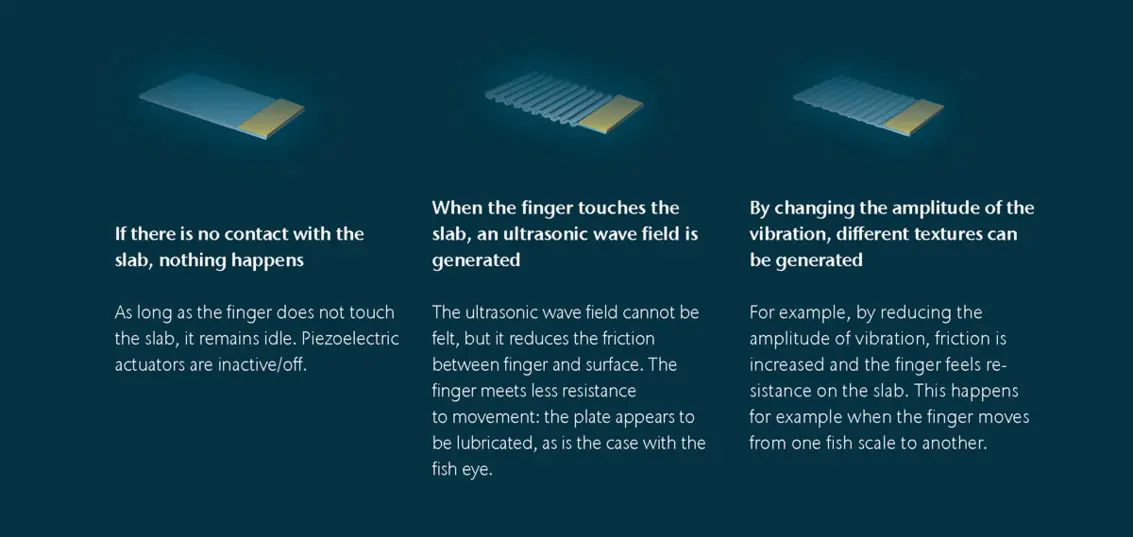
Hap2U technology generates an ultrasonic wave field on the surface that comes into contact with the skin. Using piezoelectric transducers, ultrasonic waves are emitted, vibrating several thousand times per second and they pressurize the small volume of air trapped between the fingertips and the screen. This creates an acoustic levitation force that reacts against the pressure applied by the fingertips. The contact surface area is reduced, thereby reducing the friction coefficient.

The ultrasonic vibration is thus a means to influence the friction coefficient. By controlling this vibration in real time, it is possible to emulate the friction variations similar to those encountered when exploring the real surface. In this device, piezoelectric transducers play a key role in that they have the advantage of being very reactive, they function both as an actuator and a sensor as well as being inexpensive.The challenge for our engineers is to correctly design these elements so that they provide perfect control of the vibration, regardless of the conditions of use.

What designs are demanded by the market and where does non-contact vibration testing come into play?

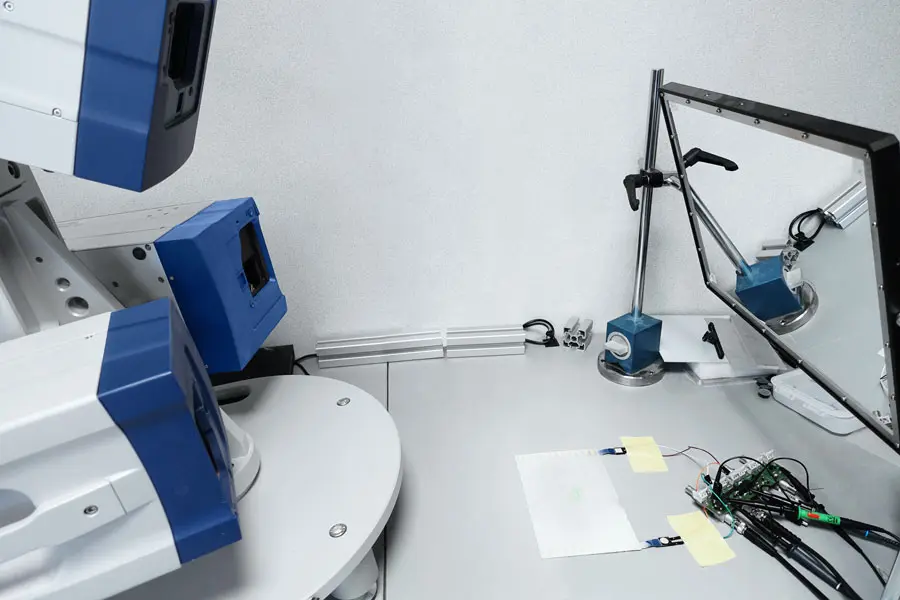
A crucial step prior to the technology going into production is to ensure that the client’s product is compatible with our limitations. We prepare a prototype for the client based on an existing product or upcoming product into which we integrate our “haptic layer”. The focus of this stage is the characterization of the client’s sample from which we extract the propagation parameters over a wide frequency range. The 3D vibration mapping with the PSV Polytec Scanning Vibrometer is done in a very short time and is the basis of our design process for the final haptic interface. Following the digital design steps, the 3D vibration characterization thus obtained allow us to control and refine our simulations if necessary.

Test setup in the laboratory, automatically scanning the sample surface for 3D vibration data

After proof of concept, the industrialization stage follows. The focus of this phase is making our technology compliant with specific market constraints. Here again, 3D scanning vibration measurements are used to support the development of the device before and after fatigue or endurance tests. The speed of the measurements make it possible to characterize a significant number of samples in a row.

Finally, we are doing a lot of R&D in order to secure our technological lead.

In this context, the 3D scanning vibrometer is an indispensable tool to create the connection between haptic perception and surface vibrations.

Dr. Matthieu Rupin
Acoustic team leader and Deputy Technical Director, Hap2U

In this regard, access to the in plane vibration components is invaluable. Indeed, the skin tissues that we are trying to vibrate do react in very different ways to different types of waves. The 3D scanning vibrometer is therefore the ideal tool to maximize the haptic effect from the weakest possible vibration. Complex measurements can also be finetuned to characterize the vibrating response of a user’s finger to a specific ultrasonic stimulus.


What do high-resolution, non-contact vibration measurement results tell you?

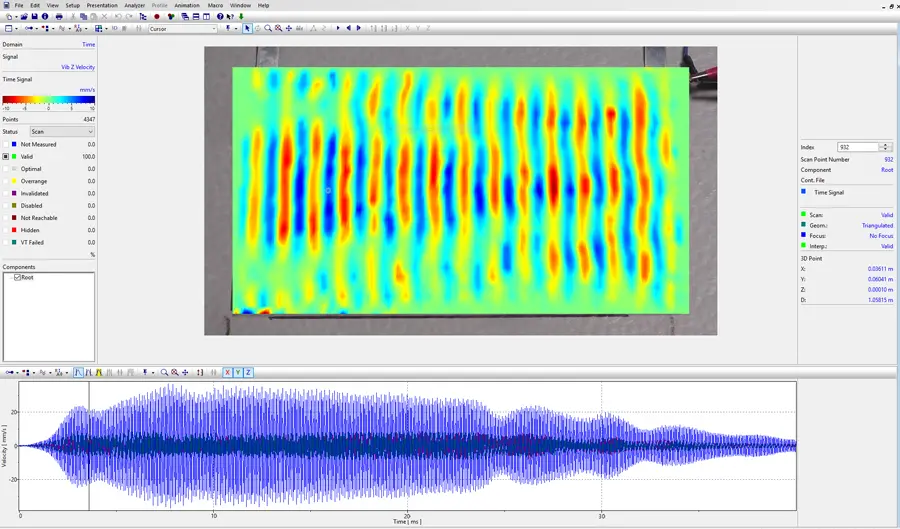
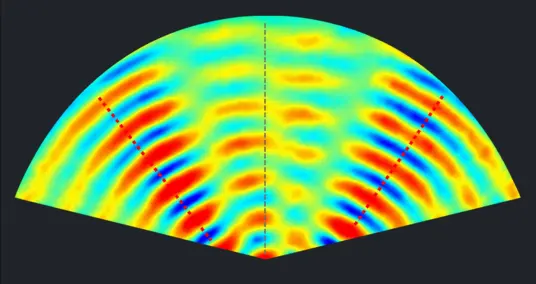
When a haptic display is being characterized, we measure the response of a large number of points crisscrossing the potentially curved surface to a pulse excitation by a source specially designed for this measurement. This way we get a wealth of spacetime information which, using advanced post processing algorithms, allow us to extract key propagation parameters. This information primarily allows us to precisely design our actuators to optimize the effectiveness of our device. But the measurements also open up new perspectives.

With the 3D vibration data we can study the x, y and z components of the ultrasonic wave field separately, allowing us to develop new haptic functions. Also, the 3D scanning vibrometer has proven to be crucial for a range of inventions we have new patents registered for, which are currently being validated.

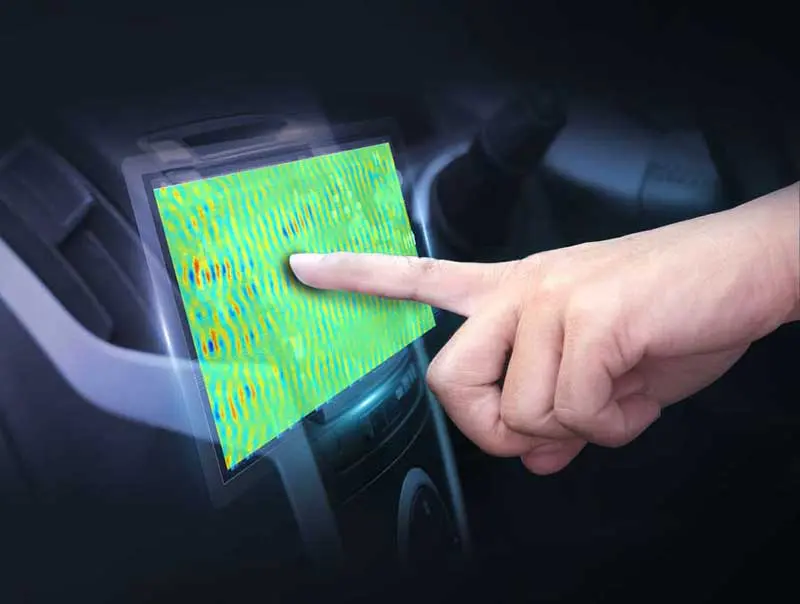
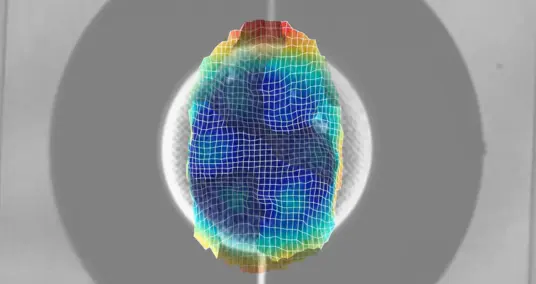
Visualized ultrasonic wave field of the haptic display (measurement data)

Where do you see 3D scanning vibration measurement compared to what you were doing before?

When we started out we were well aware of the importance of the non-contact nature of the laser Doppler vibrometry measurements, so we bought a 1D fiber optic laser vibrometer. This allowed us to link the out of plane vibration amplitude to the driving parameters of the actuators. Then, we paired the laser vibrometer with stepper motors controlling the position on the XY plane which allowed us to map the out of plane vibration field and therefore finely characterize the propagation of waves on the various surfaces.

Importantly for us the 3D scanning vibrometer has considerably reduced the amount of time needed to characterize a sample. It also enables us to measure curved surfaces which are increasingly important in our applications. Also, we have since been able to increase our use of the information rich laser measurements which will allow us to significantly accelerate our growth.


Thank you very much for this interview, Matthieu.

Images courtnesy: Images courtnesy of the authors unless otherwise specified. Cover image:igorstevanovic/shutterstock.com and Maksim Kabakou/shutterstock.com; Picture 1: My Life Graphic/shutterstock.com; Series of picutes (f.l.t.t.r): My Life Graphic/shutterstock.com, Dmitry Bun in/shutterstock.com, Open Studio/shutterstock.com.

Our Authors

Dr. Matthieu Rupin
Acoustic team leader and Deputy Technical Director, Hap2U
www.hap2u.net

Related Articles

Laser-Doppler-Vibrometer set standards in the development of electric drives

Electric machines are increasingly being used as the primary drive technology in vehicles. The acoustic behavior of the drive is a key factor in the perceived quality of electric vehicles. Numerical method…

5 min

优化光学自由曲面的制造工艺

使用光学自由曲面可以简化复杂的透镜系统,从而使其结构更加紧凑和重量优化。此外,光学自由曲面的使用还可以实现全新的功能。与此同时,它们的制造工艺更为复杂,耗时更久且成本昂贵。使用数控机床可以小批量地高效生产单个自由曲面。

4 min

激励力

人工激振是各種噪音與振動技術的基礎,涵蓋實驗模態分析、傳遞路徑分析、載荷識別、模擬模型相關性分析、混合建模等領域。結構激振可透過多種方式實現,從手動衝擊錘、自動化錘具,到外部支撐式振動台乃至自支撐式振動台皆可達成。

10 min

专注于微陨石的撞击检测

太空探索商业化进程的推进,大幅提升了对应用于太空及行星探测、卫星任务的创新技术的需求。确保太空结构的安全性与可靠性,关键在于对其结构完整性进行精准评估。太空环境极为严苛,存在辐射以及剧烈的温度波动等状况,这些因素会加速材料的劣化与损耗 。

6 min

使用激光测振仪评估触摸屏在-40° ~ 85°C温度范围内的声学性能

汽车中控面板触摸屏界面的增加会导致视觉信息过载,从而带来严重的安全隐患。触觉反馈技术可改善用户体验,并减少与触摸屏交互的认知负荷。最近由Vibra Nova收购的hap2U的触觉技术是基于压电致动器产生的超声波传播。致动器产生的振动减小了用户手指与触摸屏玻璃表面之间的摩擦系数,这种现象被称为主动润滑。

5 min

惯性激振器用于模态测试

当被测物体无法自振时需外部激励。模态试验常用电磁激振器和力锤。Polytec扫描测振仪配SAM自动力锤提升效率。

6 min

如何测量非洲象群间的低频通讯。

最近发表在《欧洲物理杂志专题》(European Physical Journal Special Topics)上的一项研究介绍了激光多普勒测振仪(LDV)的一项开创性应用,以更好地理解非洲象的发声及其行为含义。这项研究的主要目的是确定大象群体中声音交流的动态,特别关注一种被称为“我们出发吧”的的特定隆隆声。这些隆隆声序列在协调大象群体的运动、空间关系和加强社会联系方面起着至关重要的作用。

4 min

全场激光测振扫描中振动热点的直观可视化

Everybody enjoys good sound quality on a mobile device when watching a show or when communicating with friends and family or in a business environment. On the other hand, we cringe when something is off wi…

3 min

何时选择激光多普勒测振仪进行振动测量

在振动测试领域,附加质量是一个不容忽视的重大难题。动态振动样本或被测器件(DUT)的性能,极易受到额外附加质量的干扰。这种现象在振动的悬臂梁结构中表现得尤为突出,而在处理涡轮叶片这类特殊的弯曲悬臂梁时,情况更是复杂棘手。利用加速度计精准测量涡轮叶片的共振频率,向来是一项颇具挑战性的任务,其中附加质量的影响是主要阻碍因素。即便极为小巧的加速度计,其增加的质量也会改变涡轮叶片的固有频率,使得精准测量困难重重。

5 min

压电片谐振器轮廓模态的单电极传导

压电片谐振器用于传递特定的轮廓模态体声波(BAW)谐振振型。基于铌镁酸铅-钛酸铅 (PMN-PT)薄膜的独特性,必须使用激光多普勒测振仪来测量微型盘式谐振器。PMN-PT是一种铁电材料,以其良好的压电和电致伸缩性能而闻名。面内位移曲线,可显示出轮廓模态、共振模态、切向模态和酒杯模态族。这些轮廓模态对生物传感、射频和旋转传感应用具有重要意义。

4 min

剪切激波如何影响感知

触觉全息术或空中触觉技术有望让虚拟现实成为现实,但一项新研究揭示了一个令人意外的物理障碍,有待克服。加州大学圣巴巴拉分校的一个研究团队发现了一种新现象,它是新兴全息触觉显示器的基础,这一发现可能会带来更引人入胜的虚拟现实体验。

6 min

使用QTec®多通道干涉技术测量频响函数

频响函数(FRF)的测量对于获取结构的动力学特性具有重要意义。在大多数情况下,我们的测试目的是对系统进行测量分析,或者确定动态特性用于验证仿真模型。 在结构动力学中广泛使用的获取频响的方法是用脉冲锤进行系统激励,用加速度计测量响应。这种方法的缺点是,粘贴式传感器存在附加质量和和刚度(电缆)影响,尤其是在测量轻质结构时,会造成被测结构的动力学特性的显著变化。

7 min

Analyzing operational deflection shapes on loudspeakers

Noise protection and control play a major role in both professional and private environments. Airborne sound measurements help identify acoustic paths as a means of noise reduction as standard testing meth…

4 min

Manipulation of complex fluids with SAW-based acoustofluidics

Surface acoustic wave (SAW)-based acoustofluidics combines microfluidics with active microacoustic fields. This allows to realize numerous Lab-on-a-Chip operations, reaching from fluid manipulation includi…

3 min

A new driving mechanism for acoustofluidics*

Acoustofluidics is the active manipulation of fluids as well as of immersed particles or cells at the micro- and nanoscale and is a key technology for life sciences. Acoustic waves, more precisely, ultraso…

5 min

实现静音与可靠运行的噪声和模态分析

无人机市场正经历多维度的蓬勃发展

6 min

基于宽带压电激励的测量

本文以齿轮为例,对多种形式的力激励进行比较,旨在确定机械系统的传递导纳。其目标是分析和评估技术结构(如电动汽车传动系统)在高频范围内的声学特性。实验表明,采用宽带压电激励时,收集到的测量结果一致性更高,尤其是在高频段。

4 min

确定大型、自适应柔性机翼的动力学特性

第七届欧洲框架计划的SADE项目(新一代机翼的增升装置),旨在提升飞机在飞行过程中尤其是着陆时的空气动力性能、燃油经济性及降低噪音和排放。

3 min

电动机振动表面的声辐射特性测量

随着电动汽车和混合动力汽车市场需求的不断增长,人们对车内噪声水平提出了新的要求。电动汽车传动系统与传统的内燃机传动系统的声辐射特性明显不同。德国卡尔斯鲁厄理工大学(KIT)的产品工程学院(IPEK)对此做了深入研究。

4 min

制动盘的试验模态分析

仿真模型的验证是激光测振仪的重要应用领域之一。为此,先将有限元模型的几何数据导入至测量系统的软件中,由系统内置的校准系统完成模型与实物之间的校准,导入的样品几何数据与其实际的几何数据之间的偏差,都将由软件内置的形貌测试程序来进行修正并更新至模型中,这种方法精确度高,还能节省大量时间。

4 min

三维扫描式激光测振仪测量节能涡轮

飞机油耗是当前关于全球气候变化讨论的热点话题之一,这其中一个重要的影响因素是飞机发动机本身的设计。与传统发动机叶片不同,整体叶盘由一块材料加工而成。

6 min

使用PSV-500-3D Xtra系统测试滚动轮胎

使用3D Xtra系统获取滚动轮胎的3D工作变形,揭示噪音来源 在不同的驾驶条件下,滚动轮胎会在车厢内外产生大量的噪音(NVH),这种噪音必须解决掉的三大理由: ` 滚动轮胎产生的路面噪音会降低车乘体验,并会干扰道路沿线的居民。 ` 许多关注市区噪声的国家预计会出台有关限制轮胎噪音的新规定。 ` 电动汽车因没有内燃机噪音的优势,有可能因为轮胎噪音而大打折扣。

5 min
Load more