Back
General R&D
Electronics, semicon, solar

No more half-baked results

Xenon double-pulse achieves breakthrough in photonic sintering

Printed electronics are conquering the industrial application market. The technology used is well established, but not all applications can be realized with these conventional methods. The key role of the sintering process is explained here.

Photonic sintering is a process in which tiny particles are fused together using a high-energy xenon light pulse. This allows electronic circuits to be produced via conventional printing techniques such as inkjet or screen printing. Special inks containing silver or copper materials enable the creation of solid, conductive tracks through photonic sintering. With pulses lasting only a few milliseconds, even heat-sensitive substrates can be used. Photonic sintering therefore promises to become a key technology for utilizing heat-sensitive substrates while achieving high throughput in printed electronics.


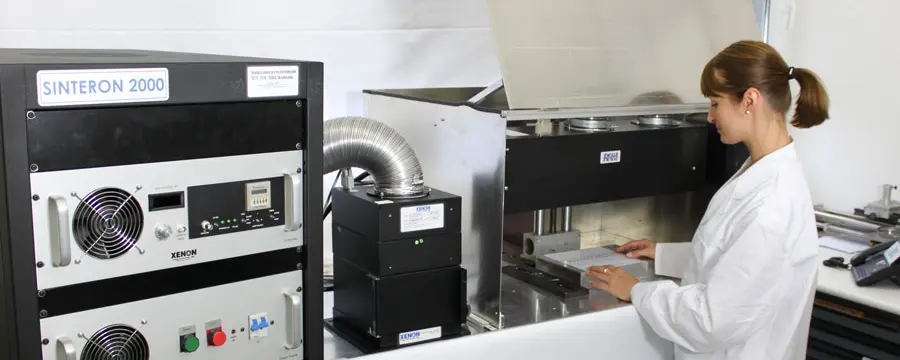
The wide variety of inks, substrates, and printing processes, as well as the differing requirements for the final product—such as adhesion, flexibility, and transparency—demand precise pulse control. Xenon Sinteron systems, for example, allow exact adjustment of pulse energy, pulse duration, and frequency to achieve an optimal sintering temperature.

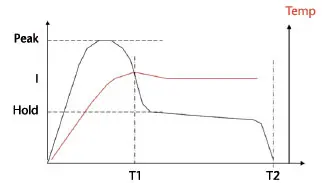
The black curve shows the peak and hold pulses of the xenon flash system, while the red curve represents the temperature profile of the sample.

However, for thick conductive structures, it is not enough to reach the temperature at the conductor track structure using a single pulse; it must be maintained so that the heat can penetrate and the deeper layers can also be sintered. If the temperature is not maintained over a longer period of time, unsintered ink remains beneath the surface. The result is poor conductivity and insufficient adhesion to the substrate. Xenon Corporation, Polytec's partner for xenon flash systems, has developed the double pulse process for the photonic sintering of thick layers.

The new S-2300 system with dual pulse technology allows the user to determine both the peak energy that enables sintering and the definition of a hold pulse that maintains the sintering temperature over a certain period of time in order to sinter thick layers consistently. This provides the flexibility for optimally adjusted processes and is still easy to use, as only two parameters need to be set.

Image Credits: Unless otherwise noted below, images © Xenon Corp., USA. Cover image: Polytec GmbH

Our Authors

Dipl.-Ing. (FH) Jochen Grimm
Strategic Product Marketing Photonics Division
info@polytec.com

Related Articles

Expanded options for deformation tests in materials analysis

In materials research, digital image correlation (DIC) is an established method for accurately and non-contactly detecting deformations. This applies to tensile, compressive, and bending tests as well as i…

5 min

How fiber-optic temperature measurement helps develop Power-to-X technologies for the energy transition

Fiber-optic systems measure temperatures across fields, excelling where many sensors, compact size, and low thermal mass are needed—one 150 µm fiber can replace hundreds of sensors.

5 min

Continuous fiber optic strain measurement

Some bridges in Germany are aging and not designed for today’s increasing traffic loads. Authorities must now find cost-effective solutions to manage these existing structures.

6 min

Precise layer thickness measurement without referencing

For many products, coating quality is crucial—such as material thickness, color, gloss, or adhesion of one or more layers to a substrate. Regardless of their purpose, measuring the thickness or uniformity …

5 min

Distributed fiber-optic temperature and strain measurement with extremely high spatial resolution

Sampling of the Rayleigh scattering along a length of optical fiber allows the realization of a distributed sensor system where every point along the fiber acts as a sensor. This novel method allows ...

10 min

Fiber Bragg Grating Sensors in Practice

Fiber-optic sensors are used in wind turbines not only for monitoring but also for control, for example, to adjust the rotor blades based on load measurements of the blades.

4 min

Distributed Fiber-Optic Sensing for Geotechnical Monitoring

Stones, blocks, steel, cement, concrete, and mortar—combined with large, heavy, clumsy, and noisy construction machinery—hardly make an ideal environment for a fragile glass fiber.

5 min

Fiber-optic sensing in basic research

Friction clutches are used in millions of automobiles to transfer the engine’s torque to the drivetrain. However, the physical processes involved in frictional power transmission are still not completely u…

4 min

Photonic sintering enables high-volume production of printed electronics.

The printed electronics technology has moved beyond its pioneering stage, with initial industrial applications already running. While potential uses are diverse, turnkey system solutions that simplify adop…

5 min
Load More