Back
Biology & medical
General R&D

Laser vibration measurement enhances osteoarthritis therapy

Non-contact alternative to dynamic and viscoelastic mechanical testing in cartilage

Osteoarthritis, a degenerative disease in the joint, is a condition that is afflicting approximately 14% of adults. Understanding the dynamics of the joint cartilage is crucial for research and for finding effective treatment methods. Laser Doppler vibrometry has been finding adoption in many biological sciences over the years, for example in hearing research or in the study of the skin response for haptics research. Upon hearing about vibrometry during her time at UC Irvine's UCI Samueli School of Engineering Dr. Gabriela Espinosa, now at Concordia University Irvine, was inspired to evaluate this measurement technology for the dynamic characterization of cartilage in the human knee.

With the support of distinguished professor Dr. Kyriacos Athanasiou and in collaboration with Polytec, Dr. Espinosa was successful in developing a technique to characterize the mechanical properties of cartilage. In her recent publication, she shows the agreement with conventional methods and highlights the benefits of using vibrometry instead. Due to its non-contact approach, vibrometry is, unlike conventional techniques, non-destructive and thus helps reduce waste and keep costs down.

Also, the vibrometry based method Dr. Espinosa developed, resulted in significantly reduced test times enhancing the speed in research efforts going forward. Dr. Espinosa plans to utilize this method to evaluate tissue-engineered cartilage’s similarity to native knee cartilage.

In her article, Dr. Espinosa shows how the dynamic modulus G* can be extracted from the measured resonance frequencies of a disk-shaped test sample when looking at only the 1st and 2nd order modes.Using phase/time delay measurements, the viscoelastic properties (loss modulus G” and storage modulus G’) can be extracted.Thus, with a single tool, vibrometry greatly facilitates meeting multiple regulatory recommendations for mechanical characterization of cartilage replacements.

Cartilage is a dynamically loaded tissue. Typical activities, such as walking, can generate large stresses between 1 and 6 MPa but may even peak up to 12 MPa. These stresses are applied cyclically at frequencies ranging from 0.01 to 2 Hz, typically resulting in up to 4 million loading cycles per year. Several factors, such as cyclical mechanical fatigue, excessive strains and rapid strain rates, are often implicated with the onset of osteoarthritis, a condition afflicting approximately 14% of adults.

Given its relevance to daily activities and role in maintaining tissue homeostasis, cartilage dynamic mechanical properties are a crucial component to the field’s ongoing research endeavours and to those seeking to replace or regenerate cartilage’s function in a dynamic environment.

Quasi-static mechanical measurements using viscoelastic testing conditions, such as stress relaxation and creep indentation, are routinely employed to evaluate cartilage and its replacements. Dynamic mechanical testing is often performed to obtain a dynamic modulus and, occasionally, viscoelastic properties. However, most of these mechanical testing modalities are destructive, which either limits the pursuit of certain investigations or requires a large amount of testable tissue.

It is certain that a non-contact form of dynamic mechanical testing would garner much attention among cartilage researchers. A major advantage of laser Doppler vibrometry showcased in these works is the ability to perform non-contact and non-invasive measurements. Given this key characteristic, vibrometry is well poised to become a valuable measurement modality in the biological sciences.

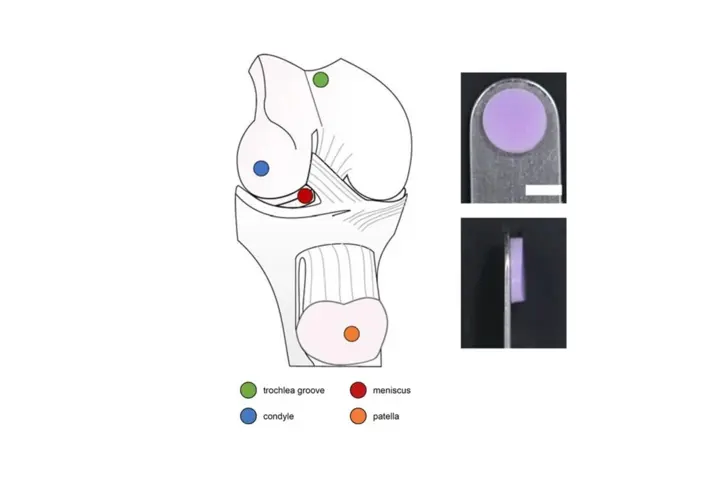
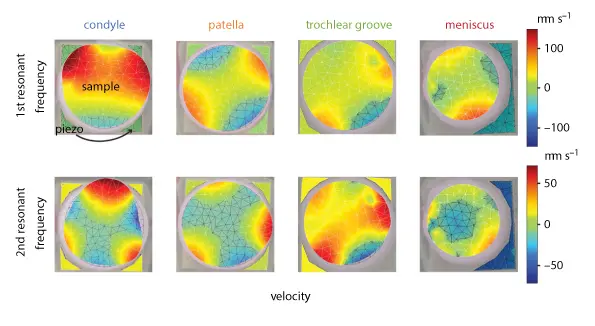
The objective of this work was to investigate the use of vibrometry as a non-contact dynamic mechanical testing modality in comparison to quasi-static mechanical and biochemical assays for articular cartilage characterization. For that purpose cartilage explants from the condyle, patella, trochlear groove and meniscus were characterized using traditional methods and vibrometry and the results were comparted.

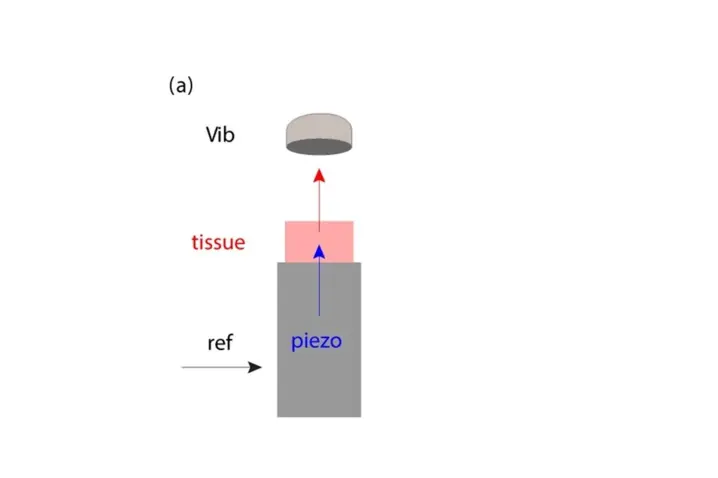
For the vibrometry measurements a PSV-500-B Xtra Scanning Vibrometer was used. The cartilage tissue explants were placed on a piezo actuator for dynamic excitation. The function generator of the PSV-500-B Xtra Scanning Vibrometer was used to drive the piezo with the relevant signals (ref) for the respective experiments. The dynamic excitation of the tissue results in tissue sample deformation. The axial displacement of the tissue’s top surface is measured by the vibrometer (vib).

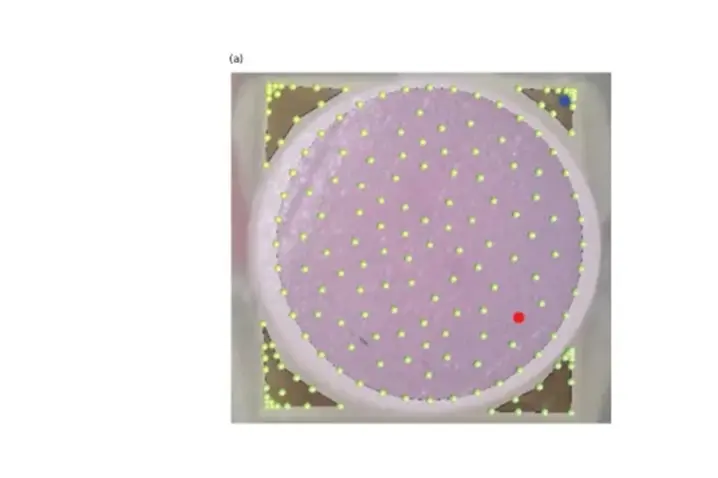
A grid (100 – 150 points) covering the tissue sample and the piezo was defined to establish the measurement points. It is important to note that measurements were taken of both the sample and the piezo.

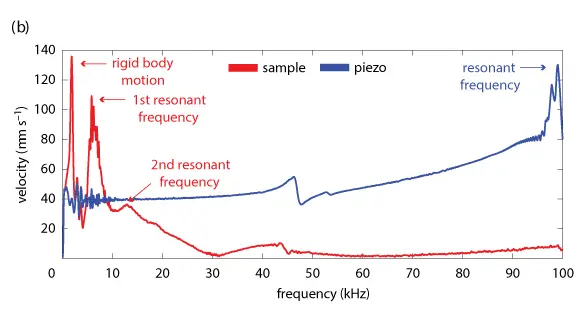
In a first measurement, the first and second resonant frequencies were found by identifying peaks in the sample velocity data across a frequency sweep ranging from 10 to 100,000 Hz. For this analysis, data from the piezo were only used to confirm that the piezo’s resonant frequencies do not interfere with those of the sample.

To differentiate from peaks due to rigid body motion, dynamic deflection shapes at resonance frequencies were observed to verify the presence of a bending mode.

The video clip showcases animations of the first and second modes of a tissue sample as derived from the PSV Software.

The dynamic modulus, G*, of each sample was determined based on the American Society for Testing and Materials International (ASTM International) guidelines for calculating dynamic mechanical properties for disc-shaped specimens via vibration. Briefly, for each resonant frequency, a dynamic modulus was calculated. The dynamic moduli for both frequencies were averaged to give a single G* value per sample.

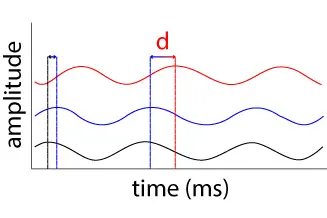
This was followed by a 500 Hz sinusoidal excitation to determine the viscoelastic properties of the tissue. A sinusoidal reference signal (black) drives the slightly shifted piezo’s response (blue). The shift is shown as the difference between the black and blue dotted lines. The tissue’s periodic deformation is shown in red, with the phase shift with respect to the piezo signal given by δ.

Using the PSV software, an inverse Fourier transform was used to convert data from the frequency domain to the time domain. In this analysis, data from both the piezo and sample were necessary

to measure the phase shift, δ, between the piezo’s and tissue’s response to the reference signal. The tangent of the phase shift is known to be the ratio of viscous to elastic contributions, also known as the loss and storage moduli, respectively. Using G* and δ, the storage modulus G’ and the loss modulus G’’ were calculated as follows:

G' = G* cos δ
G'' = G* cos δ,

As the tissue samples were not damaged by the vibrometry measurements, they could then be used to perform the conventional destructive mechanical testing to correlate the results with those obtained from vibrometry measurements. Namely stress relaxation, creep indentation and a biochemical assay were performed.

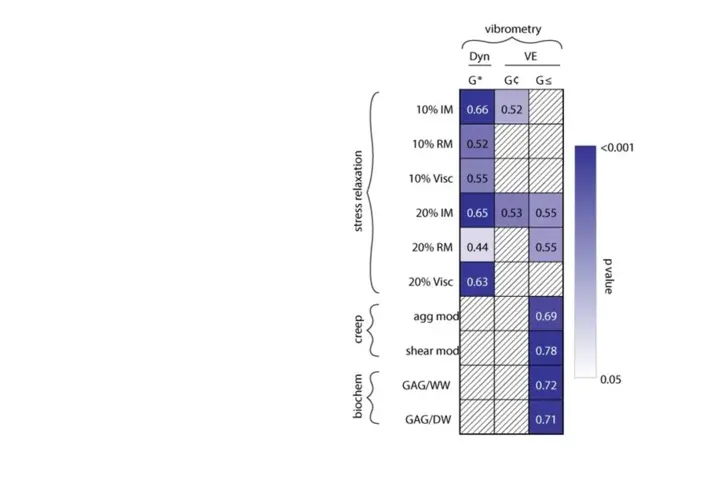
The table summarizes the strength and significance of Spearman ρ correlations of dynamic modulus G*, the storage modulus G’ and the loss modulus G’’ derived with non-destructive vibrometry measurements and traditional destructive assays used in cartilage research.

The numbers indicate the strength of the correlation (ρ), and colour indicates the degree of significance. White boxes with diagonal lines denote that statistical significance was not achieved.

This study successfully shows the use of vibrometry in a non-contact manner to measure cartilage’s dynamic mechanical properties. The dynamic properties reported here showed several correlations with quasi-static and biochemical properties, thus providing important insights into cartilage function under cyclic loading. Vibrometer-based measurements were also precise enough to detect differences in viscoelastic properties among the cartilages of the knee.

This work not only solidifies the relationship among quasi-static, viscoelastic and dynamic properties over a short testing time but also presents a practical option for high-throughput non-destructive testing, ideal for applications in cartilage developmental biology, tissue engineering and translational medicine.

Read more in this research article https://lnkd.in/gh2ek6kB
Images courtesy of the authors unless otherwise specified.

Our Authors

Dr. Gabriela Espinosa
UC Irvine's UCI Samueli School of Engineering now at Concordia University Irvine
Dipl.-Ing. Elmar Uhlitzsch
Strategic Product Marketing Product Manager Vibrometry Business Unit Vibrometry, Polytec GmbH, Germany
info@polytec.com

Related Articles

Gravity in the Lab

Anyone wanting to measure G needs an experimental setup capable of the seemingly impossible—detecting movements smaller than the diameter of an atom, triggered by pure “action at a distance.” The team arou…

7 min

Laser-Doppler-Vibrometer set standards in the development of electric drives

Electric machines are increasingly being used as the primary drive technology in vehicles. The acoustic behavior of the drive is a key factor in the perceived quality of electric vehicles. Numerical method…

5 min

激励力

人工激振是各種噪音與振動技術的基礎,涵蓋實驗模態分析、傳遞路徑分析、載荷識別、模擬模型相關性分析、混合建模等領域。結構激振可透過多種方式實現,從手動衝擊錘、自動化錘具,到外部支撐式振動台乃至自支撐式振動台皆可達成。

10 min

惯性激振器用于模态测试

当被测物体无法自振时需外部激励。模态试验常用电磁激振器和力锤。Polytec扫描测振仪配SAM自动力锤提升效率。

6 min

如何测量非洲象群间的低频通讯。

最近发表在《欧洲物理杂志专题》(European Physical Journal Special Topics)上的一项研究介绍了激光多普勒测振仪(LDV)的一项开创性应用,以更好地理解非洲象的发声及其行为含义。这项研究的主要目的是确定大象群体中声音交流的动态,特别关注一种被称为“我们出发吧”的的特定隆隆声。这些隆隆声序列在协调大象群体的运动、空间关系和加强社会联系方面起着至关重要的作用。

4 min

何时选择激光多普勒测振仪进行振动测量

在振动测试领域,附加质量是一个不容忽视的重大难题。动态振动样本或被测器件(DUT)的性能,极易受到额外附加质量的干扰。这种现象在振动的悬臂梁结构中表现得尤为突出,而在处理涡轮叶片这类特殊的弯曲悬臂梁时,情况更是复杂棘手。利用加速度计精准测量涡轮叶片的共振频率,向来是一项颇具挑战性的任务,其中附加质量的影响是主要阻碍因素。即便极为小巧的加速度计,其增加的质量也会改变涡轮叶片的固有频率,使得精准测量困难重重。

5 min

压电片谐振器轮廓模态的单电极传导

压电片谐振器用于传递特定的轮廓模态体声波(BAW)谐振振型。基于铌镁酸铅-钛酸铅 (PMN-PT)薄膜的独特性,必须使用激光多普勒测振仪来测量微型盘式谐振器。PMN-PT是一种铁电材料,以其良好的压电和电致伸缩性能而闻名。面内位移曲线,可显示出轮廓模态、共振模态、切向模态和酒杯模态族。这些轮廓模态对生物传感、射频和旋转传感应用具有重要意义。

4 min

庆祝干荣珠教授出色的职业生涯

我们有幸于2022年7月26日远程采访了干荣珠教授。在她所在的科研领域里,她的声名如雷贯耳。她是俄克拉何马大学机械工程系的首席教授,已在该大学工作了25年,更重要的是,她是人耳力学领域的先驱之一。她做过中耳,内耳的有限元建模、植入式装置、组织生物力学等等。

3 min

边界条件,测试误差,可重复度

在MAN ENERGY SOLUTIONS,我们为海事部门提供系列综合发动机、螺旋桨、艉部设备和涡轮增压器。可靠性是我们行业(尤其是船舶业)关注的第一要务。在产品的研发阶段,我们使用德国Polytec公司的扫描式激光测振仪来获取测试数据,不断地对样件进行模态验证及模型优化,测试,直到部件可以进行量产。

5 min

非接触式观察心脏颤动,相当于用八倍镜观察,虽远,但纤毫毕现

心脏和循环系统疾病是人类最常见的致死病因——甚至比癌症还要严重!因此,我们要非常重视心脏的健康。那么该如何重视呢?我们知道,当医生使用心电图(ECG)测试心脏功能时,会观察脉搏上升曲线图。

6 min

基于模态测试的监测系统

随着人们对基础设施的安全性关注度越来越高,对现有结构的安全评估和剩余使用寿命预测提出了挑战。可靠的、技术上可行的和经济的健康监测解决方案是保证结构安全和满足用途的必要条件,是获得有关结构损伤过程和当前结构特性的有用信息的关键前提。

5 min

Manipulation of complex fluids with SAW-based acoustofluidics

Surface acoustic wave (SAW)-based acoustofluidics combines microfluidics with active microacoustic fields. This allows to realize numerous Lab-on-a-Chip operations, reaching from fluid manipulation includi…

3 min

A new driving mechanism for acoustofluidics*

Acoustofluidics is the active manipulation of fluids as well as of immersed particles or cells at the micro- and nanoscale and is a key technology for life sciences. Acoustic waves, more precisely, ultraso…

5 min

关于昆虫听觉与激光测振技术的温德米尔博士访谈

来自格拉斯哥斯特拉斯克莱德大学的温德米尔博士致力于研究昆虫的听觉。我们就其研究内容及Polytec激光测振仪在其中所扮演的角色,与他展开了交流。

3 min

实现静音与可靠运行的噪声和模态分析

无人机市场正经历多维度的蓬勃发展

6 min

使用采用 EMS 压电无痛技术的超声波洁牙器,呵护健康牙齿

瑞士E.M.S.公司生产的超声波洁牙器,采用Piezon无痛技术,可有效帮助客户保持牙齿健康。为了尽可能地维持牙齿的健康,防止龋齿和牙周感染,家庭护理方法如刷牙和使用牙线是非常重要的。不过仅靠这些是不够的,因为即使这些家庭护理操作得当,口腔内仍会产生菌斑,它是龋齿、牙周病和种植体周围疾病的主要致病因素。

5 min

Vibration analysis helps to protect art

像美国圣达菲的乔治娅·奥·吉弗(Georgia O’Keeffe)这样的博物馆,为了组织巡回展览,除了自有展品外也需要从其它博物馆和私人收藏家那里临时借出藏品,丰富的展品以吸引更多的观众。仅2017年,乔治娅·奥·吉弗博物馆的绘画展览在布鲁克林、伦敦、巴黎、维也纳、多伦多、悉尼、墨尔本和布里斯班等多个城市的累计参观量超过130万人次。

4 min

蛛网的实地阻尼测试

蛛网的编织形式巧夺天工,具有非常独特的建筑学、力学和动力学性能,真可谓是自然界的奇迹!蛛网常见的结构,即由一个中心伸出的若干呈放射状的骨架丝线-纵丝和围绕这个中心的螺旋丝线-横丝构成的网状结构。蛛网需要抵抗风致振动及飞行猎物的高能冲击。为预测一个完整蛛网结构的振动阻尼响应,我们在蛛网形成地点-丛林实地,测试其组成丝线的阻尼特性。

4 min

人耳听小骨的振动研究

人类的中耳将由声波所引起的鼓膜振动通过听小骨传输至内耳。在接近听觉阈值时,鼓膜所产生的三维振动位移仅有几个纳米,因此,研究人员需要使用非常精准的非接触检测设备来测试这类振动。

3 min

Laser vibrometry is the key

叶缘焦枯病菌(xylella fastidiosa)会在农作物中会引起多种严重病害,这种植物病原体是加州和南美的葡萄树产生致命疾病的罪魁祸首,仅加州每年需为此耗资1.04亿美元。在一个专门的研究项目中,不同于现有的使用农药来消灭害虫的方法,科学家们找到了一种对生态系统无不良影响的方法-利用激光振动测量技术来分析昆虫们求偶时的通讯方式,从而采取手段来控制害虫繁衍。这为自2013年以来惨遭叶缘焦枯病菌肆虐的欧洲…

5 min

论振动在蜜蜂觅偶过程中的作用

在动物界,由雌性来决定交配权的现象很普遍。本文旨在研究雄蜂的振动是否是雌蜂选择交配对象的影响因素之一,我们使用德国Polytec公司的激光测振仪研究雄蜂在交配期间的振动,期待揭示更多蜂群使用胸腔振动来进行内部交流的秘密。

5 min
Load More