Resonant frequency and damping analysis (RFDA) is a powerful technique for determining the elastic properties of materials, especially at elevated temperatures. The integration of laser Doppler vibrometers (LDV) featuring Polytec's QTec technology extends the capabilities of conventional microphone-based detection. LDV enables reliable and continuous data acquisition even under extreme conditions characterized by high damping and complex microstructures. The use of QTec technology optimizes signal reliability by avoiding the acoustic attenuation and temperature-induced disturbances affecting microphone-based detection, making it particularly suitable for seamless integration into IMCE NV's material characterization and product inspection systems.
Introduction: motivation for RFDA
For engineers and researchers working on refractory or high-temperature ceramics, understanding elastic parameters and damping mechanisms is critical to ensuring both reliable performance and material innovation. Traditional RFDA implementations often rely on acoustic sensors (microphones), which tend to struggle under conditions of elevated damping and rapid microstructural evolution. These limitations intensify above 1200 °C, restricting reliable data collection.
LDV-based RFDA systems circumvent these challenges by directly measuring vibrations at the sample's surface, thereby improving signal quality and extending reliable modulus and damping measurements into conditions where acoustic detection becomes challenging. Integration into commercial systems from IMCE NV ensures compatibility with established workflows and standards.
Methods: RFDA and LDV with QTec technology
RFDA is based on the Impulse Excitation Technique (IET), a non-destructive method in which a specimen is mechanically excited, and its natural vibration response is analyzed. From the resonant frequencies, elastic properties such as Young's modulus and shear modulus can be determined, while the decay of the vibration provides information on material damping. The method is standardized in EN 820-5, EN 843-2, ASTM E1876, ASTM C1259 and ASTM C1548.
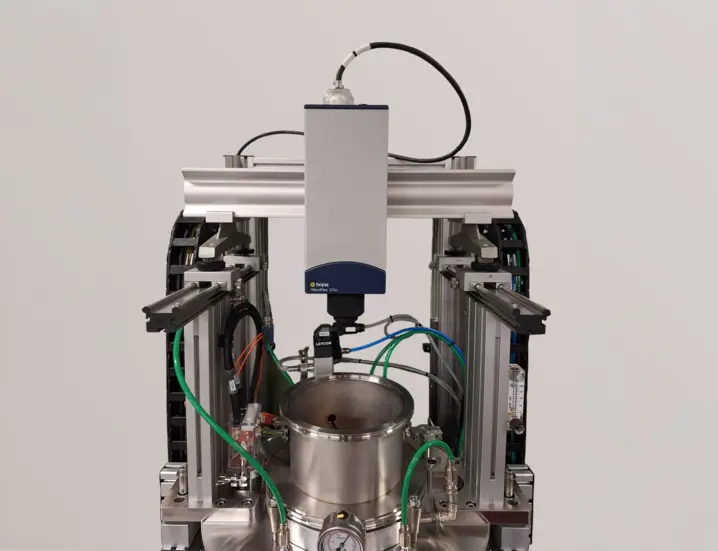
IMCE RFDA systems combine controlled impulse excitation, signal acquisition, and dedicated analysis software. High-temperature systems allow these properties to be monitored continuously during heating, dwell, and cooling cycles.
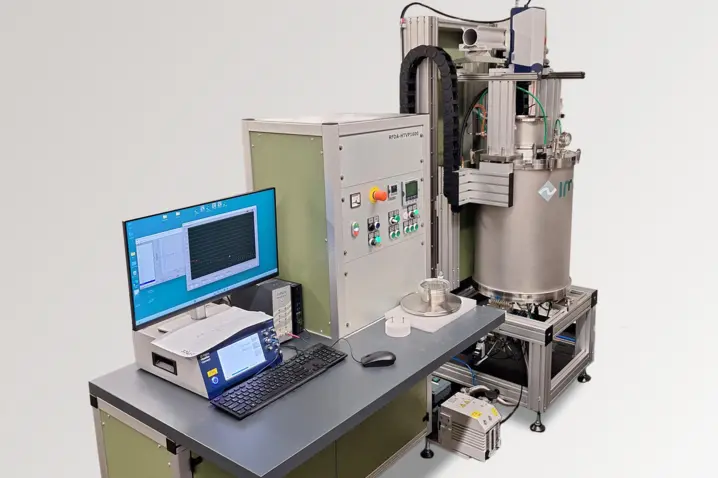
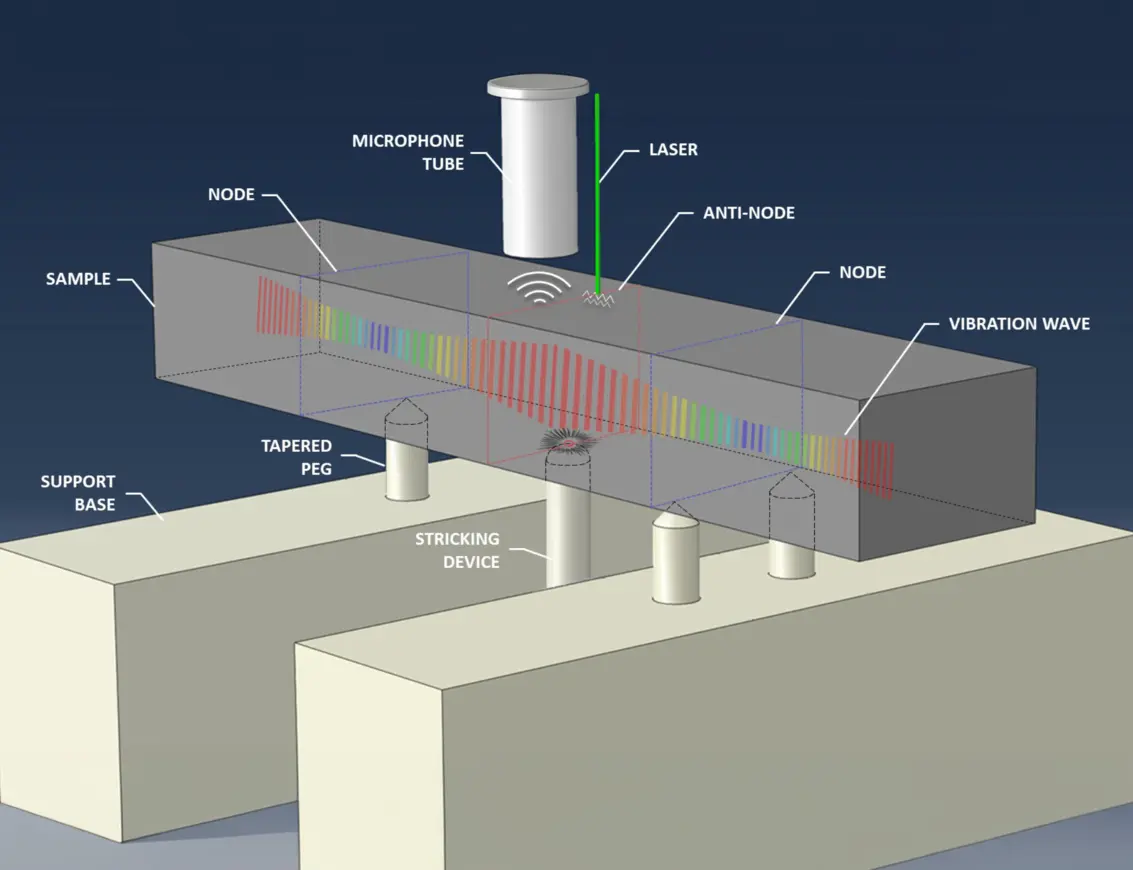
Traditionally, the vibration is detected acoustically by a microphone. The key challenge, especially at high temperatures, is that increasing material damping can strongly reduce vibration amplitude and decay time. Microphones lose signal fidelity due to acoustic attenuation, air movement, and thermal gradients.
IMCE already introduced LDV detection in the early 2000s to extend RFDA measurements to higher temperatures, particularly under vacuum conditions.
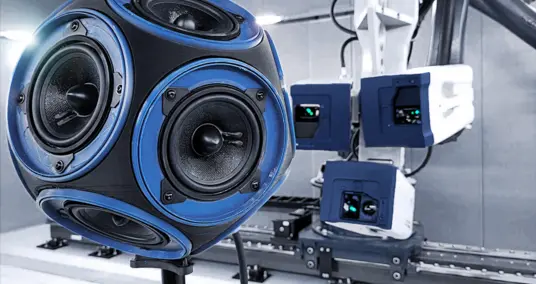
Laser Doppler vibrometers detect vibration on the specimen's surface without physical contact. Using light as a sensor, the attenuation of acoustic waves through the hot gas can be bypassed.
With Polytec's multi-path interferometry, IMCE was able to minimize the sensitivity of the laser reading to environmental influences. QTec's multi-path interferometry provides more robust optical detection under demanding conditions such as surface roughness, reduced reflectivity, or rapid thermal transitions. The technology also maintains high data reliability during microstructural events (e.g., phase formations, microcracks, and sintering processes). LDV-based RFDA measurement systems achieve robust measurement results and broad applicability in both research and production settings.
Implementation examples and outcomes
LDV-based RFDA measurement systems have been evaluated on a variety of ceramic and refractory samples:
- With dense, polycrystalline alumina, both sensor types, acoustic and optical, yielded comparable results. The LDV provided a substantially longer and higher-quality signal at elevated temperatures, although both sensors remained capable of extracting the relevant frequency and damping data up to 1550 °C.
- For ultra-low cement castables, LDV markedly outperformed microphones in samples with high damping and glass-phase development, continuing to capture resonance data under conditions where acoustic sensors failed.
- In complex, multi-component ceramics, the QTec-LDV system enabled continuous tracking of the resonance frequency that was otherwise unobservable, enabling targeted material optimization.
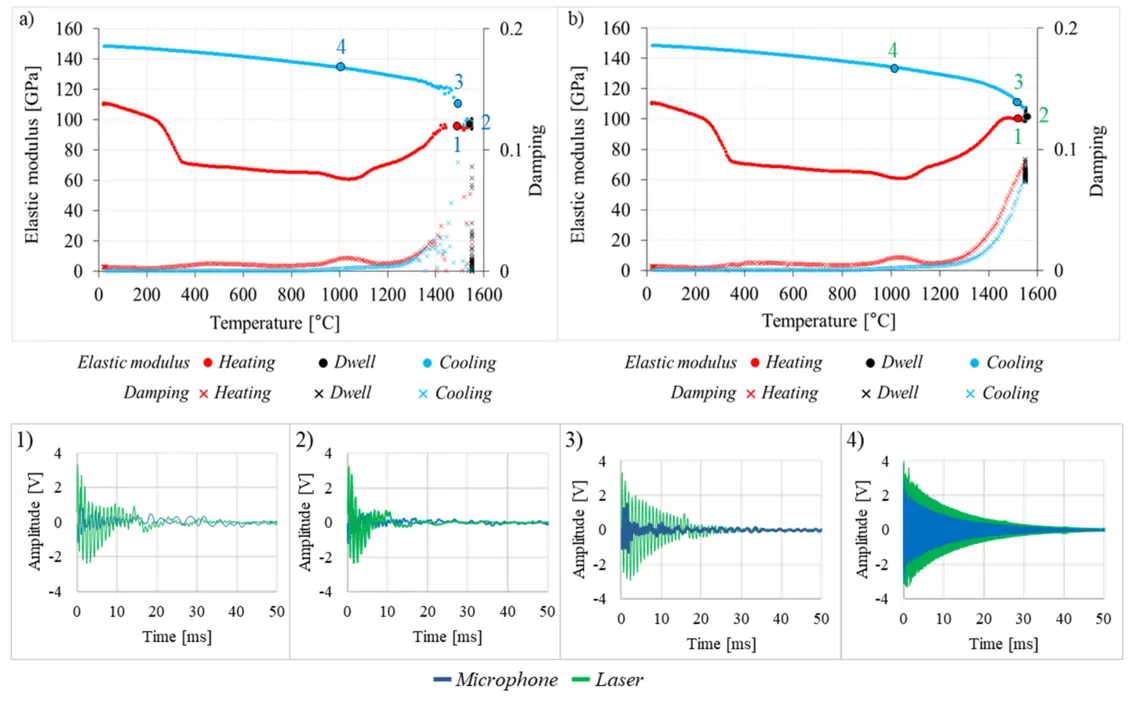
These results show how the integration of Polytec's LDV sensors with IMCE's RFDA measurement systems facilitates reliable, non-destructive material evaluation during critical thermal cycles and under challenging industrial conditions.
Troubleshooting and best practices
Optimal LDV performance requires careful alignment along the sample's central antinode. For classic LDV systems, reflection losses should be minimized via precise laser targeting. Surface preparation is less critical, since QTec actively mitigates speckle and thermal drift and thus reduces data dropout. Common sources of errors, such as poor probe alignment, inappropriate support fixtures, or missed vibration signals due to short decay times, are addressed through QTec's multi-path redundancy and advanced signal processing.
Measurable success criteria
The success of LDV-based RFDA integration into IMCE platforms is demonstrated by a continuous extraction of elastic moduli and damping across the full temperature cycle (e.g., 25 °C to 1550 °C) for multiple material types. This results in an effective identification of microstructure features like phase transitions and microdamage via changes in frequency and damping.
Conclusion
Combining RFDA with QTec laser Doppler vibrometry extends RFDA measurements beyond the limits encountered with traditional acoustic detection under high-temperature, high-damping conditions.
Direct integration of Polytec's LDV sensors into IMCE RFDA systems improves signal robustness and data continuity, supporting advanced material research and industrial quality control.
Acknowledgement of scientific collaboration
This article is based on a peer-reviewed scientific publication, resulting from a collaboration between academic research groups and industrial partners dedicated to advancing high-temperature material characterization. The research is further underpinned by contributions from leading universities and multidisciplinary laboratories, whose expertise and resources were invaluable in realizing the potential of advanced RFDA for modern material science.
The team comprised Andrea Salerno, Kwasi Addo Boateng, Marc Huger, University Limoges, Institut de Recherche sur les Céramiques, Jean-Michel Auvray, Imerys Centre Technologique, Paul Leplay, Amelie Bigeard, Saint-Gobain research and the authors of this condensed article, Jörg Sauer of Polytec GmbH and Bart Bollen of IMCE NV. Special recognition is due to the teams at Polytec GmbH, whose innovative QTec technology made significant contributions to the measurement technique, and IMCE NV, whose systems integrated the LDV solution seamlessly into standardized workflows for research and industrial inspection.