
Back
Food & agriculture
Biology & medical
Pharma & chemical industry

Sterilization by light flash

Xenon UV flash lamps in photochemical sterilization

The success of sterile environments in the pharmaceutical, medical, and food industries depends on transferring materials in and out without causing microbial contamination. Conventional surface sterilization methods using gas or UV light are slow and labor-intensive. In contrast, pulsed UV light is easy to apply, chemical- and residue-free, unaffected by immunity or heated surfaces, and acts within milliseconds.

Pharmaceutical, medical, and increasingly food companies manufacture many of their products in cleanrooms. In these industries, cleanrooms do not only mean dust-free or low-particle air, as in semiconductor and electronics manufacturing, but also sterility. This is typically achieved through filtered airflow, consistent (over)pressure, temperature and humidity control, appropriate work clothing, and various other measures. Equally crucial is the sterility of materials introduced into the cleanroom.

Larger cleanroom facilities have airlocks where materials are sterilized using hydrogen peroxide gas, peracetic acid, or ozone-based methods. Each method requires prior cleaning of the surfaces to be sterilized. Subsequently, the gases must be vented, and chemicals or resulting hazardous waste must be disposed of.
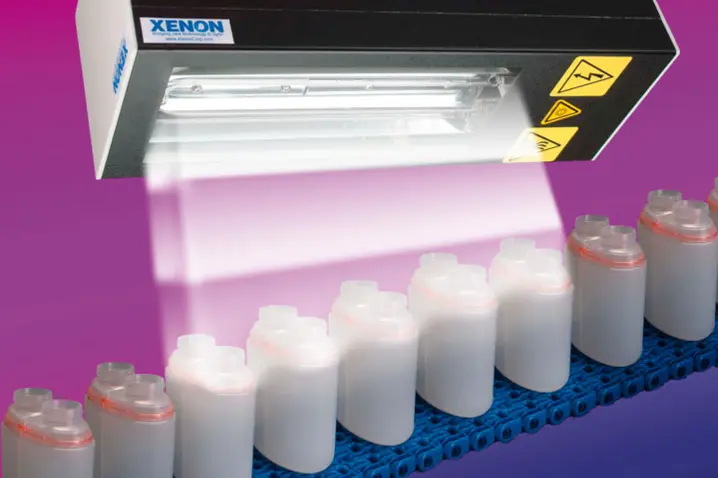
Xenon systems are increasingly being used for sterilization, not only in cleanrooms but also in pharmaceutical and food production

Another method is UV light irradiation, which exploits photochemical sterilization. Molecular bonds are broken, ultimately destroying DNA and cells. This occurs when the photon energy at a given wavelength equals or exceeds the strength of the biomolecular-chemical bonds. Biochemical studies have shown that wavelengths between 250 and 280 nm have the greatest effect on nucleic acids, meaning DNA exposed to these wavelengths is most severely damaged. Photochemical sterilization is thus achieved by applying extremely high UV radiation in germicidal wavelengths, irreversibly damaging molecular bonds and causing cell death.

Conventional mercury-vapor UV lamps are inherently weak light sources and cannot achieve a radiation flux high enough to overwhelm DNA repair mechanisms in a short time. Achieving a sufficient effect requires long exposure times, yet they still cannot reach the reduction achieved with a short, high-energy pulse. Additionally, the irradiated surface heats up significantly. In contrast, xenon lamps are very high-intensity sources that can easily reach this critical destruction threshold in milliseconds. The Xenon Steripulse-XL system produces the most effective form of germicidal UV light available.

With the increasing automation of cleanroom technology, the use of pulsed xenon UV lamps is also growing rapidly. The systems operate fully automatically and are integrated into the cleanroom setup already during development. Their millisecond exposure time is effective against all DNA-containing organisms, and the absence of chemical waste or gases makes this technology highly attractive for such applications.
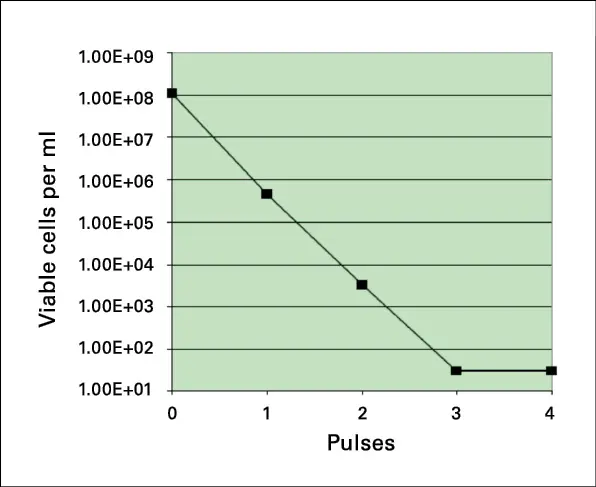

Example of the lethality of pulsed UV light on Bacillus subtilis. Experimentally determined by Abraham L. Sonenshein, PhD, Tufts University School of Medicine and Xenon Corporation
Image credits: Unless otherwise noted below, courtesy of Xenon Corp. Cover image: marketa1982/shutterstock.com; Image 2: Abraham L. Sonenshein, PhD, Tufts University School of Medicine

執筆者一覧

Dipl.-Ing. (FH) Jochen Grimm
Strategic Product Marketing Photonics Division
info@polytec.com

関連記事

Pulsed UV light against germs

Hygiene is essential in all areas of the food industry. This is especially true for dairy products like yogurt, which are highly susceptible to contamination by microorganisms and mold spores. These can or…

4 min

A modern approach to germ-free food packaging

Since the 1960s, sterile packaging has played an important role in food safety. However, there has been little innovation since then. Chemicals and heat remain the most common methods for sterilizing food …

4 min

Expanded options for deformation tests in materials analysis

In materials research, digital image correlation (DIC) is an established method for accurately and non-contactly detecting deformations. This applies to tensile, compressive, and bending tests as well as i…

5 min

How fiber-optic temperature measurement helps develop Power-to-X technologies for the energy transition

Fiber-optic systems measure temperatures across fields, excelling where many sensors, compact size, and low thermal mass are needed—one 150 µm fiber can replace hundreds of sensors.

5 min

Complete thermographic solutions for safety and process control

Thermographic methods, whose typical false colour images visualise temperatures, are suitable for many areas. Their possible uses in industry are particularly varied during the monitoring of temperature-de…

5 min

Distributed fiber-optic temperature and strain measurement with extremely high spatial resolution

Sampling of the Rayleigh scattering along a length of optical fiber allows the realization of a distributed sensor system where every point along the fiber acts as a sensor. This novel method allows ...

10 min

Fiber Bragg Grating Sensors in Practice

Fiber-optic sensors are used in wind turbines not only for monitoring but also for control, for example, to adjust the rotor blades based on load measurements of the blades.

4 min

Fiber-optic sensing in basic research

Friction clutches are used in millions of automobiles to transfer the engine’s torque to the drivetrain. However, the physical processes involved in frictional power transmission are still not completely u…

4 min

Fiber-Optic Temperature Measurement in Chemical Process Engineering

Conventional measurement methods quickly reach their limits when electromagnetic immunity, high measurement density, or chemically aggressive environments are required

10 min
Load More