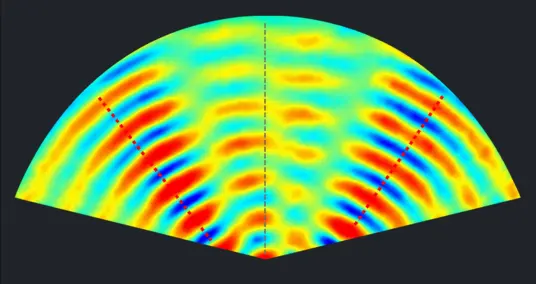
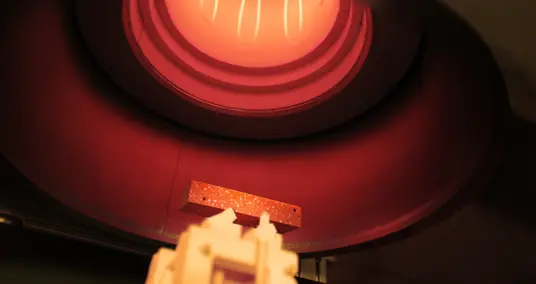
The ability to precisely shape ultrasonic wavefronts underpins a growing range of biomedical and engineering applications. In medicine, megahertz-frequency ultrasound penetrates deep into tissue while still focusing down to millimetre-scale spots, making it indispensable for non-invasive imaging and therapy. Shaping the wavefront is also what lets clinicians correct for the aberrations introduced by the skull or other heterogeneous tissue, and precisely localize ultrasonic energy for techniques such as transcranial neuromodulation1. Beyond the clinic, patterned ultrasound fields are used in acoustofluidics to sort particles and assemble cells2 into tissue constructs, and even to 3D-print objects without any physical contact.
Generating such tailored fields comes down to one of two strategies: actively steering the wave with a phased array of transducers, or passively reshaping it by sending it through a fixed lens or hologram. Each comes with its own limitations.
Running out of ways to bend sound
Today, acoustic engineers have two main options. The first is the phased array: rows of piezoelectric elements, each firing in a carefully timed sequence so their individual sound pulses interfere to build up a chosen field. Arrays are the workhorse of medical ultrasound, but every added element brings more cabling, more driving electronics and more cost, which puts a practical ceiling on how intricate a field they can produce.
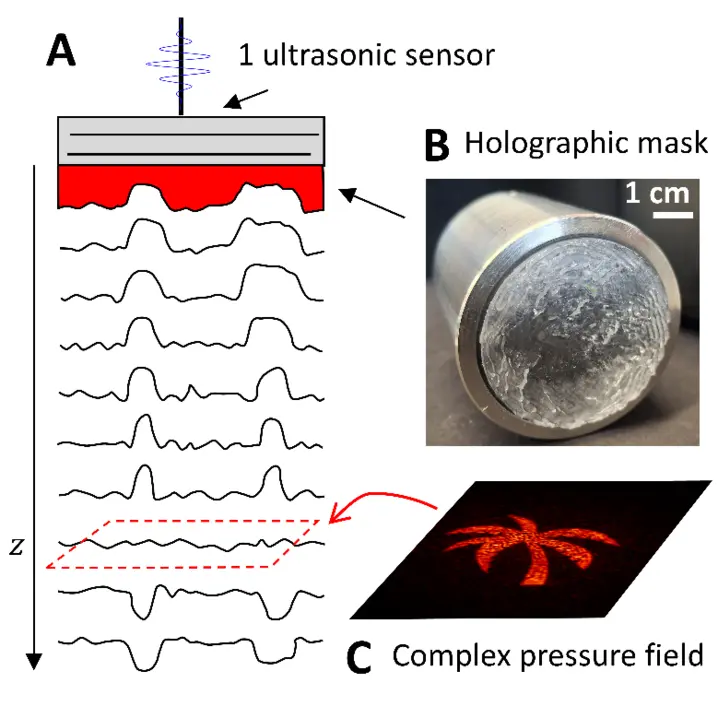
The second option turns the problem around. Rather than controlling many individual sources, a single, large-aperture transducer emits a simple, "flat" plane wave, which is then sent through a passive hologram placed in its path2 (Figure 1A). As a sound wave travels a distance d through a medium with sound speed c, it accumulates a phase shift proportional to fd/c, where f is the frequency. Wherever the hologram's local thickness or composition differs from its surroundings, the wave picks up a different phase than in neighbouring regions. In practice, the most common hologram is a 3D-printed phase plate (Figure 1B): a surface composed of many small pixels of varying height, made from a polymer whose speed of sound differs from that of the surrounding medium, typically water. By choosing each pixel's height individually, an arbitrary phase pattern can be imprinted across the entire wavefront in a single pass, encoding far more independent phase values than a phased array could ever provide with physical elements. Downstream, at a chosen target plane called the image plane (Figure 1C), the wave reconstructs the desired pressure pattern.
The trade-off is flexibility: because the phase pattern is fixed once the phase plate is fabricated, the device cannot be reconfigured. Every new wavefront, focal pattern, or target location requires fabricating a new plate, unlike a phased array, which can retarget in real time simply by re-timing its elements. On top of that, polymers absorb a lot of ultrasonic energy at megahertz frequencies. That attenuation limits device size, throws away power that a therapy application actually needs, and at higher intensities, heats the material which may even cause it to warp and degrade its own performance.
Acoustic metamaterials made of lower-loss substrates could offer better performance. By structuring a material with features much smaller than the sound wavelength, its effective behaviour can be engineered almost arbitrarily, including properties no natural material possesses3. So far, very few metamaterial architectures have been demonstrated at megahertz frequencies and at a scale of a few centimetres. Indeed, most existing designs are either very lossy, difficult to fabricate at the relevant scale, or limited to flat, two-dimensional geometries.
Carving sound waves into glass
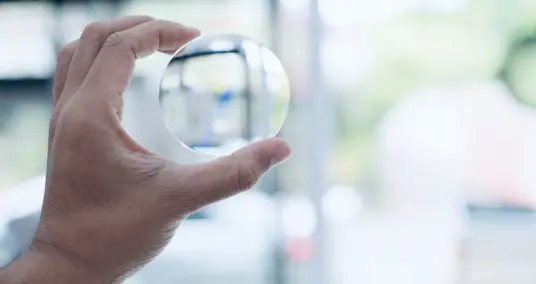
Our approach starts from an unusual material choice: ordinary optical glass. Glass is about as far as you can get from a lossy polymer: it is mechanically and thermally stable, and it is one of the least absorbing materials known for megahertz ultrasound4.
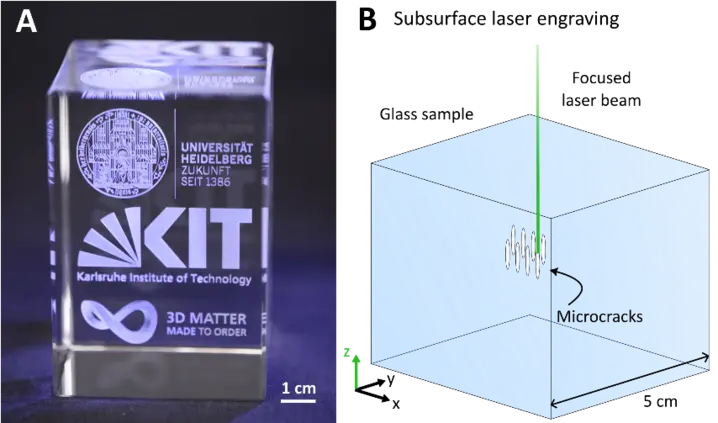
To turn a solid block of glass into a metamaterial, we use subsurface laser engraving, a technique also used to make 3D-etched glass souvenirs (Figure 2A). A high-peak-power, nanosecond pulsed laser is focused inside the bulk of the glass, where the light triggers a localized optical breakdown. This fractures the glass into a microscopic crack roughly 100 microns across, without touching or damaging the material anywhere else. Moving the focal point and repeating the process, millions of times, builds up a three-dimensional lattice of individually oriented microcracks (Figure 2B). This pattern can, in principle, take almost any shape, anywhere inside a centimetre-scale glass block.
Individually, each microcrack scatters very little sound. But because tens of them sit much closer together than the acoustic wavelength, the incoming ultrasound wave cannot resolve them one by one but feels their combined effect. That collective response is what gives the engraved glass an effective speed of sound and density which are slightly different from those of the unaffected bulk medium.
Watching sound move through solid glass
But how do we know that the metamaterial is shaping the sound as we want? When holograms are 3D printed for use in water, we can measure the sound field with an underwater microphone, called a hydrophone. In glass, however, this isn't possible. This is where laser vibrometry comes in, and where glass turns out to be doubly convenient. Because glass is optically transparent, a laser can not only probe the ultrasonic field at the glass surface but also measure inside the glass itself and track how the sound waves are shaped by the metamaterial.
In this refracto-vibrometry configuration, a measuring laser beam crosses the ultrasound path at 90° on its way to a fixed reflector behind the sample. As the pressure wave passes, it locally changes the density of the glass and, with it, its refractive index. The laser interferometer picks up the resulting phase modulation as an apparent vibration velocity even though nothing on the reflector is actually moving (Figure 3A).
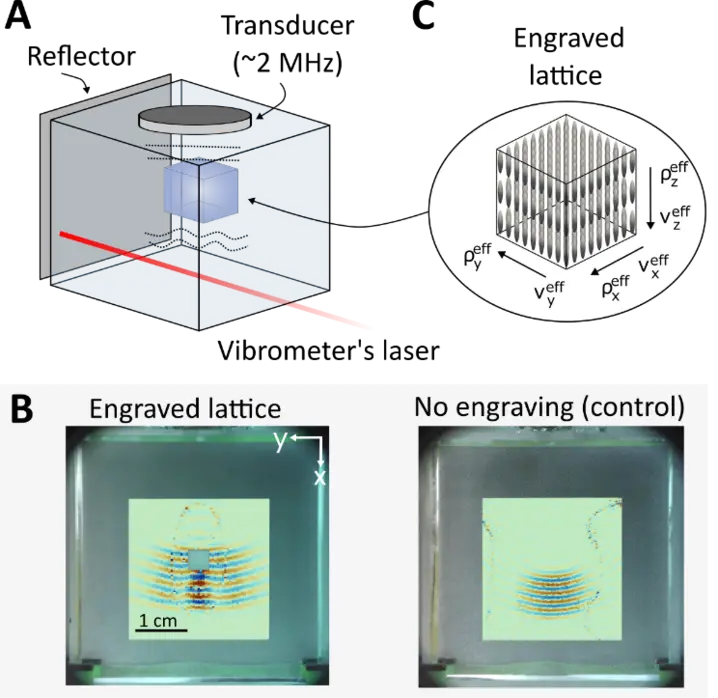
To characterize the properties of the metamaterial, we engraved a simple lattice inside a 3D box, which we called a metavoxel (size of ~4 × 4 × 31 mm3). We sent 2.25 MHz ultrasonic pulses through it and timed how long they took to cross the sample, compared to an unengraved control block of the same size (Figure 3B). Along one direction, the engraved region consistently delayed the pulse, corresponding to an effective speed of sound about 20% lower than in the surrounding bulk glass4. Because so little of the incident wave reflects off the metavoxel, we could estimate the effective density too, simply by assuming that the acoustic impedances of the engraved and bulk regions are almost the same. This points to an effective density around 20% higher than plain glass.
Repeating the measurement along each of the three axes revealed a strongly anisotropic response, tied directly to the elongated shape and orientation of the individual microcracks (Figure 3C), a signature of metamaterial physics, rather than simple, uniform scattering. A clear frequency dependence was also observed, suggesting resonant behaviour within the structure.
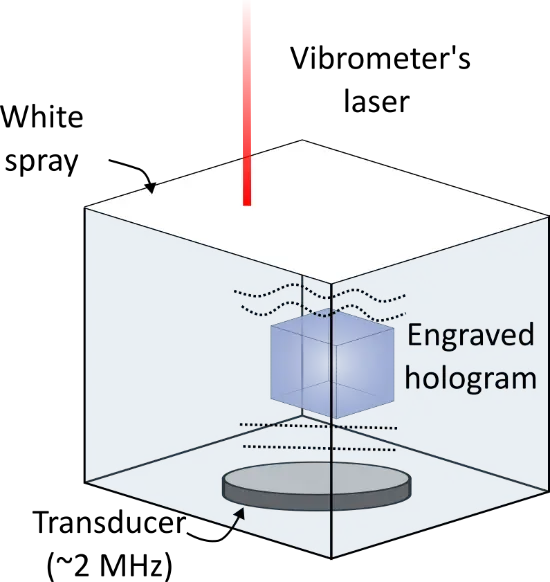
Refracto-vibrometry is ideal for probing the field deep inside the glass, but it comes with a built-in limitation: because it integrates the phase modulation along the entire optical path, it returns a projection of the 3D field rather than a true snapshot at a single plane. For some of our holograms, we specifically wanted to verify the wavefront exactly where it was designed to converge at the image plane, positioned at the glass face opposite the transducer. For that, we switched to a complementary, more conventional technique: standard surface vibrometry.
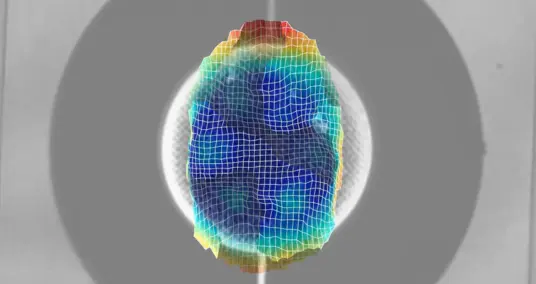
Because bare glass barely scatters the measurement laser back to the sensor, we first coated that output face with a thin layer of white spray paint to boost its optical reflectivity. A vibrometer was then positioned above the sample to perform a point-by-point scan across the coated face while the transducer fired the same ultrasonic burst (Figure 4). Out-of-plane surface vibrations induced by the sound field were measured this way. This method provided a direct, localized check that complemented the depth-integrated view from refracto-vibrometry.
A toolkit of acoustic building blocks
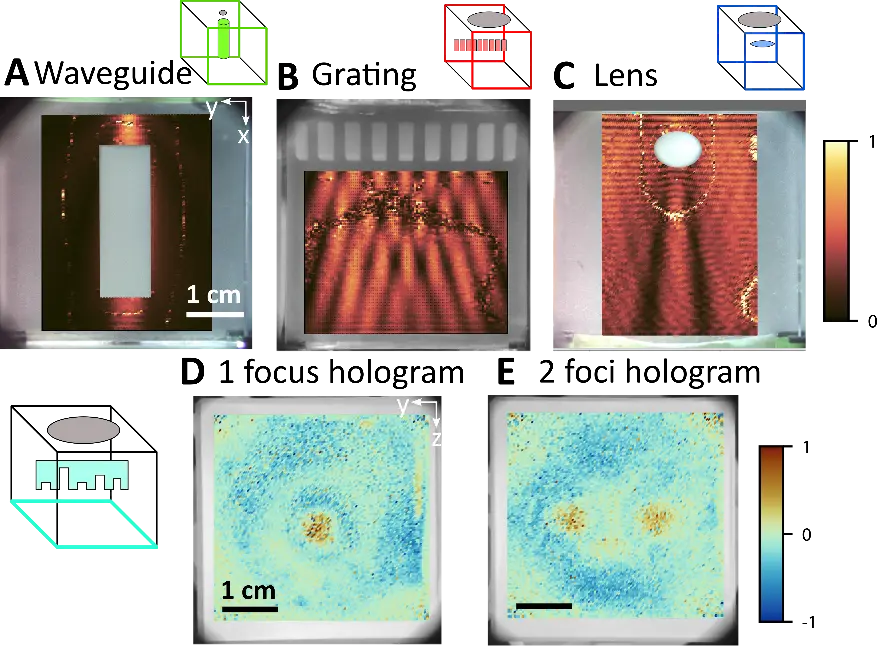
With the effective speed of sound and density of a metavoxel now known, the next step was to turn it into something useful. By locally varying the pattern and depth of engraving across a glass block, we built a small library of functional elements: a waveguide (Figure 5A), a diffraction grating (Figure 5B), a converging lens (Figure 5C), and acoustic holograms that split an incoming wavefront into one (Figure 5D) or two separate focal spots (Figure 5E).
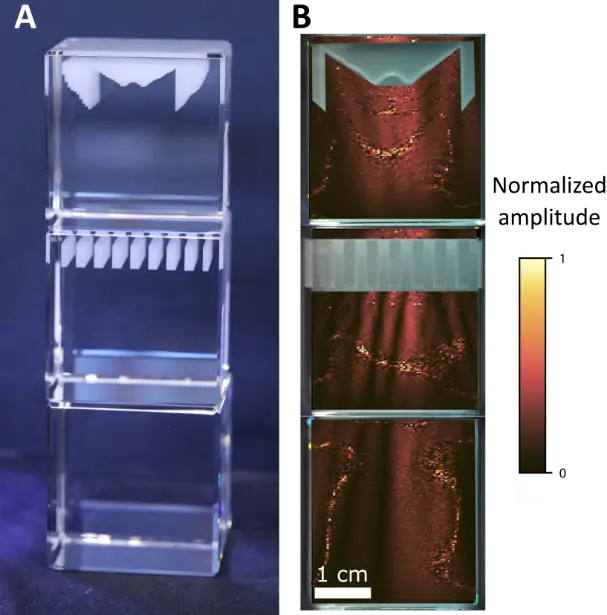
The real advantage of this approach only becomes clear once several elements are combined. Because every element is engraved into the same kind of glass block, they can simply be stacked, like optical components on a bench. This allows us to build more complex assemblies, a lens next to a grating, for instance (Figure 6), with minimal reflection at the interfaces between blocks.
That modularity, engraving a small catalogue of standard parts once and then combining them as needed, is arguably as important as any single element's performance. It turns a fixed, single-purpose device into a flexible platform for exploring new wavefront-shaping designs.
Five things we learned about refracto-vibrometry on this project
- Go small on the scan step. At 2.25 MHz, the wavelength in glass is only 2.6 mm. Following the usual rule of thumb (step size ≈ λ/5) meant scanning in 0.5 mm increments. This scan step is fine enough to need the close-up unit from the PSV-500 fitted with a micro-scan lens (PSV-A-CL-200, HeNe).
- Focus in the middle, not at the back. For these measurements, the rigid reflector was temporarily moved to a mid-plane position so the laser could be focused at the centre of the cube rather than on the rear face. Central focusing noticeably improved spatial resolution compared to back-plane focusing.
- Remember it's a 2D projection of a 3D field. Refracto-vibrometry integrates the refractive-index change along the entire optical path, so the signal is a path-averaged, 2D projection of the 3D pressure field. If the engraved region is short compared to the full optical path, its contribution is washed out and the apparent speed of sound looks close to that of the bulk glass. In our samples, the engraved region needed to span roughly 20% of the cube before the measured effective velocity reliably plateaued at its true value.
- Cross-check with a second technique. We validated the time-of-flight readings from refracto-vibrometry against a standard pulse-echo measurement of the bulk speed of sound. The two methods agreed to within 0.1%.
- Window out the reflections before you FFT. We worked mainly in the time domain, using short pulses from an external signal generator. Selecting a time window before any echoes returned from the cube's side faces, and then computing the FFT manually in Python, made it much easier to see the wavefront shaping cleanly, without background reflections muddying the picture.
What this opens up
Taken together, this metamaterial combines three properties that are hard to find in one material: extremely low ultrasonic losses, along with the mechanical and thermal robustness of glass even under sustained exposure to intensities of at least 20 W/cm². Refracto-vibrometry played a central role in getting there, as it let us directly interrogate the ultrasonic field inside the finished device, rather than only inferring it indirectly, which in turn let us cross-validate our designs against independent measurements such as conventional surface vibrometry.
The 3D patternability of the technique also opens doors that flat phase plates simply cannot reach, from truly volumetric metamaterials to devices whose flat glass faces are easy to index-match into water or tissue using standard coupling layers. Combined with the low losses, that makes the platform particularly attractive for high-power uses such as contactless ultrasonic power transfer or focused-ultrasound therapies such as ablation and hyperthermia and ultrasound-driven manufacturing. It also opens the door to more exploratory territory such as acoustic signal processing and volumetric ultrasonic neural-network-like computing.
Two questions stand out for future work. First, just how sensitive can refracto-vibrometry be made, in other words, what is the smallest pressure or density change it can reliably resolve inside a material like glass? Second, as designs move toward more intricate, computationally-optimized 3D patterns, how well do such inverse-designed structures perform once fabricated? Because the metamaterial's output can be characterized directly either inside the glass (refracto-vibrometry) or on a single face of the glass block (surface vibrometry), laser vibrometry offers a natural, non-destructive way to put those computational designs to the experimental test.