Back
Biology & medical

Gravity in the Lab

How Laser Interferometry Takes Aim at the Weakest Force of Nature

From Early Pendulum Experiments to Cutting-Edge Vibration Technology

The gravitational constant G is among the core pillars of physics. While the speed of light and the elementary charge are known with extraordinary precision, the exact value of G remains surprisingly uncertain even today—almost 350 years after Newton. Not surprisingly: Gravity is orders of magnitude weaker than any other fundamental force. Anyone wanting to measure G needs an experimental setup capable of the seemingly impossible—detecting movements smaller than the diameter of an atom, triggered by pure “action at a distance.”

The team around Jürg Dual at ETH Zurich has been taking on this challenge for years, using state-of-the-art laser measurement technology and ingenious experimental designs to set international benchmarks.

The First Step: Vibrating Beams as "Gravity Transmitters"

In a 2022 experiment, the team drew on a classic trick from vibration physics: resonance makes even very weak excitations measurable. In a spectacularly well-isolated laboratory deep in a Swiss mountain fortress, two metal beams about 1 meter long were mounted each within a vacuum chamber. One beam is set into precise vibration, “broadcasting” gravitational signals that act on the other, resonance-tuned beam in the adjacent chamber. The forces transmitted are minuscule—in the picometer range (a billionth of a millimeter)!

This is where laser interferometry comes in: Four highly precise laser vibrometers together with lock-in-amplifiers measured the tiniest trembling of the detector beam, filtering out noise and isolating true signals. The result: a value for G that is only slightly above the international reference—acquired with cutting-edge error analysis and clear potential for further refinement.

Strikingly, this dynamic method minimizes classical pitfalls, such as the influence of surrounding masses. For the first time, gravity’s effect can be directly examined not just “at rest” but in motion.

The Update: Rotating Bars as a Source of Oscillation (2023)

ETH Zurich did not stop there. In their most recent, 2023 study, the group took things a step further: Instead of linearly vibrating beams, the researchers used two slim, 0.5 m long, rotating tungsten rods arranged symmetrically opposite a bending beam resonance detector.

Through synchronized rotation, they generated a dynamic gravitational field that acted on the mechanically decoupled resonance detector beam. Once again: vacuum, meticulous isolation, and the utmost suppression of non-gravitational influences.

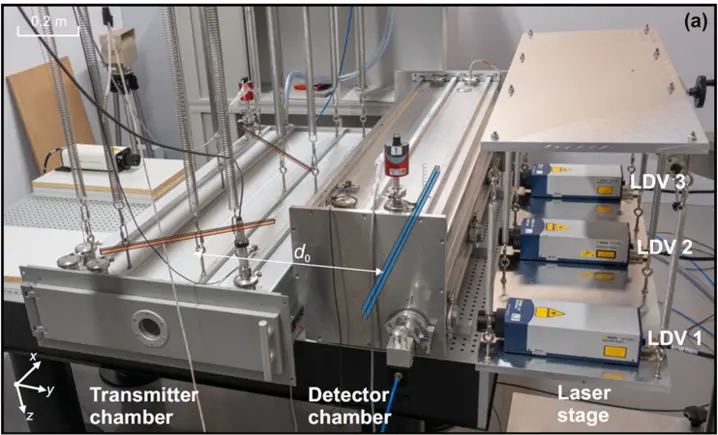
Fig. 2: Photo of the setup: The rotating transmitter bars (red drawing) are located inside the transmitter chamber. The chamber itself is hanging from springs attached to a carrier bar movable in y-direction. Inside the detector chamber the detector beam (blue) is hanging on rubber wires attached at the nodal points of the first bending mode. The detector chamber is fixed to an anti-vibration table, isolating the beam from the environment, and minimizing transmission of non-gravitational forces. The detector movement is measured using three laser Doppler vibrometers (LDV), positioned on a separate stage, likewise isolated via springs. The distance d0 is varied by moving the transmitter chamber. The whole setup is located in an underground laboratory, providing excellent temperature stability and minimal seismic noise. (Picture: https://www.nature.com/articles/s42005-023-01389-5/figures/3 a)

Again, state-of-the-art laser interferometry was used to measure the slight displacements of the resonator. The key: For maximum excitation of the detector bar, the rotation frequency of the excitation bars is precisely tuned to half or a quarter of the natural resonance frequency of the detector. If all parameters—rotational speed, alignment, temperature—fit perfectly, so does the measurement: The detector vibrates in remarkable agreement with predictions from classical gravity. The team systematically verified that no other interference could explain the effect—proving the genuinely gravitational origin of the observed signal.

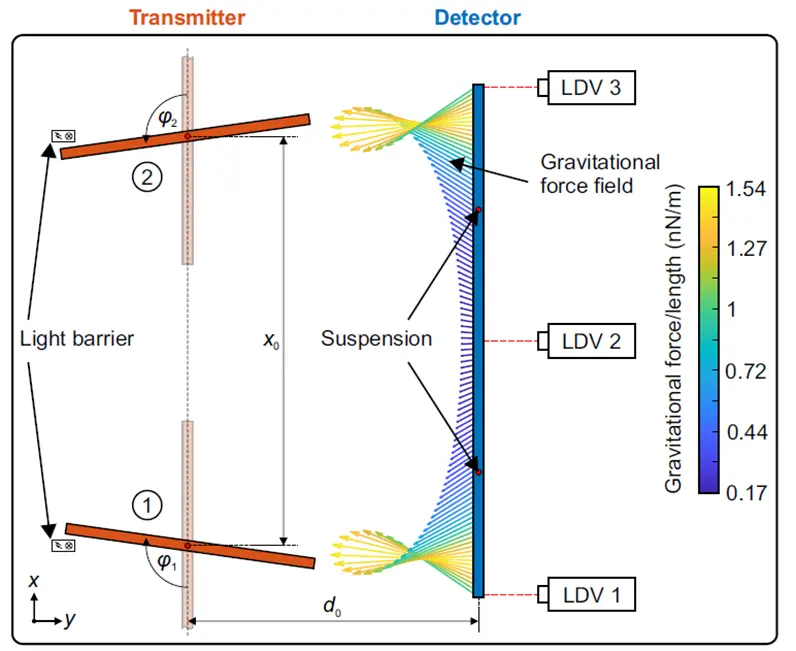
Fig. 3: Illustration of the measurement principle. Sketch of the measurement setup using two rotating bars (orange) and one detector beam (blue), suspended in the nodal points of the first bending mode. The rotating bars create a dynamic gravitational force field on the detector that is illustrated by the colored arrows (numerical solution for d0 =300 mm, φ1,2 = 98°). The vibration of the detector is measured optically by three laser Doppler vibrometers (LDV), the measurement position is indicated by the red dashed lines. The colorbar illustrates the gravitational force density of the dynamic force field in the xy-plane in nN/m. (Picture: https://www.nature.com/articles/s42005-023-01389-5/figures/1) Result: G = 6.6816 × 10⁻¹¹m3kg−1s−2, with a combined standard uncertainty of about 1.46%. The estimation is about 0.1% higher than the CODATA 2018 value This new method demonstrates: Even in a laboratory with macroscopic test bodies and at experimentally accessible frequencies (several hertz), it is possible to dynamically and interferometrically measure gravity and use it for resonance experiments—a true first in fundamental physics.

Result: G = 6.6816 × 10⁻¹¹m3kg−1s−2, with a combined standard uncertainty of about 1.46%. The estimation is about 0.1% higher than the CODATA 2018 value

This new method demonstrates: Even in a laboratory with macroscopic test bodies and at experimentally accessible frequencies (several hertz), it is possible to dynamically and interferometrically measure gravity and use it for resonance experiments—a true first in fundamental physics.

The Role of Laser Measurement Technology

None of these pioneering measurements would be possible without optical interferometry—in particular, the use of laser vibrometers. The sensitivity they offer reaches deep into the sub-nanometer range, enabling real-time detection of the tiniest amplitudes. Interferometry also allows for pinpoint rejection of unwanted signals, compensation for environmental effects, and automated data preparation.

The remaining technical challenges involve integrating additional environmental parameters and further minimizing residual noise. The ETH experiments impressively demonstrate that, for today’s precision and difference measurements, laser-based methods far outperform classical sensors.

Consequences and Outlook

Both experimental approaches push the boundaries of what is possible for direct laboratory measurement of the gravitational constant. They deliver robust data on the force that shapes stars, planets, and galaxies—and pave the way for even more precise gravitational sensors, geophysical applications, or even indirect gravitational wave detection.

For fundamental research, it is exciting to see what progress may come from even more advanced laser technology and data analysis methods. Soon, researchers may be able to significantly reduce the current uncertainties of G, or even find hints of new physics beyond the classical Newtonian model.

One thing is certain: Thanks to a blend of clever experimentation and laser measurement precision, we can now observe what was once considered unmeasurable. The quiet trembling of gravity becomes a loud message to the scientific community.

References: Brack T, Zybach B, Balabdaoui F, et al. Dynamic measurement of gravitational coupling between resonating beams in the hertz regime. Nature Physics, 2022, doi: 10.1038/s41567-022-01642-8 Brack T, Fankhauser J, Zybach B, et al. Dynamic gravitational excitation of structural resonances in the hertz regime using two rotating bars. Communications Physics, 2023, doi: 10.1038/s42005-023-01389-5 Copright Notice: Figures 2 and 3 are published under the terms of the Creative Commons CC BY license according to statement of the CCC – Copyright Clearance Center

Our Authors

Jürg Dual
Emeritierter Professor am Departement Maschinenbau und Verfahrenstechnik
dual@imes.mavt.ethz.ch
Dr. Heinrich Steger
Manager Strategic Product Marketing Business Unit Vibrometry , Polytec GmbH, Germany
info@polytec.de

Related Articles

如何测量非洲象群间的低频通讯。

最近发表在《欧洲物理杂志专题》(European Physical Journal Special Topics)上的一项研究介绍了激光多普勒测振仪(LDV)的一项开创性应用,以更好地理解非洲象的发声及其行为含义。这项研究的主要目的是确定大象群体中声音交流的动态,特别关注一种被称为“我们出发吧”的的特定隆隆声。这些隆隆声序列在协调大象群体的运动、空间关系和加强社会联系方面起着至关重要的作用。

4 min

庆祝干荣珠教授出色的职业生涯

我们有幸于2022年7月26日远程采访了干荣珠教授。在她所在的科研领域里,她的声名如雷贯耳。她是俄克拉何马大学机械工程系的首席教授,已在该大学工作了25年,更重要的是,她是人耳力学领域的先驱之一。她做过中耳,内耳的有限元建模、植入式装置、组织生物力学等等。

3 min

非接触式观察心脏颤动,相当于用八倍镜观察,虽远,但纤毫毕现

心脏和循环系统疾病是人类最常见的致死病因——甚至比癌症还要严重!因此,我们要非常重视心脏的健康。那么该如何重视呢?我们知道,当医生使用心电图(ECG)测试心脏功能时,会观察脉搏上升曲线图。

6 min

Non-contact alternative to dynamic and viscoelastic mechanical testing in cartilage

Osteoarthritis, a degenerative disease in the joint, is a condition that is afflicting approximately 14% of adults. Understanding the dynamics of the joint cartilage is crucial for research and for finding…

6 min

Manipulation of complex fluids with SAW-based acoustofluidics

Surface acoustic wave (SAW)-based acoustofluidics combines microfluidics with active microacoustic fields. This allows to realize numerous Lab-on-a-Chip operations, reaching from fluid manipulation includi…

3 min

关于昆虫听觉与激光测振技术的温德米尔博士访谈

来自格拉斯哥斯特拉斯克莱德大学的温德米尔博士致力于研究昆虫的听觉。我们就其研究内容及Polytec激光测振仪在其中所扮演的角色,与他展开了交流。

3 min

使用采用 EMS 压电无痛技术的超声波洁牙器,呵护健康牙齿

瑞士E.M.S.公司生产的超声波洁牙器,采用Piezon无痛技术,可有效帮助客户保持牙齿健康。为了尽可能地维持牙齿的健康,防止龋齿和牙周感染,家庭护理方法如刷牙和使用牙线是非常重要的。不过仅靠这些是不够的,因为即使这些家庭护理操作得当,口腔内仍会产生菌斑,它是龋齿、牙周病和种植体周围疾病的主要致病因素。

5 min

蛛网的实地阻尼测试

蛛网的编织形式巧夺天工,具有非常独特的建筑学、力学和动力学性能,真可谓是自然界的奇迹!蛛网常见的结构,即由一个中心伸出的若干呈放射状的骨架丝线-纵丝和围绕这个中心的螺旋丝线-横丝构成的网状结构。蛛网需要抵抗风致振动及飞行猎物的高能冲击。为预测一个完整蛛网结构的振动阻尼响应,我们在蛛网形成地点-丛林实地,测试其组成丝线的阻尼特性。

4 min

人耳听小骨的振动研究

人类的中耳将由声波所引起的鼓膜振动通过听小骨传输至内耳。在接近听觉阈值时,鼓膜所产生的三维振动位移仅有几个纳米,因此,研究人员需要使用非常精准的非接触检测设备来测试这类振动。

3 min

Laser vibrometry is the key

叶缘焦枯病菌(xylella fastidiosa)会在农作物中会引起多种严重病害,这种植物病原体是加州和南美的葡萄树产生致命疾病的罪魁祸首,仅加州每年需为此耗资1.04亿美元。在一个专门的研究项目中,不同于现有的使用农药来消灭害虫的方法,科学家们找到了一种对生态系统无不良影响的方法-利用激光振动测量技术来分析昆虫们求偶时的通讯方式,从而采取手段来控制害虫繁衍。这为自2013年以来惨遭叶缘焦枯病菌肆虐的欧洲…

5 min

论振动在蜜蜂觅偶过程中的作用

在动物界,由雌性来决定交配权的现象很普遍。本文旨在研究雄蜂的振动是否是雌蜂选择交配对象的影响因素之一,我们使用德国Polytec公司的激光测振仪研究雄蜂在交配期间的振动,期待揭示更多蜂群使用胸腔振动来进行内部交流的秘密。

5 min
Load more