Back
Biology & medical

Gravity in the Lab

How Laser Interferometry Takes Aim at the Weakest Force of Nature

From Early Pendulum Experiments to Cutting-Edge Vibration Technology

The gravitational constant G is among the core pillars of physics. While the speed of light and the elementary charge are known with extraordinary precision, the exact value of G remains surprisingly uncertain even today—almost 350 years after Newton. Not surprisingly: Gravity is orders of magnitude weaker than any other fundamental force. Anyone wanting to measure G needs an experimental setup capable of the seemingly impossible—detecting movements smaller than the diameter of an atom, triggered by pure “action at a distance.”

The team around Jürg Dual at ETH Zurich has been taking on this challenge for years, using state-of-the-art laser measurement technology and ingenious experimental designs to set international benchmarks.

The First Step: Vibrating Beams as "Gravity Transmitters"

In a 2022 experiment, the team drew on a classic trick from vibration physics: resonance makes even very weak excitations measurable. In a spectacularly well-isolated laboratory deep in a Swiss mountain fortress, two metal beams about 1 meter long were mounted each within a vacuum chamber. One beam is set into precise vibration, “broadcasting” gravitational signals that act on the other, resonance-tuned beam in the adjacent chamber. The forces transmitted are minuscule—in the picometer range (a billionth of a millimeter)!

This is where laser interferometry comes in: Four highly precise laser vibrometers together with lock-in-amplifiers measured the tiniest trembling of the detector beam, filtering out noise and isolating true signals. The result: a value for G that is only slightly above the international reference—acquired with cutting-edge error analysis and clear potential for further refinement.

Strikingly, this dynamic method minimizes classical pitfalls, such as the influence of surrounding masses. For the first time, gravity’s effect can be directly examined not just “at rest” but in motion.

The Update: Rotating Bars as a Source of Oscillation (2023)

ETH Zurich did not stop there. In their most recent, 2023 study, the group took things a step further: Instead of linearly vibrating beams, the researchers used two slim, 0.5 m long, rotating tungsten rods arranged symmetrically opposite a bending beam resonance detector.

Through synchronized rotation, they generated a dynamic gravitational field that acted on the mechanically decoupled resonance detector beam. Once again: vacuum, meticulous isolation, and the utmost suppression of non-gravitational influences.
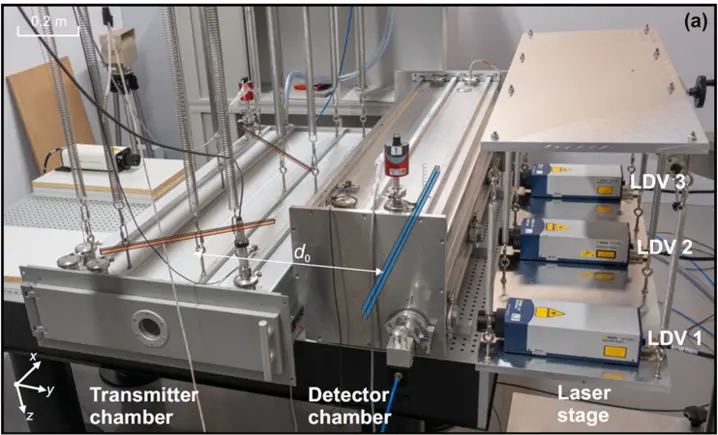
Fig. 2: Photo of the setup: The rotating transmitter bars (red drawing) are located inside the transmitter chamber. The chamber itself is hanging from springs attached to a carrier bar movable in y-direction. Inside the detector chamber the detector beam (blue) is hanging on rubber wires attached at the nodal points of the first bending mode. The detector chamber is fixed to an anti-vibration table, isolating the beam from the environment, and minimizing transmission of non-gravitational forces. The detector movement is measured using three laser Doppler vibrometers (LDV), positioned on a separate stage, likewise isolated via springs. The distance d0 is varied by moving the transmitter chamber. The whole setup is located in an underground laboratory, providing excellent temperature stability and minimal seismic noise. (Picture: https://www.nature.com/articles/s42005-023-01389-5/figures/3 a)

Again, state-of-the-art laser interferometry was used to measure the slight displacements of the resonator. The key: For maximum excitation of the detector bar, the rotation frequency of the excitation bars is precisely tuned to half or a quarter of the natural resonance frequency of the detector. If all parameters—rotational speed, alignment, temperature—fit perfectly, so does the measurement: The detector vibrates in remarkable agreement with predictions from classical gravity. The team systematically verified that no other interference could explain the effect—proving the genuinely gravitational origin of the observed signal.
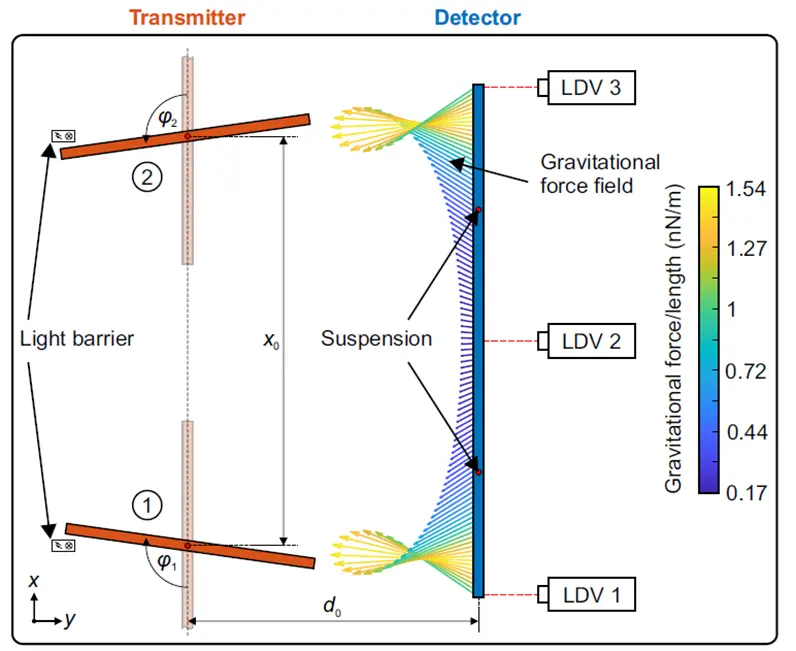
Fig. 3: Illustration of the measurement principle. Sketch of the measurement setup using two rotating bars (orange) and one detector beam (blue), suspended in the nodal points of the first bending mode. The rotating bars create a dynamic gravitational force field on the detector that is illustrated by the colored arrows (numerical solution for d0 =300 mm, φ1,2 = 98°). The vibration of the detector is measured optically by three laser Doppler vibrometers (LDV), the measurement position is indicated by the red dashed lines. The colorbar illustrates the gravitational force density of the dynamic force field in the xy-plane in nN/m. (Picture: https://www.nature.com/articles/s42005-023-01389-5/figures/1) Result: G = 6.6816 × 10⁻¹¹m3kg−1s−2, with a combined standard uncertainty of about 1.46%. The estimation is about 0.1% higher than the CODATA 2018 value This new method demonstrates: Even in a laboratory with macroscopic test bodies and at experimentally accessible frequencies (several hertz), it is possible to dynamically and interferometrically measure gravity and use it for resonance experiments—a true first in fundamental physics.

Result: G = 6.6816 × 10⁻¹¹m3kg−1s−2, with a combined standard uncertainty of about 1.46%. The estimation is about 0.1% higher than the CODATA 2018 value

This new method demonstrates: Even in a laboratory with macroscopic test bodies and at experimentally accessible frequencies (several hertz), it is possible to dynamically and interferometrically measure gravity and use it for resonance experiments—a true first in fundamental physics.

The Role of Laser Measurement Technology

None of these pioneering measurements would be possible without optical interferometry—in particular, the use of laser vibrometers. The sensitivity they offer reaches deep into the sub-nanometer range, enabling real-time detection of the tiniest amplitudes. Interferometry also allows for pinpoint rejection of unwanted signals, compensation for environmental effects, and automated data preparation.

The remaining technical challenges involve integrating additional environmental parameters and further minimizing residual noise. The ETH experiments impressively demonstrate that, for today’s precision and difference measurements, laser-based methods far outperform classical sensors.

Consequences and Outlook

Both experimental approaches push the boundaries of what is possible for direct laboratory measurement of the gravitational constant. They deliver robust data on the force that shapes stars, planets, and galaxies—and pave the way for even more precise gravitational sensors, geophysical applications, or even indirect gravitational wave detection.

For fundamental research, it is exciting to see what progress may come from even more advanced laser technology and data analysis methods. Soon, researchers may be able to significantly reduce the current uncertainties of G, or even find hints of new physics beyond the classical Newtonian model.

One thing is certain: Thanks to a blend of clever experimentation and laser measurement precision, we can now observe what was once considered unmeasurable. The quiet trembling of gravity becomes a loud message to the scientific community.

References: Brack T, Zybach B, Balabdaoui F, et al. Dynamic measurement of gravitational coupling between resonating beams in the hertz regime. Nature Physics, 2022, doi: 10.1038/s41567-022-01642-8 Brack T, Fankhauser J, Zybach B, et al. Dynamic gravitational excitation of structural resonances in the hertz regime using two rotating bars. Communications Physics, 2023, doi: 10.1038/s42005-023-01389-5 Copright Notice: Figures 2 and 3 are published under the terms of the Creative Commons CC BY license according to statement of the CCC – Copyright Clearance Center

Our Authors

Jürg Dual
Emeritierter Professor am Departement Maschinenbau und Verfahrenstechnik
dual@imes.mavt.ethz.ch
Dr. Heinrich Steger
Manager Strategic Product Marketing Business Unit Vibrometry , Polytec GmbH, Germany
info@polytec.de

Related Articles

How to measure low-frequency acoustic communication of African elephants

A recent study published in the European Physical Journal Special Topics introduces a pioneering application of laser Doppler vibrometry (LDV) to better comprehend African elephant vocalizations and their …

4 min

Celebrating the iconic career of Professor Rong Z. Gan

We had a chance to virtually sit down for an interview with Prof. Rong Zhu Gan. In her field, she is one of those personalities that needs no introduction. For the uninitiated, she is the George Lynn Cross…

3 min

Observing cardiac fibrillation from a distance and yet close

Diseases of the heart and circulation are the most common cause of death - even before cancer! So we should pay a lot of attention to the health of the heart. But how? Everyone knows the rise of pulse when…

6 min

Non-contact alternative to dynamic and viscoelastic mechanical testing in cartilage

Osteoarthritis, a degenerative disease in the joint, is a condition that is afflicting approximately 14% of adults. Understanding the dynamics of the joint cartilage is crucial for research and for finding…

6 min

Manipulation of complex fluids with SAW-based acoustofluidics

Surface acoustic wave (SAW)-based acoustofluidics combines microfluidics with active microacoustic fields. This allows to realize numerous Lab-on-a-Chip operations, reaching from fluid manipulation includi…

3 min

Interview with Dr. Windmill about hearing of insects and laser vibrometry

Dr. Windmill from the University of Strathclyde in Glasgow examines the hearing of insects. We talked to him about his research and the role that Polytec‘s optical vibrometers play there.

3 min

Keep healthy teeth with ultrasonic scaler using EMS Piezon NO-PAIN technology

In order to keep your natural teeth as long as possible and to prevent caries and periodontal infections, home-care methods like brushing your teeth and flossing are essential. Unfortunately, these alone a…

5 min

In situ damping measurements of spider webs

Spider webs are naturally occurring structures with amazing and very distinctive architecture, mechanics and dynamics. To predict the vibration damping response of a complete spider web structure, the damp…

4 min

Investigating vibrations of the human auditory ossicles

The human middle ear transfers acoustically-induced vibrations of the eardrum through the ossicles to the inner ear. Near the auditory threshold, the resulting three-dimensional vibrational patterns have d…

3 min

Laser vibrometry is the key

The bacterium Xylella fastidiosa causes various serious diseases in a large number of crop plants. Among other things, the plant pathogen is responsible for a devastating disease in grape vines in Californ…

5 min

The role of vibrations in finding a mating partner in bees

In nature, females are often the choosy sex when it comes to finding a mating partner. In the red mason bee, Osmia bicornis, all the prerequisites for so-called female choice are given and we therefore inv…

5 min
Load More