The bacterium Xylella fastidiosa causes various serious diseases in a large number of crop plants. Among other things, the plant pathogen is responsible for a devastating disease in grape vines in California and South America, which costs the Californian economy alone around 104 million USD every year.
In a unique research project, scientists analyzed the courtship communication of insects with the aid of optical laser vibration measurement – and found a new method of control that has no adverse affects on the ecosystem, unlike existing measures such as the use of pesticides. This creates hope and optimism for farmers in Europe, where the bacterium has been spreading since 2013.
The team of researchers at the United States Department of Agriculture (USDA) headed by entomologist Rodrigo Krugner has declared war on the Xylella fastidiosa bacterium in Californian vineyards. The bacterium causes severe plant diseases, such as olive quick decline syndrome in Italy or citrus canker in Brazil. The grape vines in the USA and South America suffer from Pierce’s disease, which blocks the supply of water and nutrients inside the plants. The plants then die completely within three years. The research team identified 13 insect species as vectors, i.e. carriers, including the glassy-winged sharpshooter (GWSS), a small cicada species measuring approximately 1 cm.
The GWSS is a particularly dangerous vector, since it can fly long distances and the bacterium spreads in the surrounding areas extremely quickly. Pesticides have been used to contain the GWSS population for over 25 years. However, the recently increasing tolerance of the leafhoppers to the sprayed pesticides has forced researchers to explore new methods.
Laser vibrometers in entomology
The GWSS has a complex communication system. It generates sounds by vibrating its body, thereby transmitting vibrations through the plants. The insects perceive the signals of others of its kind via sensory organs in the legs. The insects also communicate via vibrations transmitted through plants when searching for a mate.
“These are frequencies and vibrations transmitted to the plant that we cannot hear without specialized equipment”
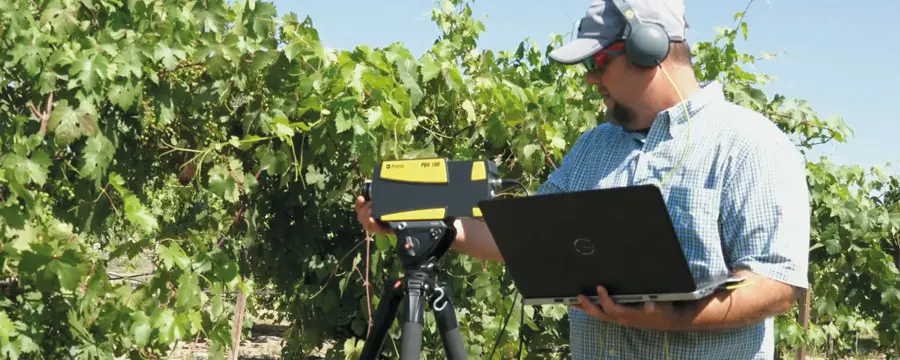
The idea of the research team was to first decipher these frequencies and vibrations, in order to find an approach to prevent or disrupt them: “The approach is to disrupt communication of the insect. The first step is to identify and describe their mating calls. We also look for weak links in their communication system. These are the places we are going to try to interfere with”, says Krugner. The researchers used a portable laser vibration sensor from Polytec to acquire and analyze the frequencies.
Mobile vibration measurement for laboratory and field studies
The stand-off distance of the compact vibrometer can be varied from 0.4 to more than 20 meters, and the power consumption is low, which makes it particularly useful for biological sampling – for laboratory analyses and for field tests directly in the vineyards. The current version of the portable, self-contained laser vibrometer optically measures the vibrational velocities of objects in the frequency range from DC to 100 kHz and therefore without contact.
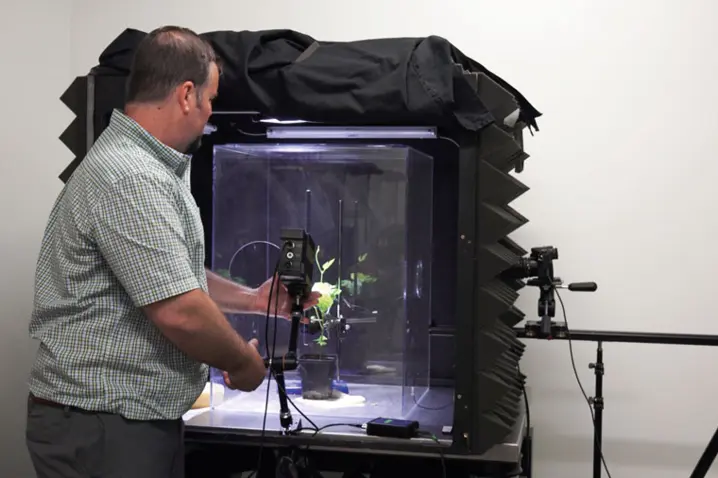
The housing is hermetically sealed, and the construction is robust and lightweight. It is explicitly designed for vibration measurements that require portability. The portable vibrometer can optionally run battery-powered, has an innovative interface concept and is compatible with common data acquisition systems: It is the ideal tool for non-contact inspection of machines as well as for studying biological samples. It can be used in the presence of strong electromagnetic fields or in other danger areas, as well as for research in remote areas such as forests and wilderness.
The researchers succeeded in acquiring the duration and spectral parameters of the various sounds and managed to analyze and allocate them to the individual courtship participants. They identified the vibration frequencies of the calling female, the courting male and the signals of rivals in the courtship communication. The behavioral and signal analysis enabled the researchers to isolate what they called “candidate disrupting signals”, which disrupted the courtship communication of the actual pair, thereby preventing mating. The team ensonified the insects with the recorded disrupting signals, in order to inhibit mating.
Results and future projects
The method is already showing promising results in the laboratory: Of 134 GWSS pairs, 28 pairs mated in the control group that was not ensonified. Of the 134 pairs that were ensonified with the disrupting signals, only one pair mated. The new method has also proved its worth in the field, as Kruger summarizes: “We took the playback sounds out into the field and were able to disrupt mating of virgin insects in vineyards.”
The method can be combined with existing measures such as the area-wide application of insecticides or the mass distribution of natural enemies of the pests. In contrast to the use of toxic spray or exotic predators, ensonification only combats one specific species and has no impact on the native beneficial insects. The communication frequencies of the GWSS are also specific to the cicada species.
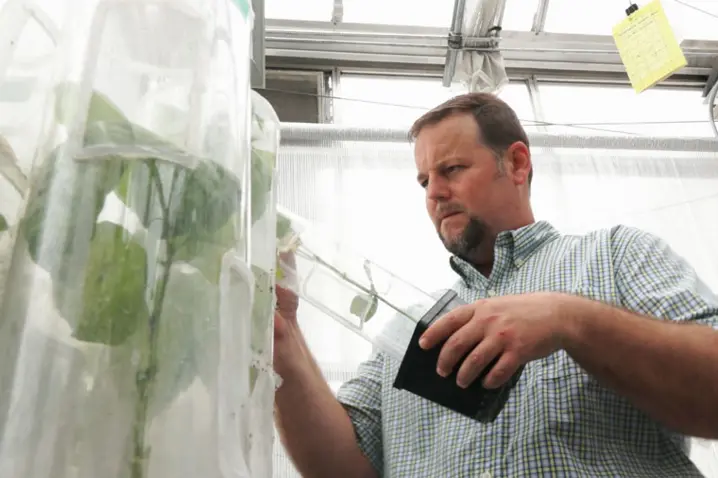
The innovative and environmentally friendly approach and the existing data give grounds for optimism that the USDA has been able to develop a method with a high potential for success, in order to contain more than just the GWSS population. The task now is to determine further and more comprehensive data and to optimize ensonification at the vine espaliers. The further away the signal source, the lower the frequencies and the lower the disruptive effect on the insects. The research team also plans to analyze other vectors of Xylella fastidiosa and other plant diseases with the aid of optical vibration measurement.