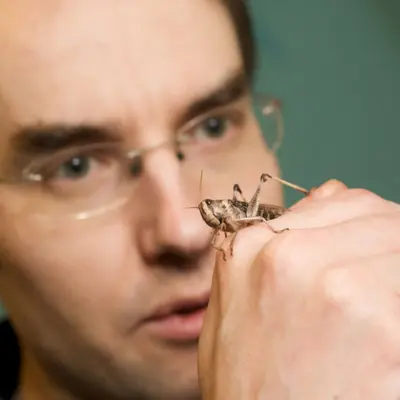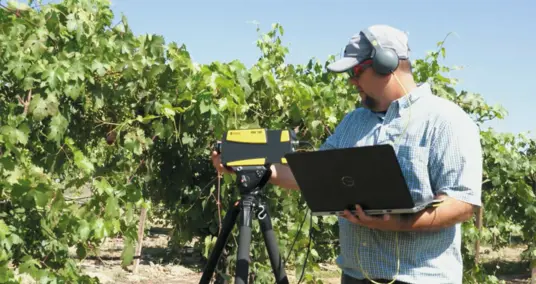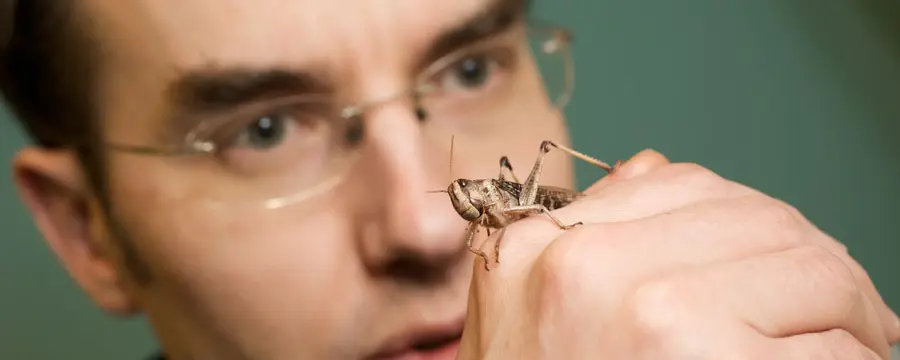
Dr. Windmill from the University of Strathclyde in Glasgow examines the hearing of insects. We talked to him about his research and the role that Polytec‘s optical vibrometers play there.
Dr. Windmill, you are working on bionic technologies, can you please explain your current research interests and activities?
Our current research interest is to learn from how biological systems sense (and create) sound. We then take this fundamental research as inspiration to create new engineered acoustic systems. This includes different application areas. The primary one at this time is to create new miniature microphone devices, inspired by insect hearing.
These microphones are aimed at mobile phone and hearing aid industries as a couple of examples. Insect ears have a variety of useful properties that we can learn from. These include a much greater sensitivity for their small size than any human engineered device. Further to that, they have interesting mechanisms for other functions, the main example here is directionality – creating a directional microphone that is far smaller than the wavelengths of the sound we are interested in analyzing. But we are also working on ultrasonic systems inspired by nature for non-destructive testing.
What role does advanced vibration measurement play in your research and can you please describe a typical application?
Many different insects hear sounds. Hearing has evolved independently 19 times in insects. Many have a tympanal ear (so a membrane like an eardrum) to detect sound. We are interested in the vibrational response of that structure. Biological systems are not linear, or homogeneous, so we need to use scanning laser vibrometry to analyze how the insect’s ‘eardrum’ responds to sounds. Now we have the MSA-100-3D, we have started to do analysis of how the ear membrane moves in 3 dimensions.
Why do you use a Polytec MSA-100-3D Micro System Analyzer? What advantages and benefits do you see?
Insect hearing organs and the miniature microphones that we are creating inspired by the ears, are typically less than 1 mm in diameter. The eardrum will move a few nanometers in response to normal sounds, and insects can detect sounds that cause sub-nanometer vibration in the membrane.
As complex, three dimensional, structures, we believed that the eardrum membranes do not simply move out of plane, but have complex motion in 3 dimensions. Therefore, the MSA-100-3D allows us to measure these small structures as they move in 3 dimensions in response to sound.
What is your experience with individual support from Polytec?
This has been excellent. Polytec's employees have always provided direct support to me, both from the UK and Germany. They have helped on every level, from technical questions about their systems and application problems. Support in specifying new systems for new applications is great. And they continue this level when it comes to setting up and using new installations. They have also always been helpful in support for our older Polytec equipment.
What do you expect for the future?
In my own research laboratory I believe that the capability that we now have with the new Polytec MSA-100-3D will open many more interesting research and engineering questions. We now have the capability to measure small devices moving in three dimensions. We will spend the next few years analyzing and understanding what we can now measure.
Polytec has shown over the past years that it is a leader in the development of vibrational measurement technology. I believe that this will continue, and look forward to seeing where their research and development in this area takes the rest of us.
Dr. Windmill, we thank you for this interview and wish you the very best for your future.