We had a chance to virtually sit down (July 26, 2022) for an interview with Prof. Rong Zhu Gan. In her field, she is one of those personalities that needs no introduction. For the uninitiated, she is the George Lynn Cross Research Professor, Presidential Research Professor, Charles E. Foster Chair, and Prof. of Biomedical and Mechanical Engineering, School of Aerospace & Mechanical Engineering at The University of Oklahoma and has been there for 25 years. More importantly, she is one of the pioneers in the field of ear mechanics. She has done it all – middle ear, inner ear, FE modeling, implantable devices, tissue biomechanics, and a lot more.
In this interview, we want to expand on her many achievements and dig into different facets of her personality. The questions below were chosen to explore not only her technical prowess but also her life, motivation and vision moving forward. The article is divided into two sections: The interview is certainly center stage for this piece. There is an extended version of the interview available for download including a “short” list of publications that displays in all its glory the broad-spectrum of Prof. Gan’s contributions in many fields. It is an absolute pleasure and a privilege for Polytec to be associated with a stalwart personality that is Prof. Gan. Click here for her full biography.
How did you decide to go into hearing research?
My career in biomedical engineering, particularly in biomechanics, began in 1978 when the higher education and graduate program resumed in China. I passed the entrance exam and came back to Huazhong University of Science and Technology (HUST) to study Mechanics and then transferred to Biomechanics introduced by Prof. Y.C. Fung, the Father of Modern Biomechanics, when he visited HUST. From 1978 to 1995, I completed the MS and PhD studies and the Postdoc training which were all in the field of cardiopulmonary system and blood flow.
In 1995, at the Biomedical Engineering Society spring meeting, Hough Ear Institute in Oklahoma City posted a position for Director of Engineering to develop the implantable hearing device. When I met Dr. Ken Dommer, who was the Research Director at Hough Ear Institute and Professor of Physiology at University of Oklahoma Health Sciences Center at the conference, I was impressed by the implantable hearing device research because the middle ear consisting of ossicular bones, soft tissues, and joints for sound transmission is a perfect mechanical structure/system.
Research on middle ear fits well with my background in biomechanics and my 10-year industry work experience in China would be suitable for device design and manufacturing process. I also believed that hearing research is more related to solving human health problem than the basic research in lung biomechanics I was working on. Therefore, I made the decision of changing my major research direction to hearing.
My first project was to complete the design and functional tests of the middle ear implantable hearing device which is an electro-magnetic hearing device with the magnet implanted at the middle ear ossicular chain and the coil placed inside the ear mold in the ear canal, called Direct Drive Hearing System (DDHS).
I would like to state that without the laser vibrometry we would not have today’s biomechanical research for auditory system."
What role has vibrometry played for you and for the field in general?
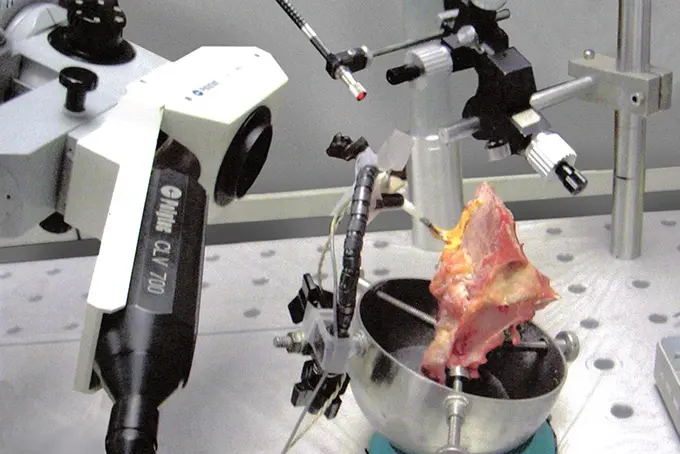
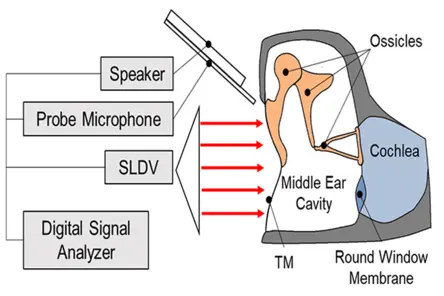
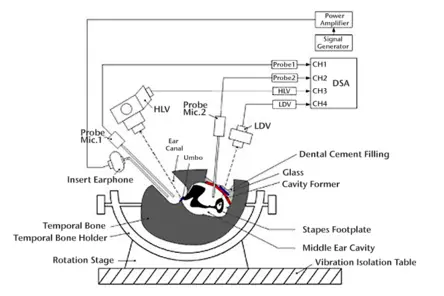
The Hough Ear Institute is one of the first institutes to use Polytec laser Doppler vibrometer (LDV) for research in human ears or temporal bones. I led the research team at the institute to setup the experiment with LDV in human temporal bones to test the DDHS by measuring vibrations of the eardrum or tympanic membrane and middle ear ossicles (e.g., stapes footplate). The hearing device is designed to increase stapes footplate movement using coupled electromagnetic drive was characterized. Laser vibrometry has played a critical role for completing the measurements on DDHS function.
With all the LDV data, we submitted IDE (investigational device exemption) application to the U.S Food & Drug Administration (FDA) and finally Soundtec DDHS was approved by the FDA in 2001 as the 1st middle ear implantable device in the US market. Furthermore, 4 journal articles were published through the device development including the LDV measurement, mass loading on ossicles and middle ear function, biomaterials, and clinical trial.
The laser vibrometry technology involved in the implantable hearing device research for hearing health is one example of using Polytec LDV in my research projects since 1995. After joining The University of Oklahoma faculty in 1999, the LDV has been used in all my projects with the publications listed in this article. The 27 years of my research experiences since 1995 have demonstrated that laser vibrometry is the leading research technique in hearing research field in all aspects.I would like to state that without the laser vibrometry we would not have today’s biomechanical research for auditory system.
What do you think is the future of hearing research?
I think the future of hearing research should be focusing more on protection and restoration of hearing through the translational research from animal model to human and development of therapeutics for hearing restoration including hearing protection devices (e.g., earplugs) and implantable devices (e.g., middle ear reconstruction, cochlea implant, central hearing system implant).
Here are some important research areas:
- Computational modeling for predicting structure-function relationship
- Animal studies for direct connection to hearing
- Therapeutics for hearing restoration
- Implants or implantable devices for hearing restoration
With regards to the technological development, LDV and imaging technologies will provide major technical tools supporting both research and clinics.
If you could award significant funds for hearing research, which areas do you think would make a difference in the lives of people?
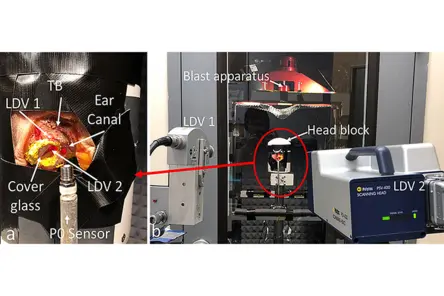
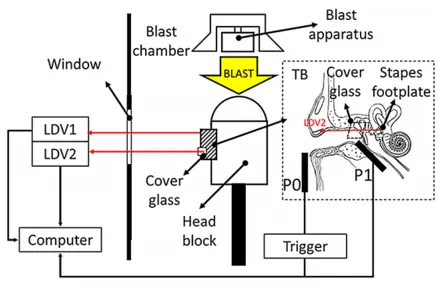
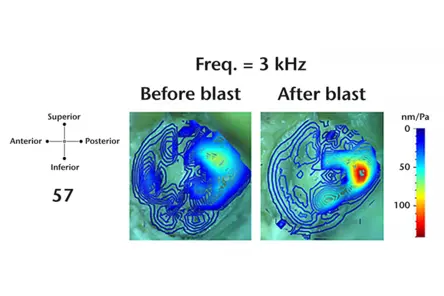
My research work in last 10 years has been in high intensity sound or blast induced hearing loss and protection mechanisms using the experimental approach in human temporal bones and animals and the 3D computational model of human and animal ears. If I could award significant funds for hearing research, I would like to continue this direction because it has more challenges than the normal sound induced hearing loss and would make a difference in the lives of veterans.
There are two areas I am interested in: On one hand providing quantitative descriptions of auditory injuries after repetitive exposure to blast (or high intensity sound) in relation to the blast intensity, number of exposures, frequency of occurrence, and post-exposure progression time and on the other hand, determining the protective mechanisms of hearing protection devices in the central and peripheral auditory system in response to repetitive blast. To our knowledge this state-of-the-art approach has not been experimentally applied to evaluating the biomechanical and neurophysiological bases for auditory blast injuries.
In order to demonstrate that our 3D multi-scale FE model of the human ear can be extended to
simulate the blast damage, we correlate the outputs of the FE model of the ear to the auditory brainstem and cortex with an association to traumatic brain injury (TBI)-induced damage of the central auditory system.
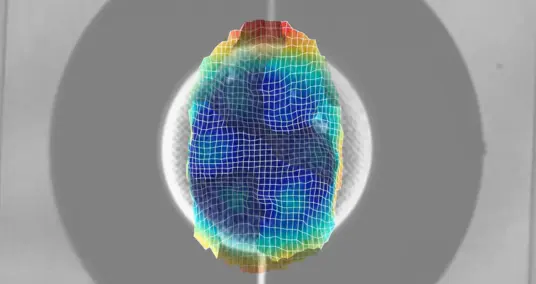
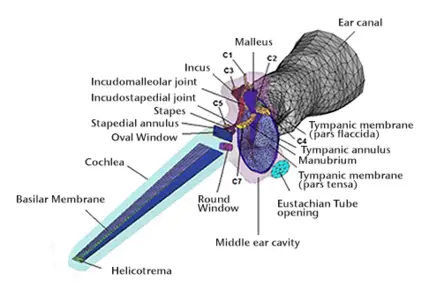
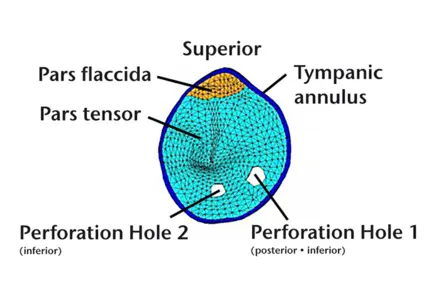
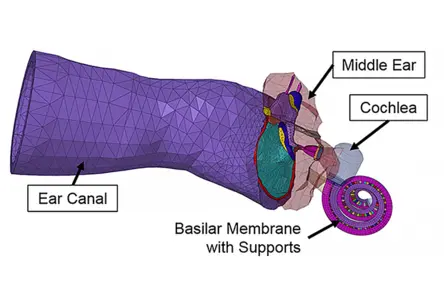
This image section shows the 3D finite element (FE) model of the human ear with the 2-chamber straight cochlea for simulation of tympanic membrane (TM) perforation and the effect tympanic membrane perforation on stapes movement. The model was validated with LDV measurements in human temporal bones (TB).
What advice will you give a young researcher?
My advice for young researchers is to seek innovation, collaboration, and publish the work on time. To be successful in research career, you must always stay motivated and work hard.
As I mentioned earlier, my doctoral research and postdoctoral training were all in blood flow and biomechanics of soft tissues (e.g., blood vessels), especially in lungs before I joined Hough Ear Institute. The success for such a huge change of research field is due to my strong background in biomechanics and mechanical engineering. As a young researcher, particularly working in interdisciplinary areas (e.g., biomedical engineering), you must have 100% confidence in your original trained area but spend most of your time working on a new direction because there must be innovation to solve the problem.
What are the plans after retirement?
I may not be able to immediately stop certain professional activities such as reviewing research grants and attending some meetings after retirement. However, I will gradually move to another type of life: no scheduled school activities, no every Friday 5 pm lab meetings, etc.
One plan after retirement is to write a book-autobiography about my life and family. I want my experiences and my father’s history to pass to the young generation. I would also like to travel with my daughter’s family and grandkids.
For Prof. Gan’s technical achievements, which span several decades, we recommend watching her webinar hosted by Columbia University and organized by World Association for Chinese Biomedical Engineers.