In nature, females are often the choosy sex when it comes to finding a mating partner. In the red mason bee, Osmia bicornis, all the prerequisites for so-called female choice are given and we therefore investigated if the males’ vibrations are one of the criteria a female might use to choose a mating partner. We investigated these vibrations using a laser vibrometer aimed at the male during their mating behavior. Females showed a preference for male precopulatory vibrations that were significantly longer with shorter breaks in between. Vibrations may indicate strength and assure that males selected by females are active and healthy.
Female choice of a mating partner is widespread in the animal kingdom. Theory suggests that if one sex invests significantly more heavily in offspring, this sex will try to maximize its reproductive fitness by choosing the best possible mate. Females typically invest more heavily than males in offspring, and they use a variety of male traits such as color, size, mating song or scent to evaluate the quality of a male before accepting it for mating.
In diverse groups of bees (bumble bees, stingless bees and honeybees), thoracic vibrations are used in recruitment communication, in pollen collection and in defense. However, little research has been done on the function of vibration signals in bee mating behavior, although several species are known to emit them while mating. In bees, vibrations are generated by contracting the wing muscles while the wings are kept still. Increasing muscle contraction leads to an increased stiffening of the thorax and thus to higher frequencies.
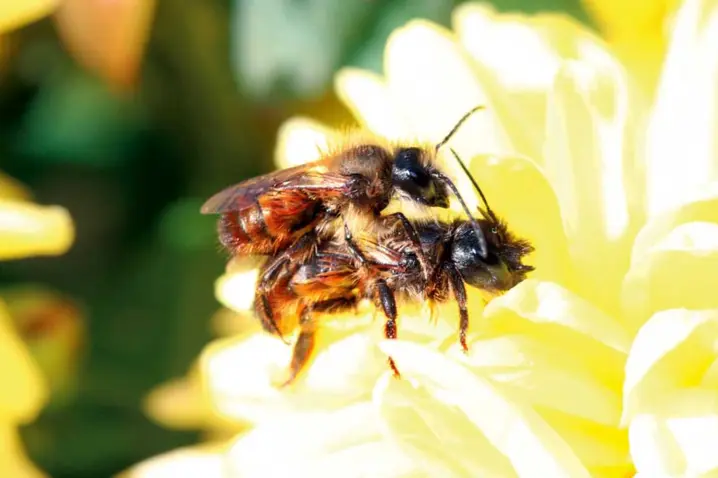
The red mason bee, Osmia bicornis, is a widespread solitary bee of Central and Northern Europe. During precopulatory courtship the male embraces the female by standing on her back and engaging in a series of behaviors in order to persuade the female to mate. The male may vibrate his thorax, rub himself against the female, pass his antennae repeatedly over those of the female and his forelegs over the female’s compound eyes. During this courtship, the female may reject the male by physically pushing him off her back, yet which of the male cues a female uses in mate selection is still not known.
Here we analyzed if male vibrations are signals by which a female Osmia bicornis may select a male that has engaged in a pre-copulatory embrace with her.
Methods and materials
We used Osmia bicornis reared at the University of Ulm in trap nests comprising a wooden box, on the roof of the university building. Vibrations were recorded during daylight. Male and female bees used for the recordings had emerged in separate flight cages at room temperature. In order to obtain mating pairs, one female at a time was introduced into a flight cage with about 40 males that originated from numerous trap nests.
Once a mating pair had become established in pre-copulatory embrace (one male sitting on a female and the other males retreating), the pair was taken out of the flight cage and put in a plastic box (40 x 20 x 10 cm).
The thoracic vibrations produced by males during the precopulatory phase were recorded with a portable laser vibrometer connected to a laptop computer using a 32-bit sound card and Soundforge 8.0 software at a sampling rate of 44.1 kHz. The files were later analyzed using Avisoft SasLab Pro. All males had been marked with a white spot on their thorax to enhance the reflection of the laser beam. We recorded and compared the vibrations of males that were either accepted (allowed by the female to copulate) or rejected by the female. Females occasionally moved during the recordings and the angle between the laser and the bees changed. Hence we were unable to compare the amplitude of the male signal.
Results
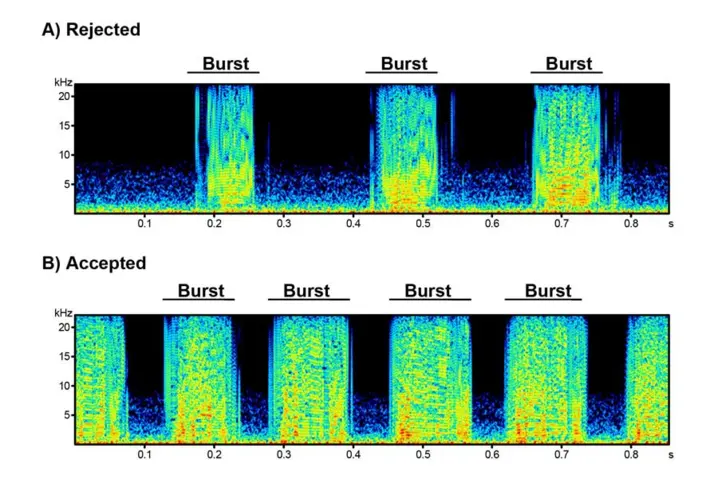
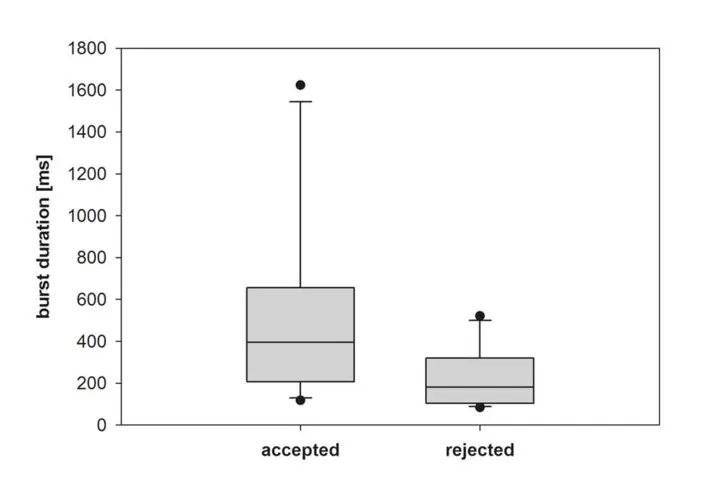
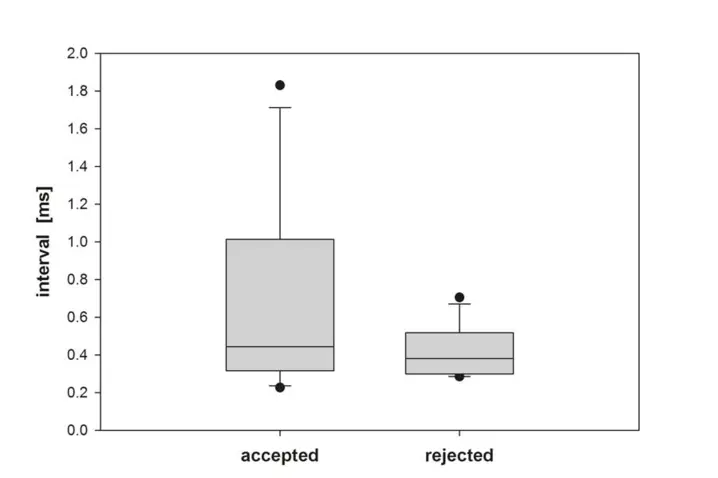
The sound analyses showed that male vibrations occur in 1 to 9 trains (periods of vibrations), with each train comprising about 10 to 220 bursts (figure 1). Accepted males showed significantly longer burst duration than males rejected before copulation (Mann-Whitney U test, P < 0.05) (figure 2). The time between bursts appeared to be shorter in accepted males but the difference was not significant (Mann-Whitney U tests, P > 0.05) (figure 3).
The importance of male vibrations
Male Osmia bicornis have a pattern of vibrations that is characterized by a series of trains that are made up of several bursts. Our results show clearly that females prefer to copulate with males exhibiting longer vibrational bursts.
Given that the production of vibrations requires thorax contractions that are presumably energetically costly, females may use vibrations as a signal of vigor and health. This may lead to discrimination against older males because they lack the energy to produce long bursts.
Although there is little known about the importance of male vibrations in female choice, there is evidence that in many cases it might be used by females to discriminate amongst males.
Since vibrations produced by male Osmia bicornis cost a significant amount of energy, they are likely to represent an honest signal. Experiments in which male vigor, health and age are manipulated whilst their precopulatory vibrations are recorded are needed to support these ideas.
These results shed a completely new light on the “buzzing” of bees which up until this study has largely been neglected due to the assumption that bees cannot hear very well. However, they obviously use sensors to detect these vibrations and further studies might reveal that many more bees use vibrations in their communication.
References: This article was also published in the “Journal of Experimental Biology”: Conrad, T. Paxton, R. J. Barth, F. G. Francke, W. & Ayasse, M. Female choice in the red mason bee, Osmia rufa (L.) (Megachilidae). The Journal of Experimental Biology 213, 4065–4073 (2010).