Characterization of a biomechanical joint
The human middle ear transfers acoustically-induced vibrations of the eardrum through the ossicles to the inner ear. Near the auditory threshold, the resulting three-dimensional vibrational patterns have displacements in the range of only a few nanometers. Highly accurate and non-intrusive measuring systems are required to detect these vibrations.
Besides sound-borne vibrations, the human middle ear has to deal with large quasi-static pressure fluctuations, for example caused by variations in ambient air pressure. These pressure variations can be many times greater than the acoustic sound pressure at the pain threshold. They are not only caused by ambient pressure changes, but also by everyday events, such as sneezing, the air flow of an open car window or a change of posture.
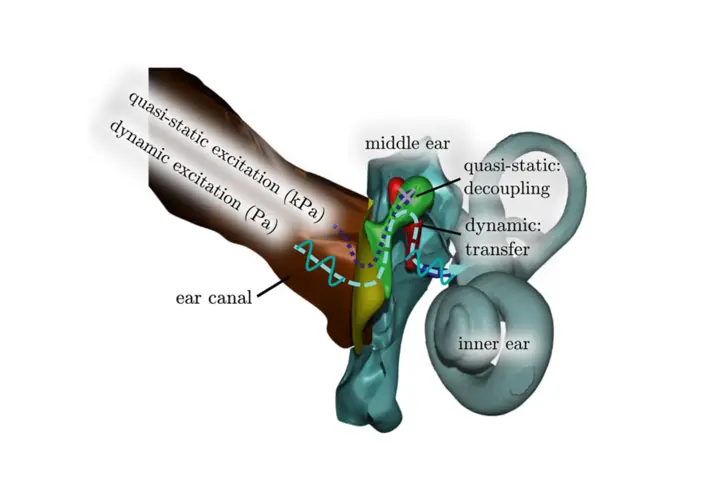
In order to process this enormous excitation bandwidth, the human middle ear works as a mechanical filter which decouples the large quasi-static excitations and transfers the low dynamic excitations (figure 1).
This behavior is mainly influenced by the hammer-anvil joint (Incudo-Malleolar Joint - IMJ), which connects the two auditory ossicles (hammer and anvil) together. The aim of this research project is to investigate the functioning of the IMJ for different suggestions and to determine a mathematical model of the joint.
Experimental setup
To characterize the IMJ, measurements on isolated IM complexes are carried out to minimize the influence of other (middle ear) structures such as ligaments and eardrum.
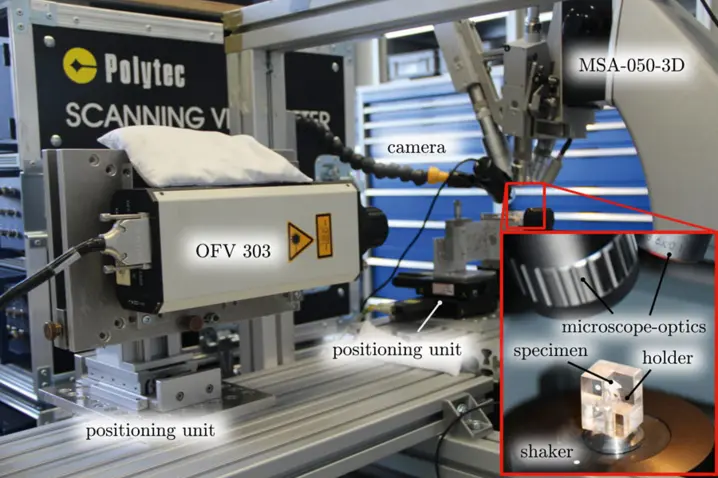
The IM complex is a very small (about 7 x 4 x 9 mm) and lightweight (55 mg) structure comprising two auditory ossicles connected by soft biological tissue. A Laser Doppler Vibrometer (LDV) is the ideal tool for investigating this structure, as it allows non-intrusive and high-resolution measurements of miniature objects such as these. Polytec's MSA Micro System Analyzer and a Single Point Laser Vibrometer head are used here to detect spatial velocities and displacements (figure 2). The LDV units and measured object can be aligned and the measurement point positions determined by using manual and electronic positioning.
Drying of the biological soft tissue during the investigation causes the material properties of the specimen to change with increasing measurement time. The effects of drying can be minimized by defining measurement points in advance, by using electronic positioning with short semi-automated measurement times, and by increasing the humidity.
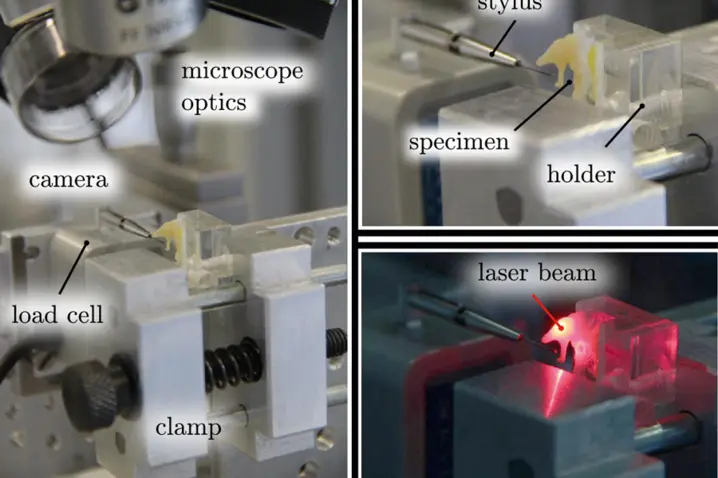
The specimen is excited dynamically by using an electrodynamic shaker (figure 2) and quasi-statically by a stylus connected to a load cell (figure 3). The measurement process is monitored by the cameras integrated into the LDV heads (figure 4). Measurements are performed on different points of the ossicles with the excitation remaining constant. Three-dimensional movements of the two ossicles can be reconstructed in post-processing from these individual measurements.
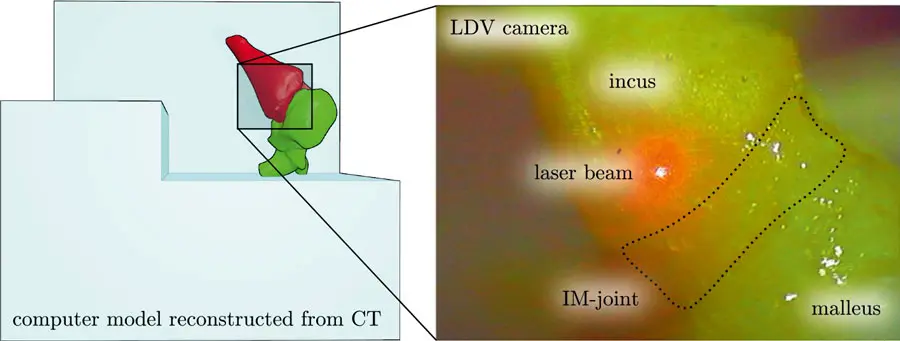
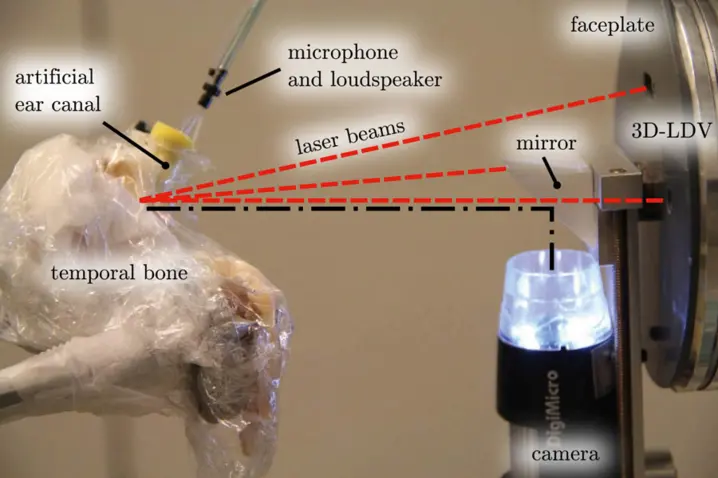
In addition to studies on isolated IM complexes, measurements are carried out on human temporal bones. The ossicles are dissected without damaging the eardrum, middle ear and inner ear bands. The eardrum is acoustically excited with a loudspeaker and the three-dimensional velocity is measured at several points on the hammer and anvil with Polytec's Compact Laser Vibrometer system (figure 5).
The measurement point position is monitored by a camera coupled into the beam path of the laser vibrometer, and the intensity of the laser beams is minimized with an aperture to avoid glare.
Results and conclusions
Individual point measurements can be used to reconstruct movements of the hammer and anvil for both quasi-static and dynamic excitation. For quasi-static excitations, the IM-complex experiences motion caused by the saddle shaped structure of the joint surfaces. In the case of acoustic excitation, as the frequency increases there is a relative spatial movement in the IM-joint with increasing complexity of the vibration pattern in the ossicles.
A 3D laser vibrometer can be used to visualize this relative movement in the IM-joint for different excitation patterns. This improves the understanding of the mechanical functioning of the joint and the parameter determination for a mathematical model.
Acknowledgements
The authors thank Prof. Alex M. Huber, Dr. Jae Hoon Sim, Dr. Ivo Dobrev and Rahel Gerig from the University Hospital in Zurich for their cooperation during this project.