To organize traveling exhibitions, museums like the Georgia O’Keeffe Museum in Santa Fe, New Mexico supplement their own collection with temporary loans from other museums and private collections. In 2017, over 1.3 million museum visitors experienced exhibitions of paintings from the Georgia O’Keeffe Museum, in cities like Brooklyn, London, Paris, Vienna, Toronto, Sydney, Melbourne and Brisbane.
Those loans mean hundreds of hours of motor and air transport and thousands of miles of continuous, low-frequency vibration. The problem, of course, is these vibration energies will result in cumulative damage to irreplaceable works of art. Protecting Georgia O’Keeffe’s (1887 – 1986) paintings from vibration-induced damage is a major part of the job for Dale Kronkright, the head of conservation at the museum.
Every work of art is “born” with a finite number of chemical and mechanical bonds which provide both mechanical and visual characteristics. As a rule, the older a work of art becomes, the fewer bonds remain and the more susceptible the work is to damage as stresses exceed the decreasing strain fatigue limits. The tradition of canvas painting during the 20th century involved stretching a woven linen canvas over an adjustable wooden frame.
The resulting painted fabric membrane is like that of a rectangular drumhead with each painting having natural and resonant frequencies falling into a range that is dependent upon the size, weight and tension of the canvas, and the application and direction of design paints. The resonant vibration frequency range of 16 to 50 Hz is problematic to the preservation of the museum’s paintings precisely because it coincides with the range of input vibration frequencies created by fine art transport trucks traveling down a highway.
Missing from the initial test data were visualizations of the canvases moving in primary and secondary drum modes, whether those canvas excursions correlated to the location of cracks, and whether the transit crates that the museum had engineered for their paintings actually damped vibrations across the critical resonant frequency range.
Because of the non-contact architecture and full-field measurement capability with high spatial resolution, the Polytec MPV Multipoint Vibrometer and the PSV-500 Scanning Vibrometer clearly have the technical specifications to help the museum measure and visualize canvas excursion frequencies, amplitudes, velocities and distributions.
Additionally, by measuring the movement of the canvas secured inside of various framing and crating configurations, the Polytec vibrometers would further allow conservators to understand the damping impact of multiple mitigation and vibration damping measures.
Polytec’s team of engineers brought both the Polytec MPV Multipoint Vibrometer and the PSV Scanning Vibrometer to the Georgia O’Keeffe Museum for a week of testing. Along with Kronkright, the O’Keeffe Museum had invited vibration engineers and mathematicians from Los Alamos National Lab and the University of Michigan to collaborate on the analyses of the spectral power distribution FFTs.
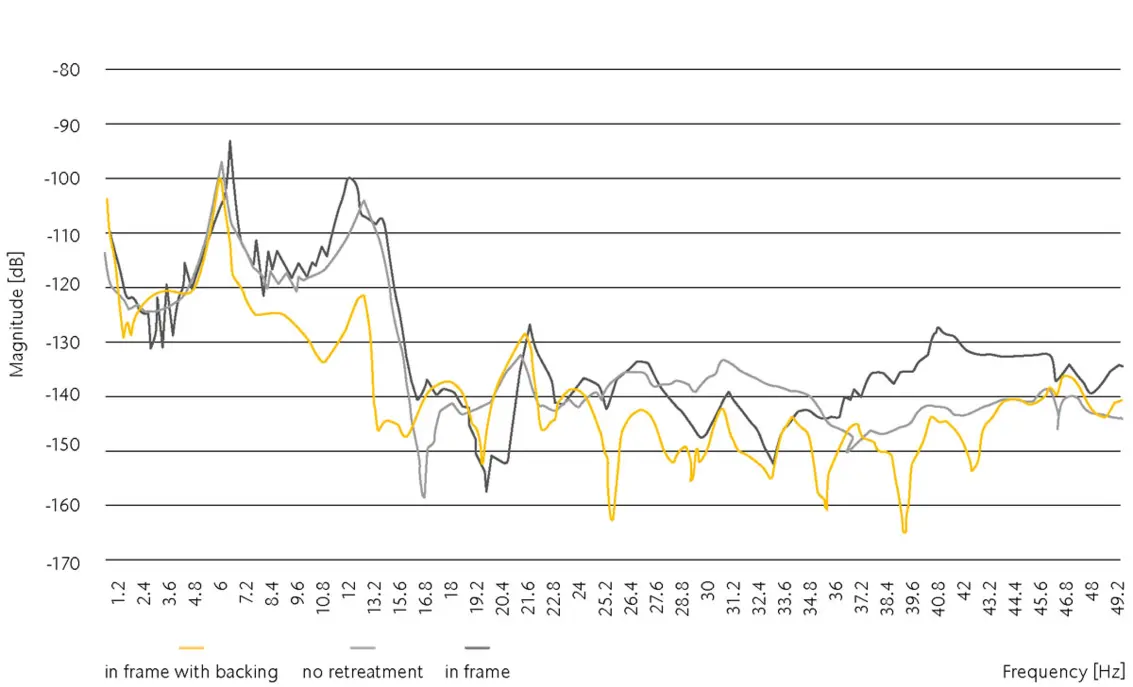
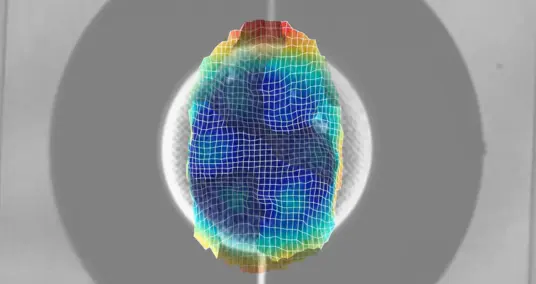
Conducting tests on facsimile linen canvas paintings first, conservators learned that the configurations of foam cushions inside their carefully engineered wood crates went into additive interference phases that actually increased canvas excursions in the critical avoidance range of 10 Hz to 40 Hz. The Polytec engineers were also able to visualize the transitions from first to second drum vibration modes in the canvases.
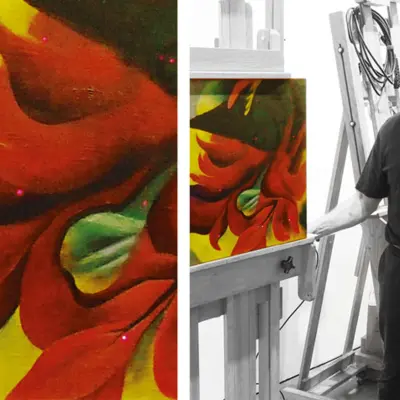
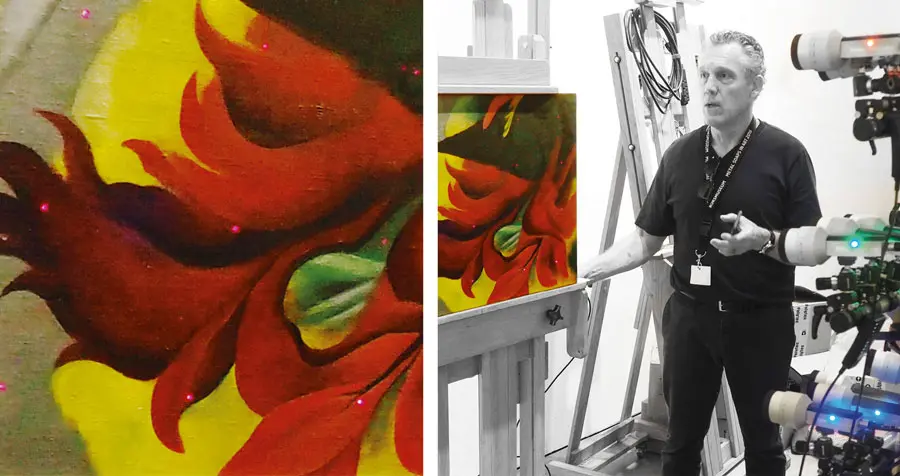
The Polytec MPV Multipoint Vibrometer allowed the team to measure natural frequency and canvas excursion behaviors of actual paintings by Georgia O’Keeffe. Paintings were secured in an upright easel and the 24 laser vibrometer channels were focused in a grid pattern which measured the modal movements of both the easel and the entire dimension of the canvas and stretcher. The paintings were then given a calibrated excitation from a low amplitude tap on the back of the easel using a 100 gram, modally tuned, instrumented hammer.
Using the 24 point visualizations and frequency response data generated at each of those points, the team was able to see that the first and second drum modal vibrations occur in the critical range of 10 to 40 Hz and that canvas excursion behaviors are closely correlated to both the paint thickness and the location of historic cracks.
Finally, like the tests on facsimile paintings, the scanning vibrometer confirmed on actual paintings the superior damping of framing techniques incorporating lightweight, rigid honeycomb core panels and rigid acrylic glazing in the front of the frame.