Back
Micro & nanotechnology
Acoustics & ultrasonics
General R&D

Selective polarization conversion of surface acoustic waves

A new driving mechanism for acoustofluidics*

Acoustofluidics is the active manipulation of fluids as well as of immersed particles or cells at the micro- and nanoscale and is a key technology for life sciences. Acoustic waves, more precisely, ultrasonic waves featuring high frequencies far beyond the audible range, are predestined for this purpose because they allow for precisely controllable and contact-free handling of very small objects. A novel mechanism for microfluidics driven by highfrequency acoustic waves has been developed at IFW’s SAWLab Saxony. The method is based on the active manipulation of the mechanical vibration plane of surface acoustic waves and was successfully demonstrated to significantly improve microfluidic actuation for lab-on-a-chip applications.

Surface acoustic wave (SAW) devices like high-frequency analog bandpass filters and resonators are already key components for all mobile communication devices, including wireless networks, mobile phones, Bluetooth and infrared signaling. The current activities at the SAWLab Saxony are focused on the second and third generation of SAW applications, namely I) wireless, self-sufficient sensing at high temperatures (>600°C) and harsh environments, and II) SAW-driven acoustofluidics.

The topic presented here refers to the latter one and results from a comprehensive approach considering electroacoustic fundamentals, functional thin films as well as the specific microfluidic application.

Polarization conversion of surface acoustic waves

Using ultrasonic waves for selective and noninvasive actuation of fluids as well as of immersed particles and cells at the microscale is state of the art. In general, the interaction of high-frequency mechanical waves with the fluid gives rise to acoustically induced forces that can be used for rapid fluid mixing, for sorting and trapping of particles/cells and for aerosol generation.

The most common method to excite ultrasonic waves relies on the inverse piezoelectric effect, i.e. the generation of mechanical strain in a specific solid material resulting from an applied electrical field. In case of surface acoustic waves (SAW), the voltage is applied to a pair of comb-shaped, planar electrodes (interdigital transducer, IDT) that are arranged on the piezoelectric substrate material, e.g. lithium niobate. Thus, the acoustic wave propagates along the substrate surface with a penetration depth in the order of the wavelength. The mechanical strain (displacement amplitude) is composed of three spatial components, namely, two in-plane components in parallel and perpendicular to the propagation direction respectively, as well as one out-of-plane component that is directed perpendicular to the surface. Moreover, an electrical field is accompanying the SAW since the mechanical strain generates an electrical potential due to the piezoelectric effect. The distribution of both, the components of mechanical displacement amplitude and the electrical potential represents the polarization of the surface acoustic wave.

SAW-based microfluidic devices mostly consist of at least one IDT on a piezoelectric substrate utilized for the excitation of high-frequency mechanical waves. The fluid and immersed particles/cells are in direct contact to the substrate surface and enclosed by a vessel commonly made from a polymer. For actuation purposes, vertically polarized SAWs are typically utilized due to their large out-of-plane (vertical) displacement amplitude that mainly provokes the transfer of momentum to the fluid resulting in the acoustic radiation force and acoustic streaming. Using vertically polarized SAW comes along with two major drawbacks:

I) the SAW is strongly attenuated during the transmission under the vessel wall and II) the interaction with the fluid immediately starts after the SAW encounters the fluid volume inside the vessel.

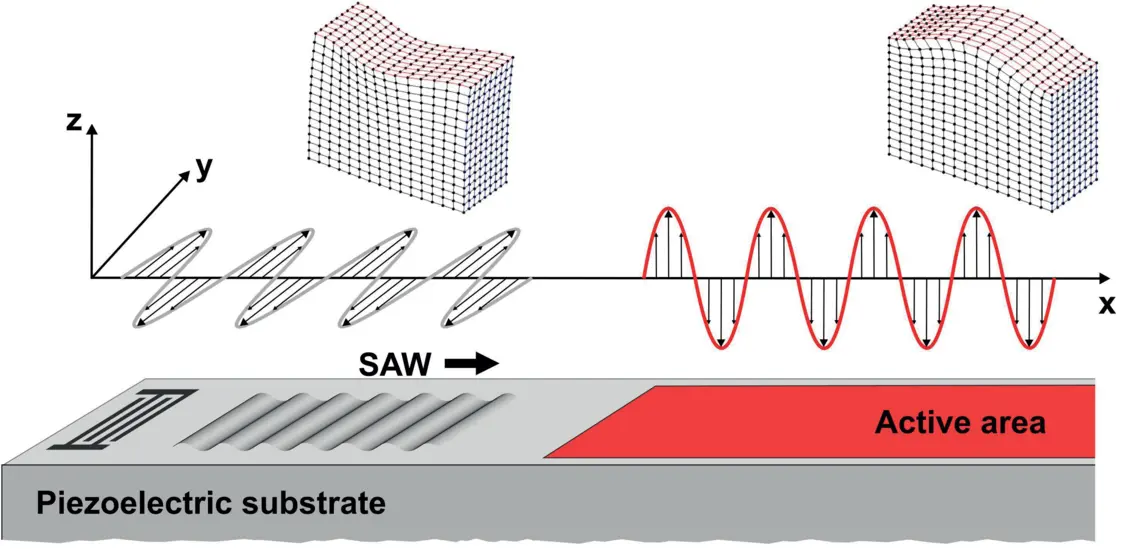
To overcome these drawbacks, an alternative approach has been invented and investigated at IFW’s SAWLab Saxony based on the selective conversion of SAW polarization. The fundamental idea is to excite a shear-horizontal SAW characterized by a dominating in-plane component of mechanical displacement that is directed perpendicular to the SAW propagation direction, and to change SAW polarization inside the microfluidic vessel in order to start fluid actuation (Fig. 2).

Fig. 2: Fundamental principle of polarization conversion of surface acoustic waves (SAW).

Using shear-horizontally polarized SAW significantly reduces the attenuation during transmission of the vessel wall. Moreover, the interaction with the fluid is minor as compared to vertically polarized SAW yielding almost no transfer of momentum. Thus, the outof-plane displacement has to be increased once the SAW propagates inside the vessel, i.e. the polarization has to be changed.

A straightforward approach for the selective conversion of SAW polarization has been investigated in the IFF research team Surface Dynamics. Therefore, a metal thin film is deposited on the surface of a piezoelectric substrate that locally changes the electrical boundary conditions of SAW propagation, i.e. shortens the electrical field at the substrate surface. Under certain conditions, i.e. for particular substrate materials, the out-of-plane displacement amplitude significantly increases if the SAW passes the transition from free to metallized surface. This effect was comprehensively investigated with the help of experiments and simulations.

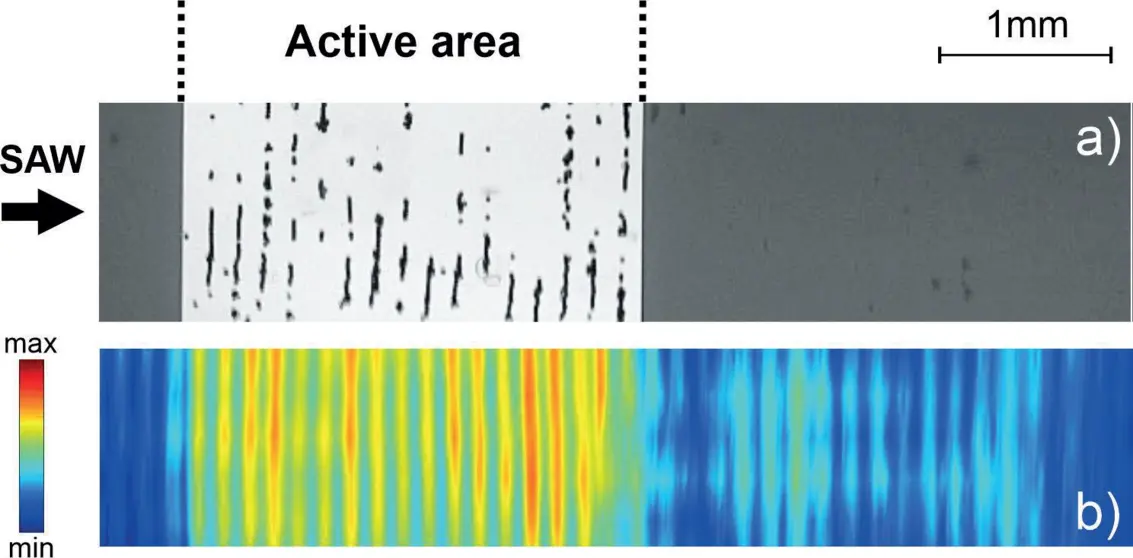
Fig. 3: Polarization conversion of surface acoustic waves (SAW) allows for selective particle trapping: particles are solely trapped at the active area (microscopic image, a) showing comparable higher out-of-plane displacement amplitude (measured with laser Doppler vibrometer, b).

A high-frequency laser Doppler vibrometer was used to realize high-resolution measurement of the out-of-plane (vertical) component of mechanical displacement. Corresponding results also help to validate numerical simulations and the underlying physical model. Performing simulations is of particular importance because it gains insight to micro acoustic fundamentals that are not accessible by means of experiment, e.g. the determination of the complete SAW polarization vector as well as the detection of other acoustic wave modes inside the substrate material.

New opportunities for SAW-driven microfluidics

The novel concept of SAW polarization conversion provides two main advantages for microfluidic actuation purposes. Besides the reduced attenuation of SAW during transmission of the vessel wall, the region of fluid actuation (active area) can be precisely selected by means of the lateral layout of the metallized substrate area. This effect was successfully demonstrated for the trapping of particles (10 µm diameter) immersed in water (Fig. 3). The particles accumulate within the active area characterized by a larger out-of-plane displacement amplitude caused by the intended change of SAW polarization. Thus, the acoustic radiation force induced by the vertical displacement is significantly higher at this region yielding to a trapping of particles. Regions without this polarization conversion show significantly lower amplitudes yielding minor forces in the fluid not capable to trap particles. 

The lateral position, the dimensions as well as the shape of the active area can be simply adapted by means of the lateral layout of the metal thin film. Hence, a new degree of freedom is available for the design of SAW-driven microfluidic devices that are predestined for controllable handling, e.g. separation or trapping of cells.

The fundamental concept of SAW polarization conversion has been granted as a patent (DE 10 2017 118 878).


References

[1]        A.N. Darinskii et al., Ultrasonics 78 (2017) 10
[2]       A.N. Darinskii et al., J. Appl. Phys. 123 (2018) 014902
[3]       R. Weser et al., Appl. Phys. Lett. 117 (2020) 143502


*With kind permission of the Leibniz Institute for Solid State and Materials Research Dresden e. V.: This article is an authorized reprint from the IFW Annual Report 2020.

Images courtesy: Images courtesy of the authors unless otherwise specified

Our Authors

Robert Weser et al.
www.ifw-dresden.de
SAWLab Saxony
www.sawlab-saxony.de

Related Articles

Laser-Doppler-Vibrometer set standards in the development of electric drives

Electric machines are increasingly being used as the primary drive technology in vehicles. The acoustic behavior of the drive is a key factor in the perceived quality of electric vehicles. Numerical method…

5 min

优化光学自由曲面的制造工艺

使用光学自由曲面可以简化复杂的透镜系统,从而使其结构更加紧凑和重量优化。此外,光学自由曲面的使用还可以实现全新的功能。与此同时,它们的制造工艺更为复杂,耗时更久且成本昂贵。使用数控机床可以小批量地高效生产单个自由曲面。

4 min

激励力

人工激振是各種噪音與振動技術的基礎,涵蓋實驗模態分析、傳遞路徑分析、載荷識別、模擬模型相關性分析、混合建模等領域。結構激振可透過多種方式實現,從手動衝擊錘、自動化錘具,到外部支撐式振動台乃至自支撐式振動台皆可達成。

10 min

使用激光测振仪评估触摸屏在-40° ~ 85°C温度范围内的声学性能

汽车中控面板触摸屏界面的增加会导致视觉信息过载,从而带来严重的安全隐患。触觉反馈技术可改善用户体验,并减少与触摸屏交互的认知负荷。最近由Vibra Nova收购的hap2U的触觉技术是基于压电致动器产生的超声波传播。致动器产生的振动减小了用户手指与触摸屏玻璃表面之间的摩擦系数,这种现象被称为主动润滑。

5 min

惯性激振器用于模态测试

当被测物体无法自振时需外部激励。模态试验常用电磁激振器和力锤。Polytec扫描测振仪配SAM自动力锤提升效率。

6 min

如何测量非洲象群间的低频通讯。

最近发表在《欧洲物理杂志专题》(European Physical Journal Special Topics)上的一项研究介绍了激光多普勒测振仪(LDV)的一项开创性应用,以更好地理解非洲象的发声及其行为含义。这项研究的主要目的是确定大象群体中声音交流的动态,特别关注一种被称为“我们出发吧”的的特定隆隆声。这些隆隆声序列在协调大象群体的运动、空间关系和加强社会联系方面起着至关重要的作用。

4 min

全场激光测振扫描中振动热点的直观可视化

Everybody enjoys good sound quality on a mobile device when watching a show or when communicating with friends and family or in a business environment. On the other hand, we cringe when something is off wi…

3 min

何时选择激光多普勒测振仪进行振动测量

在振动测试领域,附加质量是一个不容忽视的重大难题。动态振动样本或被测器件(DUT)的性能,极易受到额外附加质量的干扰。这种现象在振动的悬臂梁结构中表现得尤为突出,而在处理涡轮叶片这类特殊的弯曲悬臂梁时,情况更是复杂棘手。利用加速度计精准测量涡轮叶片的共振频率,向来是一项颇具挑战性的任务,其中附加质量的影响是主要阻碍因素。即便极为小巧的加速度计,其增加的质量也会改变涡轮叶片的固有频率,使得精准测量困难重重。

5 min

压电片谐振器轮廓模态的单电极传导

压电片谐振器用于传递特定的轮廓模态体声波(BAW)谐振振型。基于铌镁酸铅-钛酸铅 (PMN-PT)薄膜的独特性,必须使用激光多普勒测振仪来测量微型盘式谐振器。PMN-PT是一种铁电材料,以其良好的压电和电致伸缩性能而闻名。面内位移曲线,可显示出轮廓模态、共振模态、切向模态和酒杯模态族。这些轮廓模态对生物传感、射频和旋转传感应用具有重要意义。

4 min

剪切激波如何影响感知

触觉全息术或空中触觉技术有望让虚拟现实成为现实,但一项新研究揭示了一个令人意外的物理障碍,有待克服。加州大学圣巴巴拉分校的一个研究团队发现了一种新现象,它是新兴全息触觉显示器的基础,这一发现可能会带来更引人入胜的虚拟现实体验。

6 min

基于激光多普勒测振技术,实现精确且可重复的原子力显微镜测量,助力更定量的检测

原子力显微镜(AFM)作为一种强大且应用广泛的纳米级成像技术,极大地革新了我们在原子和分子尺度层面对表面及材料的认知。凭借其在纳米尺度下实现高分辨率成像、力测量以及材料操控的卓越能力,AFM 已然成为材料科学、生物学和纳米技术等诸多领域中不可或缺的关键工具。

8 min

庆祝干荣珠教授出色的职业生涯

我们有幸于2022年7月26日远程采访了干荣珠教授。在她所在的科研领域里,她的声名如雷贯耳。她是俄克拉何马大学机械工程系的首席教授,已在该大学工作了25年,更重要的是,她是人耳力学领域的先驱之一。她做过中耳,内耳的有限元建模、植入式装置、组织生物力学等等。

3 min

边界条件,测试误差,可重复度

在MAN ENERGY SOLUTIONS,我们为海事部门提供系列综合发动机、螺旋桨、艉部设备和涡轮增压器。可靠性是我们行业(尤其是船舶业)关注的第一要务。在产品的研发阶段,我们使用德国Polytec公司的扫描式激光测振仪来获取测试数据,不断地对样件进行模态验证及模型优化,测试,直到部件可以进行量产。

5 min

基于模态测试的监测系统

随着人们对基础设施的安全性关注度越来越高,对现有结构的安全评估和剩余使用寿命预测提出了挑战。可靠的、技术上可行的和经济的健康监测解决方案是保证结构安全和满足用途的必要条件,是获得有关结构损伤过程和当前结构特性的有用信息的关键前提。

5 min

Non-contact alternative to dynamic and viscoelastic mechanical testing in cartilage

Osteoarthritis, a degenerative disease in the joint, is a condition that is afflicting approximately 14% of adults. Understanding the dynamics of the joint cartilage is crucial for research and for finding…

6 min

Analyzing operational deflection shapes on loudspeakers

Noise protection and control play a major role in both professional and private environments. Airborne sound measurements help identify acoustic paths as a means of noise reduction as standard testing meth…

4 min

Manipulation of complex fluids with SAW-based acoustofluidics

Surface acoustic wave (SAW)-based acoustofluidics combines microfluidics with active microacoustic fields. This allows to realize numerous Lab-on-a-Chip operations, reaching from fluid manipulation includi…

3 min

Laser vibrometry visualizing haptic feedback

The smartphone has shown that buttons can be replaced without sacrificing comfort. The freely configurable display with gesture control has made it even easier to switch between applications. Hap2U drives …

7 min

实现静音与可靠运行的噪声和模态分析

无人机市场正经历多维度的蓬勃发展

6 min

精密测量自激励多悬臂梁MEMS微器件的振动

使用超高分辨率显微式激光测振仪MSA-600获取受分子布朗运动激励的多悬臂梁MEMS微器件的振动特性。这种新颖的测试方法还可用于如原子力显微镜(AFM)的微小针尖的振动测量。

4 min

Vibration analysis helps to protect art

像美国圣达菲的乔治娅·奥·吉弗(Georgia O’Keeffe)这样的博物馆,为了组织巡回展览,除了自有展品外也需要从其它博物馆和私人收藏家那里临时借出藏品,丰富的展品以吸引更多的观众。仅2017年,乔治娅·奥·吉弗博物馆的绘画展览在布鲁克林、伦敦、巴黎、维也纳、多伦多、悉尼、墨尔本和布里斯班等多个城市的累计参观量超过130万人次。

4 min

超声换能器的有限元验证

超声成像是医学影像技术的主要工具之一,通常被称为医学超声波诊断法。产生超声波的超声换能器技术的发展是医学超声研究的热门课题。

6 min

快速测量超声换能器的性能

Next generation ultrasound imaging research is focused on a new sensor technology which utilizes large arrays of small membrane sensors. Accurate performance from these sensors can enable a new suite of me…

4 min
Load more