Back
Automotive & aerospace

Above the clouds

Determining the dynamic characteristics of an aircraft’s large-scale, adaptive compliant wing slat section prototype

The SADE project (SmArt high lift DEvices for next generation wings) of the 7th European Framework Program (Grant Agreement 213442) studied “smart” morphing mechanical elements of next generation wings, which was aimed at improving aerodynamic performance, fuel efficiency, as well as reducing noise and emissions in all stages of flight, especially landing.

The project investigated a number of adaptive control concepts. One of the options developed by German experts from the DLR and Airbus Group (formerly EADS), is an adaptive, smart morphing slat or leading edge structure, which attaches directly to the wing box (figure 1).
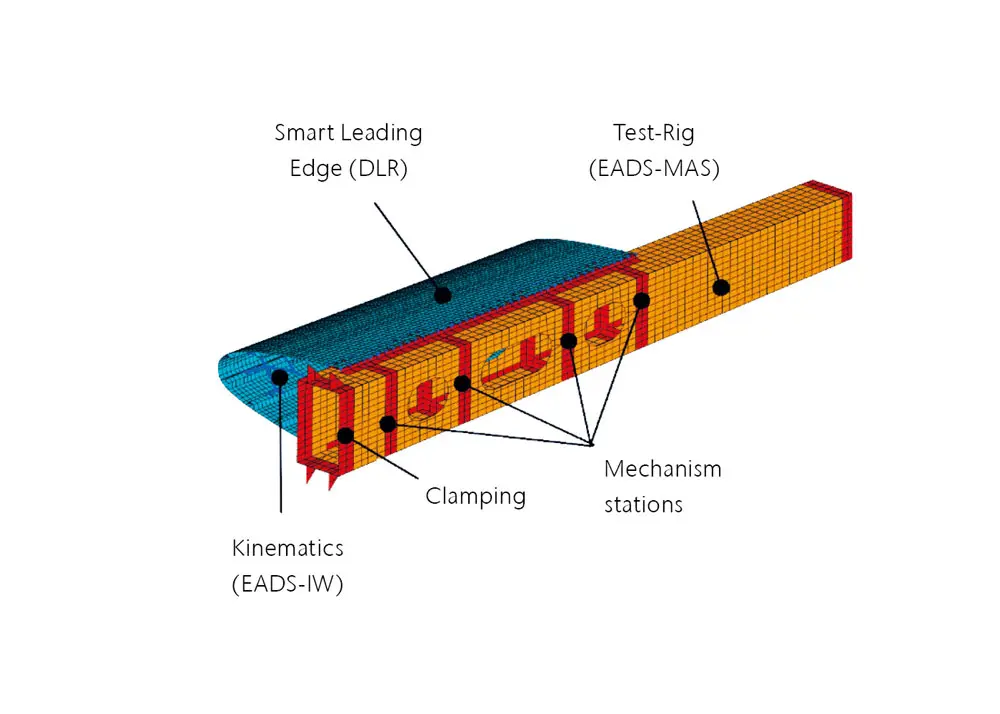
 

Figure 1: The finite element model of the test structure with a “smart” slat and kinematic control mechanism

An important step in studying this concept was the creation of a large-scale prototype aircraft wing section with a morphing slat, and testing it in the large, low speed “TsAGI 101” wind tunnel, (figure 2). The three-section adaptive slat includes a reinforced elastic skin made from glass-fiber-reinforced plastic.

As part of SADE’s immensely complex computational and experimental work, experts from the Central Aerohydrodynamic Institute (TsAGI), a Russian State Research Center, participated in the design and manufacture of a prototype’ measurements of aerodynamic balance in the T-101 wind tunnel, and identified the dynamic and static stiffness characteristics of a wing section. This work is relevant not only to the safety requirements of wind tunnel testing of aeroelastic phenomena (flutter, buffeting, etc.), but also to the need to validate the CAD geometry and finite element model (NASTRAN) of the prototype using experimentally determined natural frequencies and mode shapes.
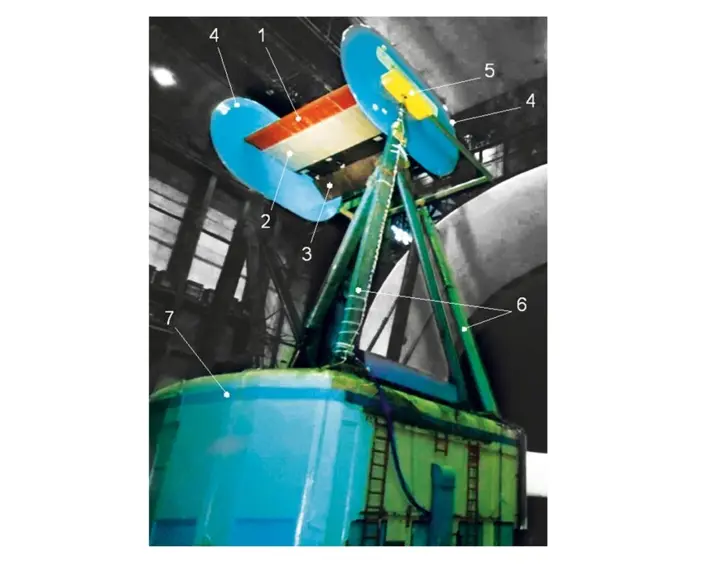
Figure 2: The prototype wing section in the working portion of the wind tunnel (1 - adaptive slat, 2 - caisson, 3 - flap, 4 - fin, 5 - fairing, 6 - aerodynamic support scales, 7 - aerodynamic stall scales)

To achieve the required boundary conditions when performing experiments, the prototype was suspended on either side from two sets of elastic cords which were hung from special cross members, mounted to hooks on a bridge crane (figure 3).
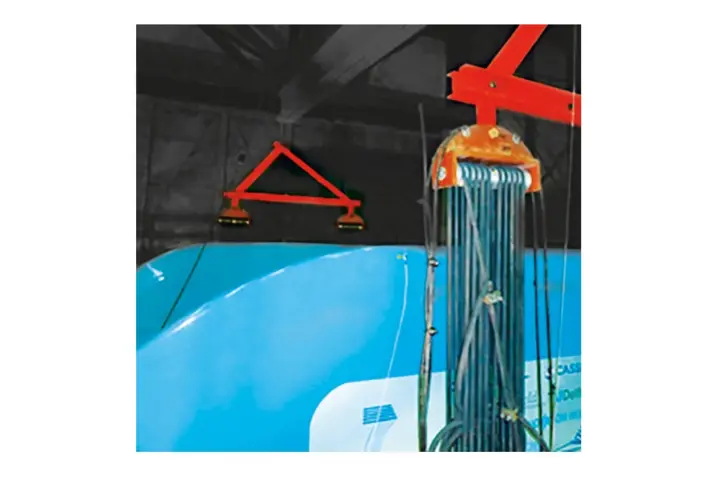
Figure 3: Elastic support system for prototype frequency experiments

The main dynamic characteristics of the prototype were determined from two different approaches:

  • the standard stepped sine method for finding resonances using an electrodynamic shaker together with contact transducers for measuring vibration,
  • the non-contact method of scanning laser Doppler vibrometry (LDV) with pulsed excitation of free damped oscillations using an impact hammer with integrated force transducer.


For the standard method, the structure was excited with a Prodera EX220SC electrodynamic shaker and dynamic characteristics were recorded using LMS SCADAS III / Stepped Sine LMS Test.Lab hardware and software coupled to PCB 333V32 contact sensors.

Non-contact measurements were performed with a Polytec PSV-H4 system, and vibrations of the structural elements were excited with a PCB 086E80 impact hammer hitting the metal parts or the stiffening ribs of the prototype.

In figure 4, natural modes of vibration of the prototype computed using NASTRAN (bottom row of images) are compared to data acquired experimentally using the non-contact method (top row) and the standard method (middle row).
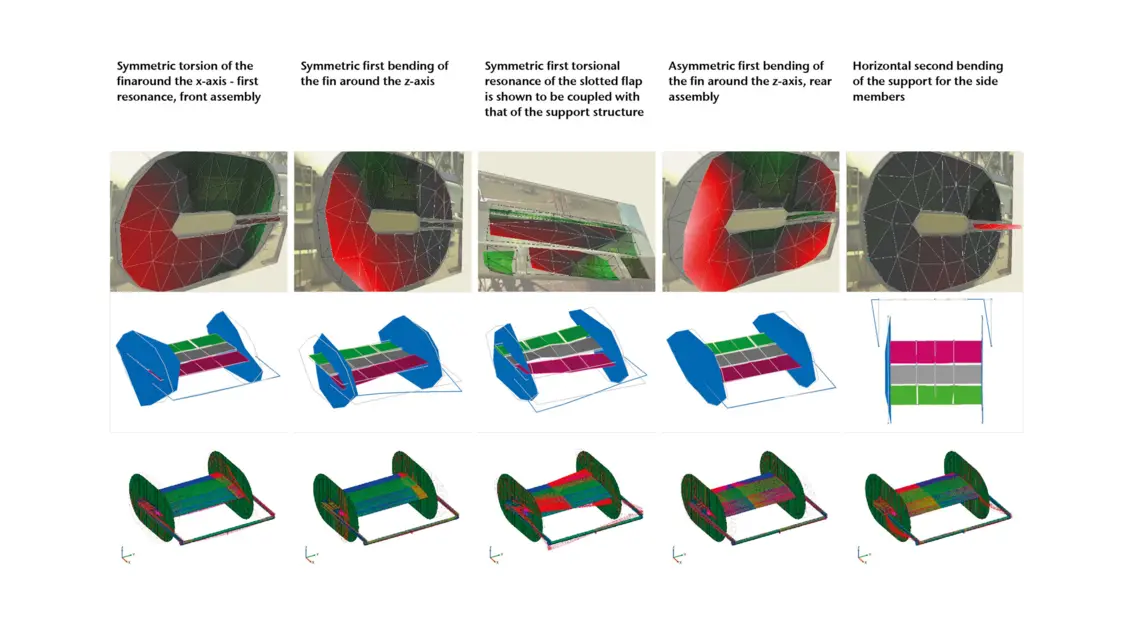
Figure 4: Comparison of some mode shapes of the prototype from simulation and experiment

The test was designed to determine the basic dynamic characteristics of the first 20 natural modes of the prototype, which allowed the mathematical simulation to be refined to take into account complex non-linear dynamic behavior. As a result, the divergence between the computed and experimental values determined by the standard method did not exceed 6.5%.

By comparing these two test methods, important advantages of using laser Doppler vibrometers became apparent including technical and economic effectiveness. The standard phase resonance method required 13 days with 2 engineers and 2 technicians, while using Polytec’s non-contact PSV-H4 required only 5 days with 2 engineers and no technicians to achieve an acceptable quality of experimental data.

References: Kintscher M. Method for the Pre-Design of a Smart Droop Nose using a Simplex Optimization Scheme. – SAE Aerotech Congress and Exhibition, 10.-12. November 2009, Seattle, Washington, USA. Amiryants G., Malyutin V., Timokhin V. Selectively deformable structures for design of adaptive wing smart elements. 27th Congress of the International Council of the Aeronautical Sciences – ICAS2010, 19.-24. September 2010, Nice, France.


Images courtesy: Images courtesy of the authors unless otherwise specified. Cover image: ©fotolia.com/tanasan

Our Authors

Dr. Sci. Tech. Gennady A. Amiryants at al.
Main Scientist​​​​​
www.tsagi.ru

Related Articles

Laser-Doppler-Vibrometer set standards in the development of electric drives

Electric machines are increasingly being used as the primary drive technology in vehicles. The acoustic behavior of the drive is a key factor in the perceived quality of electric vehicles. Numerical method…

5 min

On self-supporting and self-aligning compact shakers

Artificial excitation is the basis for various noise and vibration techniques, from experimental modal analysis, over transfer path analysis, load identification, simulation model correlation, hybrid model…

10 min

Focus on impact detection of micrometeorites

The commercialization of space exploration increases the need for innovative technologies for space and planetary exploration and satellite missions. To ensure the safety and reliability of space structure…

6 min

Laser vibrometer based acoustic performance evaluation from -40° to 85°C

The increase of touchscreen interfaces in automotive applications leads to a visual overload of information that has serious safety implications. Haptic feedback technology is seen as an opportunity to imp…

5 min

Inertial shakers for modal testing

If you would like to test the vibration behavior of an object that is not vibrating by its own, you have to excite it externally. For modal tests both an electromagnetic shaker and a modal hammer are commo…

6 min

How singing capacitors affect the audio experience in consumer electronics

Everybody enjoys good sound quality on a mobile device when watching a show or when communicating with friends and family or in a business environment. On the other hand, we cringe when something is off wi…

3 min

When to choose a laser Doppler vibrometer for vibration measurement

In the realm of vibration testing, a significant obstacle arises in the form of mass loading. The behavior of a dynamic vibration sample, or device under test (DUT), is profoundly influenced by the additio…

5 min

Frequency response function measurement using QTec® multi-path interferometry

The measurement of frequency response function (FRF) plays an important role for the dynamic characterization of structures. In most cases, the goal is the measurement-based analysis of a system or the det…

7 min

Analyzing operational deflection shapes on loudspeakers

Noise protection and control play a major role in both professional and private environments. Airborne sound measurements help identify acoustic paths as a means of noise reduction as standard testing meth…

4 min

Laser vibrometry visualizing haptic feedback

The smartphone has shown that buttons can be replaced without sacrificing comfort. The freely configurable display with gesture control has made it even easier to switch between applications. Hap2U drives …

7 min

Noise and modal analysis for quiet and reliable operation

The growth of the drone market is multi-faceted: growing concerns about national and border security drive the need for advanced aerial surveillance, package delivery services experience an increased deman…

6 min

Measurements using broadband piezoelectric excitation

The following article compares various forms of force excitation in order to determine the transfer admittances of mechanical systems using a gear wheel as an example. The objective is to analyze and asses…

4 min

Acoustic radiation of vibrating surfaces in electric drive systems

The growing electric and hybrid vehicles market faces new demands on product acoustic quality. The acoustical emission behavior of electric drivetrains is clearly different from that of conventional drives…

4 min

Experimental modal test with laser vibrometers

The validation of simulation models is an important application area of laser vibrometers. To do this, the geometric data from a finite element mesh is loaded into the software of the measurement system an…

4 min

3D scanning laser Doppler vibrometry for fuel-efficient turbines

Fuel consumption of aircrafts is a hot topic in the current discussion about global climate change. An important factor is the design of the aircraft engine itself. In order to reduce weight and build more…

6 min

Xtra 3D scanning vibrometry on rolling tires

Dynamic 3D operational deflection shapes captured with an Xtra Scanning Vibrometer help reveal the source of rolling tire noise. For a wide range of driving conditions, rolling tires stimulate a significan…

5 min
Load More