Back
Automotive & aerospace

Experimental modal analysis of gear wheels

Measurements using broadband piezoelectric excitation

The following article compares various forms of force excitation in order to determine the transfer admittances of mechanical systems using a gear wheel as an example. The objective is to analyze and assess the acoustic properties of technical structures, e.g. the drive train of an electric vehicle, in the higher frequency range. The experiments demonstrated that with a broadband piezoelectric force excitation the gathered measurement results become far more consistent, especially at high frequencies.

State of the art

As the use of electric drives in vehicles increases, new requirements for the acoustic properties of the overall drive train are arising. The conventional internal combustion engine generates a relatively high noise level, which covers certain disturbing noises, e.g. the “gearbox whine”. This “auditory masking” of the internal combustion engine does not apply to electric drives, whereby fractions in the higher frequency range come to the fore. Current research and development activities therefore focus on reducing these acoustic properties.

The transfer response of the components of the drive train is described by “network models” [1] at Fraunhofer IWU. One basis for this approach is the description of the individual components, e.g. a gear wheel, by way of frequency-dependent transfer functions. This is provided by means of harmonic force excitation of the components and measurement of the structural response using 3D laser scanning vibrometry.

Force excitation in the interesting frequency range (up to 20 kHz) represents a challenge to the existing excitation technology, especially in the case of large structures. Electrodynamic shakers or pulse hammers are the state of the art. Often, the applied forces are not high enough to obtain consistent measurement results (absolute value and phase), particularly at higher frequencies (> 5 kHz). A procedure for broadband force excitation using a piezoelectric modal exciter (dm 2) and a comparison with a conventional exciter (Brüel&Kjær 4810) is described in this article.

Measurement setup

The two shakers were compared under free-free boundary conditions, whereby the respective exciter and the test object were suspended in a rack by means of springs and elastic decoupling elements. The rigid coupling between shaker and test object was realized via a load cell (Brüel&Kjær, type 8203). Figure 1 shows the described test setup with the piezoshaker dm 2.

The system response was acquired by means of a Polytec PSV-3D Scanning Vibrometer. A periodic chirp was used as an excitation signal, whereby the specified excitation and evaluation frequency range was 3.5 to 16 kHz (bandwidth 20 kHz, 12800 FFT lines).
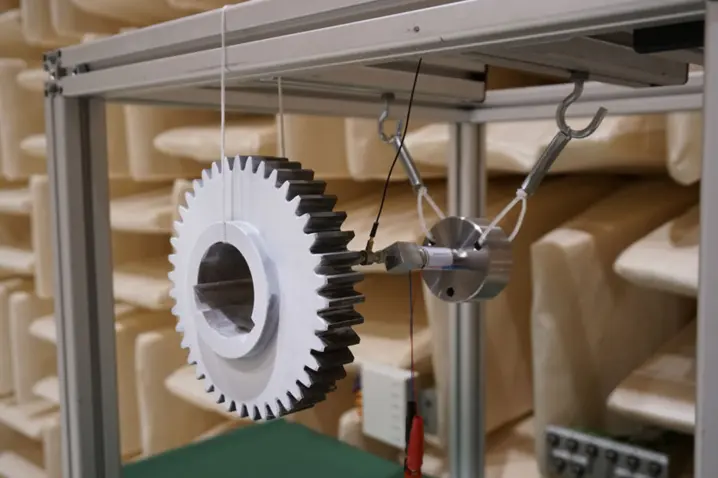
Figure 1: Measurement setup

Results

Figure 2 shows the comparison of the transfer admittances of the individual measurement points diametrically opposite the point of force application (cf. figure 1). The natural frequencies (marked in red) were determined in a preceding experimental modal analysis using an automated pulse hammer. In addition, the associated coherence profiles are shown in the bottom diagram in figure 2.
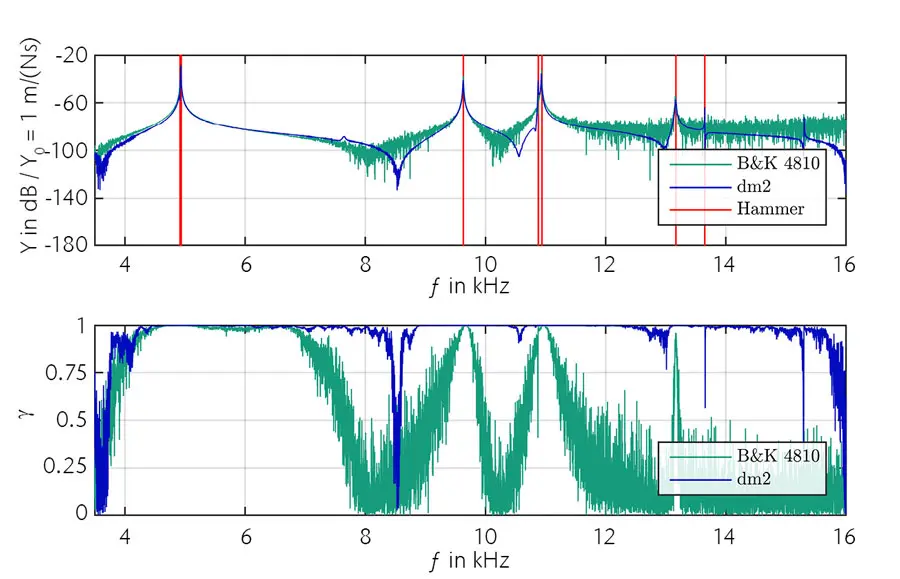
Figure 2: Comparison of the results of a selected scan point. Top: Transfer admittance; Bottom: Associated coherence profile

It is apparent that the amount of energy that can be applied to the system with the shaker B&K 4810 above approx. 7 kHz is not high enough to obtain a satisfactory signal-to-noise ratio, as illustrated by the respective coherence and the clearly identifiable noise levels in the course of the transfer admittance from 7 kHz. When using the dm 2, it is apparent that this is suitable for acquisition of the system responses in the higher frequency range. Clean acquisition of the transmission functions is possible due to the significantly higher energy input, which is also illustrated by the comparison of the phase frequency responses shown in figure 3.
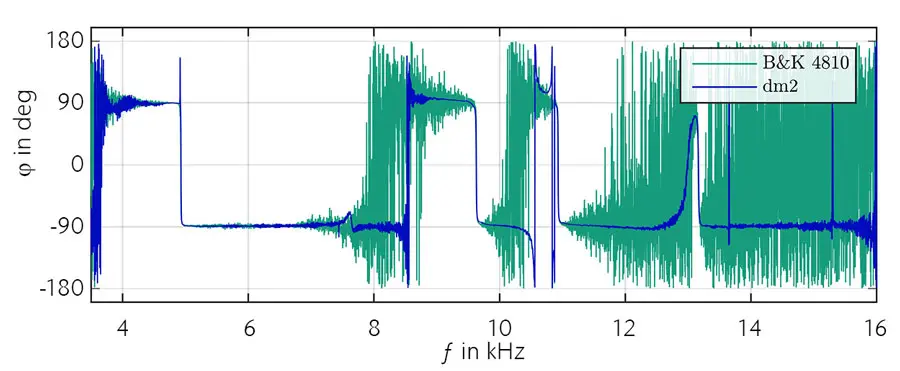
Figure 3: Comparison of the phase frequency responses of the considered scan points

Summary

Various force exciters were compared in this article, in order to measure the transfer admittances of gear wheels. The objective was to find a suitable excitation method in the higher frequency range, in order to enable e.g. the description of the acoustic properties of technical structures on the basis of metrologically acquired transmission functions. It was demonstrated that significantly more consistent measurement results can be obtained with broadband piezoelectric force excitation, especially at high frequencies.

Further work will include investigation of the connection of the force exciter and extension of the frequency range to lower frequencies. In addition, future work will focus on the acquisition of rotational degrees of freedom in the higher frequency range.

References
[1] Bräunig, J. et al.: Options for the vibro-acoustic structure investigation of a wheel body of a tooth system.
In: ant journal, Antriebstechnik 53 (2 2014), p. 3-9.


Images courtesy: Images courtesy of the authors unless otherwise specified. Cover image: ©FredFroese/iStock.com

Our Authors

Dr. Martin Brucke
Dynamics Mechanics, Germany
www.dynamic-mechanics.com
Eric Hensel
Fraunhofer Institute for Machine Tools and Forming Technology IWU, Germany
iwu.fraunhofer.de

Related Articles

Laser-Doppler-Vibrometer set standards in the development of electric drives

Electric machines are increasingly being used as the primary drive technology in vehicles. The acoustic behavior of the drive is a key factor in the perceived quality of electric vehicles. Numerical method…

5 min

On self-supporting and self-aligning compact shakers

Artificial excitation is the basis for various noise and vibration techniques, from experimental modal analysis, over transfer path analysis, load identification, simulation model correlation, hybrid model…

10 min

Focus on impact detection of micrometeorites

The commercialization of space exploration increases the need for innovative technologies for space and planetary exploration and satellite missions. To ensure the safety and reliability of space structure…

6 min

Laser vibrometer based acoustic performance evaluation from -40° to 85°C

The increase of touchscreen interfaces in automotive applications leads to a visual overload of information that has serious safety implications. Haptic feedback technology is seen as an opportunity to imp…

5 min

Inertial shakers for modal testing

If you would like to test the vibration behavior of an object that is not vibrating by its own, you have to excite it externally. For modal tests both an electromagnetic shaker and a modal hammer are commo…

6 min

How singing capacitors affect the audio experience in consumer electronics

Everybody enjoys good sound quality on a mobile device when watching a show or when communicating with friends and family or in a business environment. On the other hand, we cringe when something is off wi…

3 min

When to choose a laser Doppler vibrometer for vibration measurement

In the realm of vibration testing, a significant obstacle arises in the form of mass loading. The behavior of a dynamic vibration sample, or device under test (DUT), is profoundly influenced by the additio…

5 min

Frequency response function measurement using QTec® multi-path interferometry

The measurement of frequency response function (FRF) plays an important role for the dynamic characterization of structures. In most cases, the goal is the measurement-based analysis of a system or the det…

7 min

Analyzing operational deflection shapes on loudspeakers

Noise protection and control play a major role in both professional and private environments. Airborne sound measurements help identify acoustic paths as a means of noise reduction as standard testing meth…

4 min

Laser vibrometry visualizing haptic feedback

The smartphone has shown that buttons can be replaced without sacrificing comfort. The freely configurable display with gesture control has made it even easier to switch between applications. Hap2U drives …

7 min

Noise and modal analysis for quiet and reliable operation

The growth of the drone market is multi-faceted: growing concerns about national and border security drive the need for advanced aerial surveillance, package delivery services experience an increased deman…

6 min

Determining the dynamic characteristics of an aircraft’s large-scale, adaptive compliant wing slat section prototype

The SADE project studied “smart” morphing mechanical elements of next generation wings, which was aimed at improving aerodynamic performance, fuel efficiency, as well as reducing noise and emissions in all…

3 min

Acoustic radiation of vibrating surfaces in electric drive systems

The growing electric and hybrid vehicles market faces new demands on product acoustic quality. The acoustical emission behavior of electric drivetrains is clearly different from that of conventional drives…

4 min

Experimental modal test with laser vibrometers

The validation of simulation models is an important application area of laser vibrometers. To do this, the geometric data from a finite element mesh is loaded into the software of the measurement system an…

4 min

3D scanning laser Doppler vibrometry for fuel-efficient turbines

Fuel consumption of aircrafts is a hot topic in the current discussion about global climate change. An important factor is the design of the aircraft engine itself. In order to reduce weight and build more…

6 min

Xtra 3D scanning vibrometry on rolling tires

Dynamic 3D operational deflection shapes captured with an Xtra Scanning Vibrometer help reveal the source of rolling tire noise. For a wide range of driving conditions, rolling tires stimulate a significan…

5 min
Load More