Back
Acoustics & ultrasonics
Automotive & aerospace
Electronics, semicon, solar
Materials research & NDT

Testing haptic displays for tough automotive conditions

Laser vibrometer based acoustic performance evaluation from -40° to 85°C

The increase of touchscreen interfaces in automotive applications leads to a visual overload of information that has serious safety implications. Haptic feedback technology is seen as an opportunity to improve the user experience and reduce the cognitive load of interacting with touchscreens.

hap2U’s haptic technology, recently taken over by Vibra Nova, is based on ultrasonic wave propagation generated by piezoelectric actuators. The vibration created by those actuators reduces the friction coefficient between the finger of the user and the glass surface of the haptic display. This phenomenon is known as active lubrication because the fingertip, under the effect of the ultrasonic vibration, undergoes a reduction of its contact area1,2 and therefore of its coefficient of friction. As the human body is very sensitive to friction changes, compelling tactile sensations can be achieved through the control of the contact with the plate surface by activating and deactivating the ultrasonic vibration, creating the friction modulation.


In order to optimize the excitation of the system and to simplify the command, a global resonance of the display is used as it is represented in Figure 1.

Laser Doppler vibrometry is used in this context to evaluate the performance of the mechanical system since it allows the measurement of the amplitude of vibration at the surface of the plate. For automotive applications, the propagation of ultrasonic waves needs to be characterized in the full temperature range of -40 to 85°C, in which the display is required to work consistently.
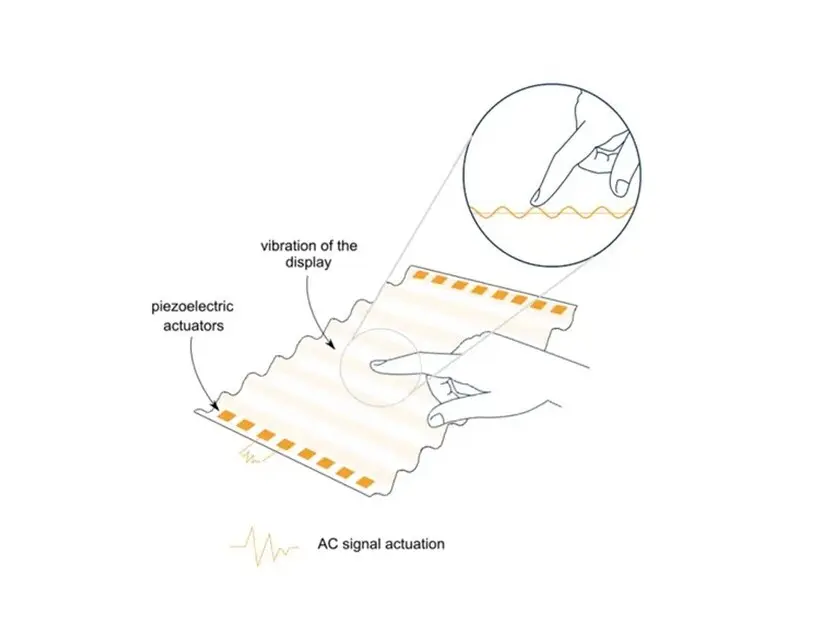
Figure 1: Schematic principle of ultrasonic haptics from hap2U/Vibra Nova

Material characterization

The acoustic characteristics of the system for the propagation of ultrasound waves is very important for a uniform and constant haptic sensation independent of temperature. Today's displays are multi-layer mechanical systems. In these layers, we find many plastic and adhesive materials that change their mechanical behavior with temperature.

Moreover, as the frequency range in which hap2U/Vibra Nova works is ultrasound, it is unusual to find the properties of such materials in this frequency range in literature. Therefore, hap2U/Vibra Nova has developed the know-how to characterize the systems at ultrasound frequencies and at different temperatures.
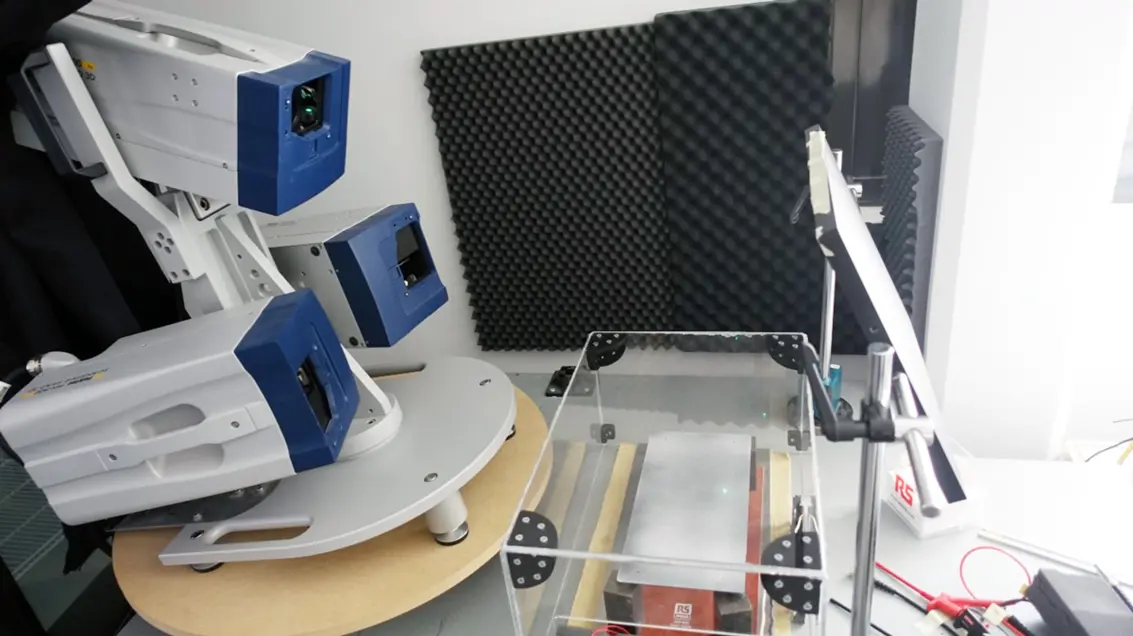
Figure 2: Example of thermal characterization setup: display exposed to high temperatures inside the climatic chamber. Laser vibrometry measurement performed through the plexiglass wall.

To do this, the system is exposed to different temperatures inside a climatic chamber. Figure 2 shows a simple example, only used for measurements at high temperature. Tests in commercial climatic chambers at both high and low temperatures have also been performed. A Polytec 3D Scanning Vibrometer is used to measure the vibrations generated on the entire surface of the display. The Polytec Laser allows the measurement of very small vibrations in the subnanometer range and this measurement can even be performed through a glass or plexiglass wall (as in Figure 2).

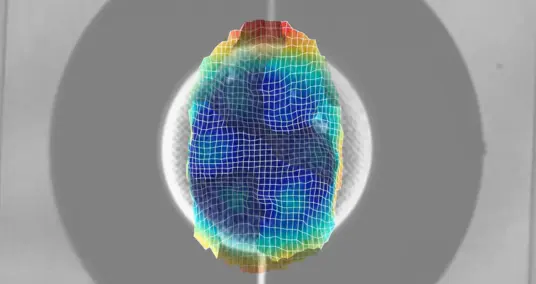
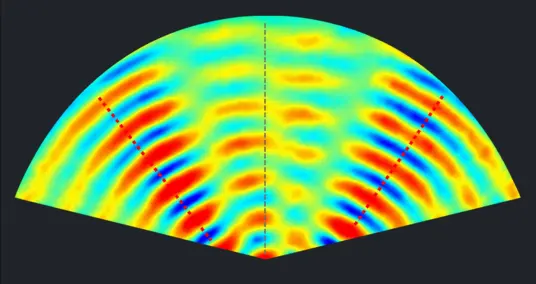
Ultrasonic vibration is generated by activation of piezoelectric elements which create a flexural wave in the display. The response of the system to this excitation is measured to obtain vibrational maps as shown in Figure 3.

The vibrational map of Figure 3 corresponds to a display with good acoustic properties, where haptic technology can be implemented in optimal conditions. To define if the system behaviour is suitable for wave propagation, the acoustic properties of the display are estimated at different temperatures.
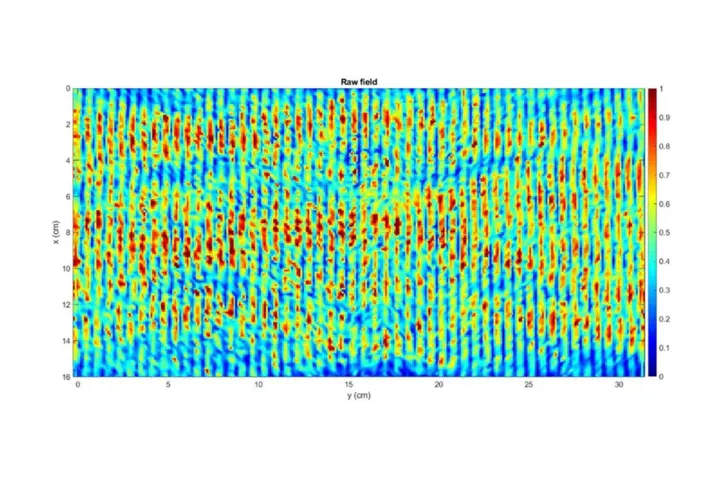
Figure 3: Amplitude of the out-of-plane component of the vibration field measured in an LCD. In the map, the scale has been normalized to the peak value. The uni-axial flexural standing wave pattern is clearly visible.

One of the main parameters to be considered is the damping of the display. The damping is described by the attenuation coefficient. To estimate this attenuation coefficient, an impulse is generated by a piezoelectric element in the surface of the display, and the achieved displacement is measured with the laser vibrometer throughout the surface of the sample.

The attenuation coefficient describes the reduction of the vibrational amplitude as a function of the distance. The higher its value, the higher the losses of vibration amplitude with the distance to the source.

Figure 4 shows an example of two different types of displays characterized at room temperature and 85°C. Display n° 1 (blue curves) shows a higher damping than display n°2 (red curves) already at room temperature and an increase to even higher values at higher temperatures (see dashed blue curve).

Furthermore, the damping depends on the excitation frequency. Maximum damping was measured between 50 - 60 kHz at 85°C. On the other hand, display n°2 shows a lower damping at room temperature and its value is constant with temperature and varies only slightly with excitation frequency.

Given the characteristics of the two systems, display n°2 presents an optimal performance for haptic compatibility in an automotive application.
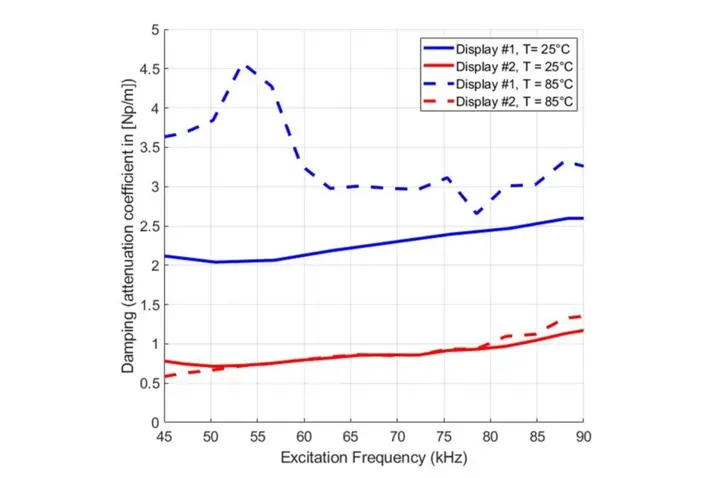
Figure 4: Damping variation of two different displays at 25°C and 85°C temperatures

Scanning laser vibrometry presents an efficient method for the characterization of the acoustic and especially damping parameters of haptic displays over temperature and frequency. This is crucial for the development of displays that show excellent performance over the entire large temperature range as demanded by automotive specifications.


References

1. Wiertlewski, M., Fenton Friesen, R. & Colgate, J. E. Partial squeeze film levitation modulates fingertip friction. Proc. Natl. Acad. Sci. U. S. A. 113, 9210–9215 (2016).
2. Vezzoli, E. et al. Friction Reduction Through Ultrasonic Vibration : Part 1 : Modelling Intermittent Contact. 1412, 1–13 (2017).

Images courtesy: Images courtesy of the authors unless otherwise specified. Cover image: metamorworks/shutterstock.com & Vector Tradition/shutterstock.com

Our Authors

Soledad Commisso
Industrialization Director, hap2U/Vibra Nova
www.hap2U.net

Related Articles

Laser-Doppler-Vibrometer set standards in the development of electric drives

Electric machines are increasingly being used as the primary drive technology in vehicles. The acoustic behavior of the drive is a key factor in the perceived quality of electric vehicles. Numerical method…

5 min

Optimized manufacturing processes for optical free-form surfaces

The use of optical free-form surfaces allows complex lens systems to be simplified and thus made more compact and weight-optimized. In addition, the use of optical freeform surfaces enables the realization…

4 min

On self-supporting and self-aligning compact shakers

Artificial excitation is the basis for various noise and vibration techniques, from experimental modal analysis, over transfer path analysis, load identification, simulation model correlation, hybrid model…

10 min

Focus on impact detection of micrometeorites

The commercialization of space exploration increases the need for innovative technologies for space and planetary exploration and satellite missions. To ensure the safety and reliability of space structure…

6 min

Inertial shakers for modal testing

If you would like to test the vibration behavior of an object that is not vibrating by its own, you have to excite it externally. For modal tests both an electromagnetic shaker and a modal hammer are commo…

6 min

How to measure low-frequency acoustic communication of African elephants

A recent study published in the European Physical Journal Special Topics introduces a pioneering application of laser Doppler vibrometry (LDV) to better comprehend African elephant vocalizations and their …

4 min

How singing capacitors affect the audio experience in consumer electronics

Everybody enjoys good sound quality on a mobile device when watching a show or when communicating with friends and family or in a business environment. On the other hand, we cringe when something is off wi…

3 min

When to choose a laser Doppler vibrometer for vibration measurement

In the realm of vibration testing, a significant obstacle arises in the form of mass loading. The behavior of a dynamic vibration sample, or device under test (DUT), is profoundly influenced by the additio…

5 min

Single electrode transduction of contour modes in piezoelectric disk resonators

Piezoelectric disk resonators are designed to transduce specific contour mode bulk acoustic wave (BAW) resonant shapes. Utilizing a unique property of lead magnesium niobite-lead titanate (PMN-PT) thin fil…

4 min

How shear shock waves influence perception

Haptic holography or mid-air haptics promises to bring virtual reality to life, but a new study reveals a surprising physical obstacle that will need to be overcome. A research team at UC Santa Barbara has…

6 min

LDV based displacement sensor AFM enables more quantitative measurements

Atomic Force Microscopy (AFM) is a powerful and versatile nanoscale imaging technique that has revolutionized our understanding of surfaces and materials at the atomic and molecular scale. By enabling high…

8 min

Using toys to investigate the complex physics of quasi-periodic metamaterials

Metamaterials are artificial assemblies of known materials in particular arrangements that result in novel properties not encountered in naturally occurring materials. Among many applications, they hold gr…

6 min

Frequency response function measurement using QTec® multi-path interferometry

The measurement of frequency response function (FRF) plays an important role for the dynamic characterization of structures. In most cases, the goal is the measurement-based analysis of a system or the det…

7 min

Analyzing operational deflection shapes on loudspeakers

Noise protection and control play a major role in both professional and private environments. Airborne sound measurements help identify acoustic paths as a means of noise reduction as standard testing meth…

4 min

Manipulation of complex fluids with SAW-based acoustofluidics

Surface acoustic wave (SAW)-based acoustofluidics combines microfluidics with active microacoustic fields. This allows to realize numerous Lab-on-a-Chip operations, reaching from fluid manipulation includi…

3 min

A new driving mechanism for acoustofluidics*

Acoustofluidics is the active manipulation of fluids as well as of immersed particles or cells at the micro- and nanoscale and is a key technology for life sciences. Acoustic waves, more precisely, ultraso…

5 min

Laser vibrometry visualizing haptic feedback

The smartphone has shown that buttons can be replaced without sacrificing comfort. The freely configurable display with gesture control has made it even easier to switch between applications. Hap2U drives …

7 min

Noise and modal analysis for quiet and reliable operation

The growth of the drone market is multi-faceted: growing concerns about national and border security drive the need for advanced aerial surveillance, package delivery services experience an increased deman…

6 min

Measurements using broadband piezoelectric excitation

The following article compares various forms of force excitation in order to determine the transfer admittances of mechanical systems using a gear wheel as an example. The objective is to analyze and asses…

4 min

Determining the dynamic characteristics of an aircraft’s large-scale, adaptive compliant wing slat section prototype

The SADE project studied “smart” morphing mechanical elements of next generation wings, which was aimed at improving aerodynamic performance, fuel efficiency, as well as reducing noise and emissions in all…

3 min

Acoustic radiation of vibrating surfaces in electric drive systems

The growing electric and hybrid vehicles market faces new demands on product acoustic quality. The acoustical emission behavior of electric drivetrains is clearly different from that of conventional drives…

4 min

Experimental modal test with laser vibrometers

The validation of simulation models is an important application area of laser vibrometers. To do this, the geometric data from a finite element mesh is loaded into the software of the measurement system an…

4 min

3D scanning laser Doppler vibrometry for fuel-efficient turbines

Fuel consumption of aircrafts is a hot topic in the current discussion about global climate change. An important factor is the design of the aircraft engine itself. In order to reduce weight and build more…

6 min

Xtra 3D scanning vibrometry on rolling tires

Dynamic 3D operational deflection shapes captured with an Xtra Scanning Vibrometer help reveal the source of rolling tire noise. For a wide range of driving conditions, rolling tires stimulate a significan…

5 min
Load More