Back
Automotive & aerospace

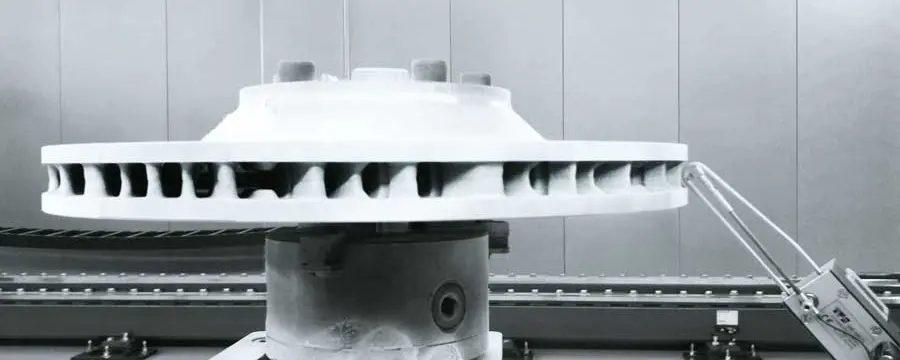
Brake discs on the test station

Experimental modal test with laser vibrometers

The validation of simulation models is an important application area of laser vibrometers. To do this, the geometric data from a finite element mesh is loaded into the software of the measurement system and brought into alignment with the real object using an integrated alignment process. Any geometric deviations between the model and prototype can be corrected and updated to the model with integrated geometry measurement. This facilitates highly precise, time-saving alignment of the simulation model with the experimental data.

Laser vibrometers offer many advantages over the classic process which involves affixing many acceleration sensors to the structure being tested. For example, during automotive modal test measurements for the alignment of FE simulation models, between 40 and 400 sensors are affixed to precisely calculated positions and precisely aligned in all three dimensions for the measurement. In the process, the Euler angles must be determined in order to align the measurement directions of the sensors with the coordinate system of the object on curved surfaces.

However, not only do mounting and adjustment take a lot of time; they also bring with them a high potential for error, since even the slightest inaccuracy in placing and aligning the sensors can result in measurement errors. At the same time, the sensors change the mass of the object, which also has to be taken into account, and the number of sensors cannot be increased as desired due to their size.

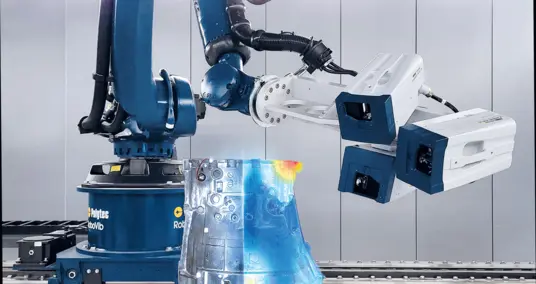
The laser beam of a scanning vibrometer, however, does not have any mass and the number of measurement points could theoretically be as great as desired; the corresponding geometry data can be directly recorded in the software of the measurement system from the finite element mesh in the simulation or in the CAD drawing. This is aligned with the real object using an integrated alignment process. Ultimately, measurement results obtained in this way are more precise, meaningful, and take considerably less time, especially if the laser scanning vibrometer is mounted on robot systems that carry out the tests automatically. Laser vibrometry and its automated variant, RoboVib®, offer a number of advantages that are best illustrated with a concrete example.

Test preparation within a few hours

For the modal test of a brake disc, its FE shell model with approximately 150,000 nodes is imported into the software for the Polytec laser scanning vibrometer (figure 1). Four prominent points in the mesh help to teach the position of the object to the software. To accomplish this, the points of intersection of the laser beams were moved to these prominent positions one right after the other, the corresponding position of the robot arm was stored, and the corresponding coordinates from the FE mesh were assigned to these positions.
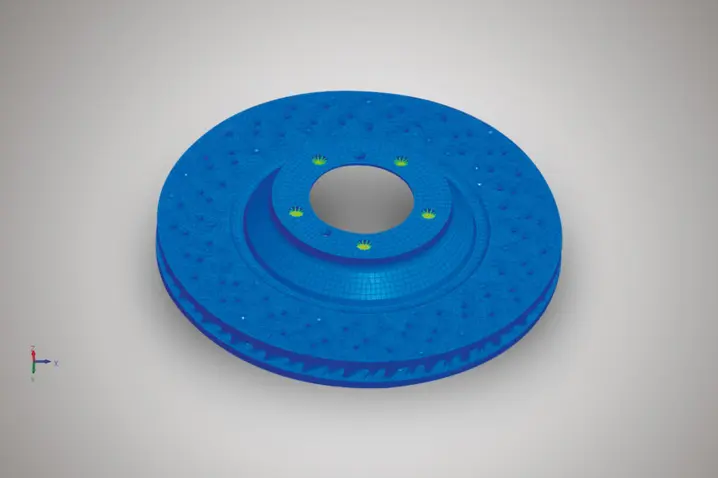
Figure 1: Imported FE model of the brake disc with 150,000 nodes

Then the imported FE mesh was coarsened to 5,000 points, since measurement with 150,000 points is possible, but very time-intensive (figure 2). Additionally, such a high spacial resolution as the FE method requires is not even remotely necessary, even for illustrating complicated vibration modes. To make it easier to determine correlations later, points were merely deleted during coarsening, not shifted. The 5,000 remaining points are situated at their original locations with their original indices.

In the next step, the approximately 20 robot positions, with which the entire object could be measured from all sides using the scanner mirror, were programmed. Teaching the reference points, programming the robot positions, and doing a test run of the program required only one workday. Now, the system is ready to begin the test. There is no need to monitor the test since the modal analysis with the RoboVib® runs automatically. It can, for example, also run through the night and is not dependent on business hours.
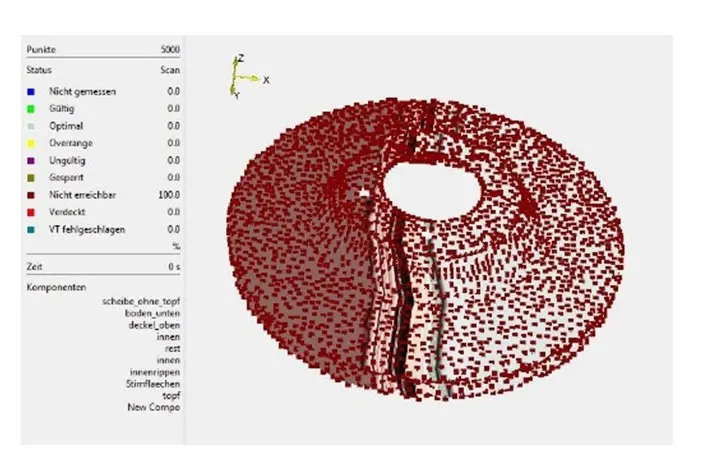
Figure 2: Measurement grid with approx. 5,000 points

Detailed illustration of complex deflection shapes

An automatic modal hammer hitting at an angle to the axis to excite as many modes as possible was chosen to provide excitation for the modal test of the brake disc (figure 3). The modal hammer eliminates the influence of an impedance sensor, which is always needed when an electrodynamic shaker is utilized. At the same time, it also allows for the excitation of far higher frequencies than needed for this experiment.
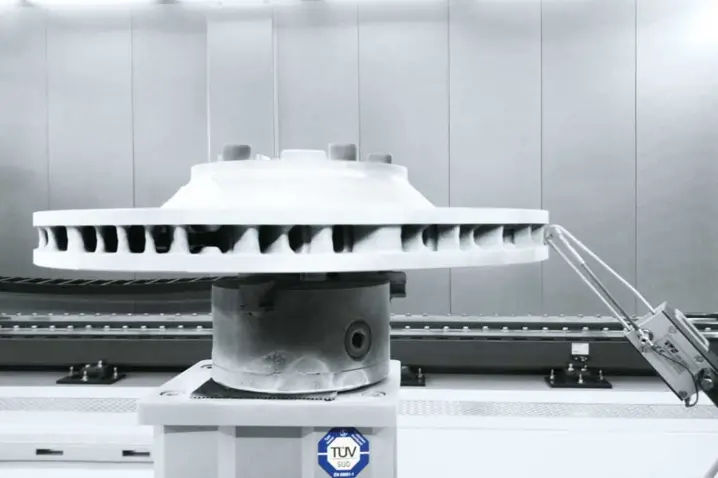
Figure 3: Measurement setup for experimental modal analysis with an automatic modal hammer

Frequencies up to 10 kHz were evaluated. This evaluation demonstrates that even complex deflection shapes can be illustrated in clear detail at higher frequencies (figure 4). Since this is a 3D measurement system, all three spacial components were captured. The measured data was then exported as a universal file and subjected to a modal extraction by FEM tools.
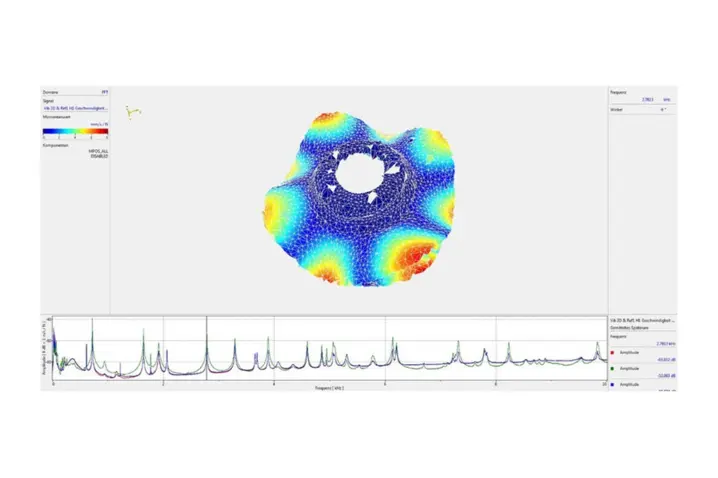
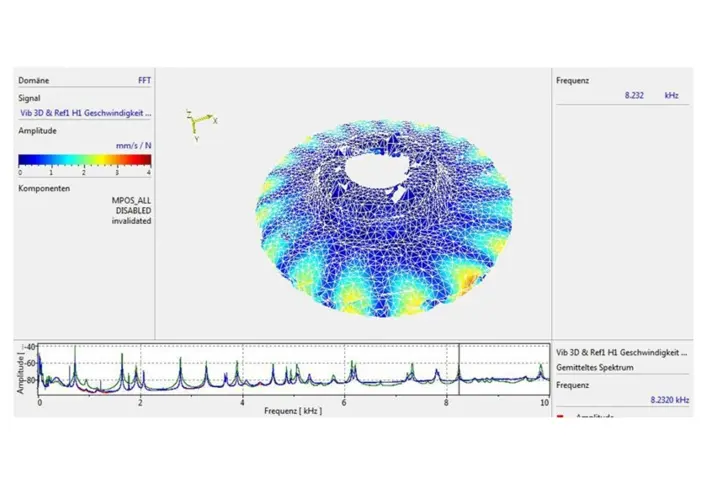
Figure 4a: Deflection shape at 2,781 Hz
Figure 4b: Deflection shape at 8,232 Hz

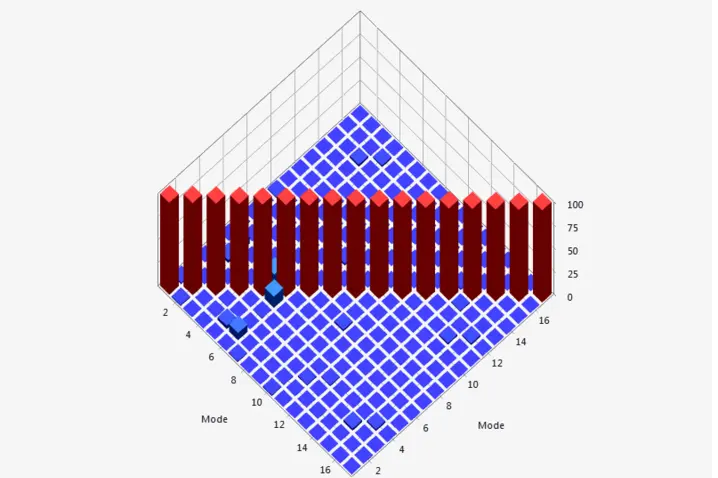
Even complex modes can be illustrated separately, thanks to the excellent spacial resolution and non-reactiveness (figure 5). These modes can be directly compared with those of the FE simulation. The quality of the FE model was checked and then the model parameters for the best possible fit were adapted to the real specimen.
Images courtesy: Images courtesy of the authors unless otherwise specified.

Our Authors

Dr. Jochen Schell
Manager Application Services Business Unit Vibrometry, Polytec GmbH, Germany
info@polytec.de
Dr. Daniel Wallner et al.
Development Brakes, Porsche AG

Related Articles

Laser-Doppler-Vibrometer set standards in the development of electric drives

Electric machines are increasingly being used as the primary drive technology in vehicles. The acoustic behavior of the drive is a key factor in the perceived quality of electric vehicles. Numerical method…

5 min

On self-supporting and self-aligning compact shakers

Artificial excitation is the basis for various noise and vibration techniques, from experimental modal analysis, over transfer path analysis, load identification, simulation model correlation, hybrid model…

10 min

Focus on impact detection of micrometeorites

The commercialization of space exploration increases the need for innovative technologies for space and planetary exploration and satellite missions. To ensure the safety and reliability of space structure…

6 min

Laser vibrometer based acoustic performance evaluation from -40° to 85°C

The increase of touchscreen interfaces in automotive applications leads to a visual overload of information that has serious safety implications. Haptic feedback technology is seen as an opportunity to imp…

5 min

Inertial shakers for modal testing

If you would like to test the vibration behavior of an object that is not vibrating by its own, you have to excite it externally. For modal tests both an electromagnetic shaker and a modal hammer are commo…

6 min

How singing capacitors affect the audio experience in consumer electronics

Everybody enjoys good sound quality on a mobile device when watching a show or when communicating with friends and family or in a business environment. On the other hand, we cringe when something is off wi…

3 min

When to choose a laser Doppler vibrometer for vibration measurement

In the realm of vibration testing, a significant obstacle arises in the form of mass loading. The behavior of a dynamic vibration sample, or device under test (DUT), is profoundly influenced by the additio…

5 min

Frequency response function measurement using QTec® multi-path interferometry

The measurement of frequency response function (FRF) plays an important role for the dynamic characterization of structures. In most cases, the goal is the measurement-based analysis of a system or the det…

7 min

Analyzing operational deflection shapes on loudspeakers

Noise protection and control play a major role in both professional and private environments. Airborne sound measurements help identify acoustic paths as a means of noise reduction as standard testing meth…

4 min

Laser vibrometry visualizing haptic feedback

The smartphone has shown that buttons can be replaced without sacrificing comfort. The freely configurable display with gesture control has made it even easier to switch between applications. Hap2U drives …

7 min

Noise and modal analysis for quiet and reliable operation

The growth of the drone market is multi-faceted: growing concerns about national and border security drive the need for advanced aerial surveillance, package delivery services experience an increased deman…

6 min

Measurements using broadband piezoelectric excitation

The following article compares various forms of force excitation in order to determine the transfer admittances of mechanical systems using a gear wheel as an example. The objective is to analyze and asses…

4 min

Determining the dynamic characteristics of an aircraft’s large-scale, adaptive compliant wing slat section prototype

The SADE project studied “smart” morphing mechanical elements of next generation wings, which was aimed at improving aerodynamic performance, fuel efficiency, as well as reducing noise and emissions in all…

3 min

Acoustic radiation of vibrating surfaces in electric drive systems

The growing electric and hybrid vehicles market faces new demands on product acoustic quality. The acoustical emission behavior of electric drivetrains is clearly different from that of conventional drives…

4 min

3D scanning laser Doppler vibrometry for fuel-efficient turbines

Fuel consumption of aircrafts is a hot topic in the current discussion about global climate change. An important factor is the design of the aircraft engine itself. In order to reduce weight and build more…

6 min

Xtra 3D scanning vibrometry on rolling tires

Dynamic 3D operational deflection shapes captured with an Xtra Scanning Vibrometer help reveal the source of rolling tire noise. For a wide range of driving conditions, rolling tires stimulate a significan…

5 min
Load More